Unlocking Microservices: Why API Gateways Matter
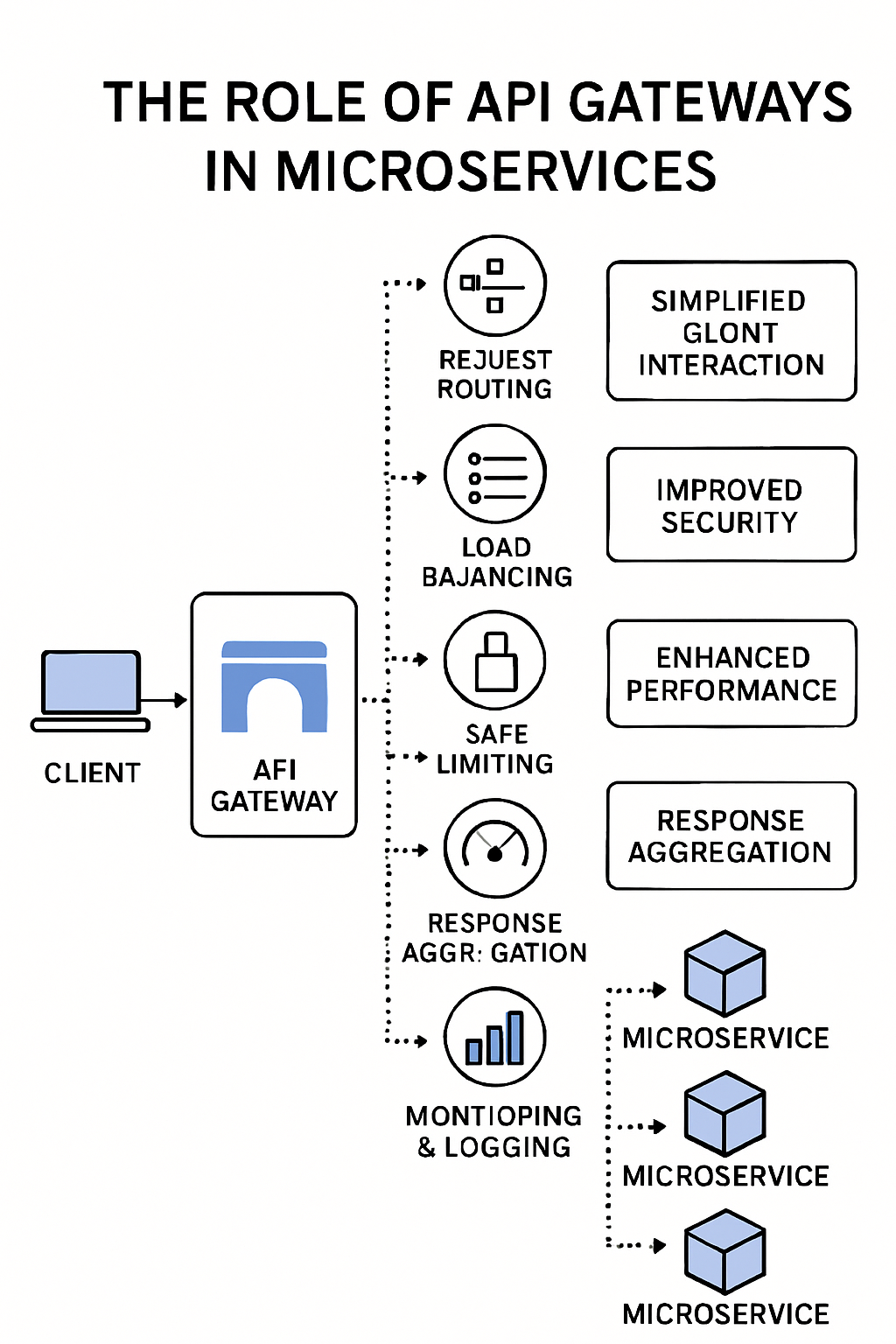
API gateways are a cornerstone of modern microservices architecture. Acting as a single entry point for client requests, they simplify client interactions and centralize cross-cutting concerns so individual services can stay focused on business logic.
Below is a concise guide to what API gateways do, why they matter, common trade-offs, and practical best practices for implementation.
What an API gateway does
- Request routing: Directs incoming requests to the appropriate microservice or backend.
- Load balancing: Distributes traffic to healthy service instances.
- Security: Enforces authentication and authorization (JWT, OAuth2), performs SSL/TLS termination.
- Rate limiting & throttling: Protects services from traffic spikes and abuse.
- Response aggregation: Combines data from multiple services into a single response for clients.
- Protocol translation: Converts between protocols (e.g., HTTP/REST, gRPC, WebSockets).
- Caching: Reduces load and improves latency for repeatable responses.
- Observability: Centralized logging, metrics, and tracing integration for monitoring request flows.
- Traffic control: Support for routing rules, canary releases, and A/B testing.
Why API gateways matter
- Simplified clients: Clients call one endpoint instead of coordinating multiple services.
- Centralized security & policy enforcement: Easier to apply consistent auth, rate limits, and access control.
- Improved performance and reliability: Caching, load balancing, and circuit-breaking at the edge reduce strain on services.
- Better observability: One place to collect metrics and traces for incoming traffic patterns.
- Evolution & versioning: Gateways can handle version routing and protocol changes without forcing client updates.
Trade-offs and considerations
- Single point of failure: The gateway must be highly available and fault-tolerant.
- Added latency: One more network hop; minimize with efficient implementations and caching.
- Increased complexity: Operational overhead and potential vendor lock-in with managed solutions.
- Responsibility creep: Don’t overload the gateway—keep service-specific logic inside services.
Best practices
- Keep gateways stateless and horizontally scalable.
- Push business logic into services; use the gateway for cross-cutting concerns only.
- Implement health checks and graceful failover for the gateway layer.
- Use standardized auth tokens (JWT, OAuth2) and centralize policy decisions where possible.
- Combine API gateway with a service mesh when you need fine-grained intra-cluster controls.
- Monitor latency, error rates, and throughput at the gateway and set alerts.
- Use versioned routes and clear consumer-facing contract management.
When to use alternatives
- Lightweight reverse proxy or BFF (Backend for Frontend) might be better for simple use cases.
- Service mesh is ideal when you need advanced intra-service features (mTLS, retries, traffic shaping) inside the cluster.
Quick checklist before adoption
- Do you need a single entry point for multiple clients? ✓
- Do you need centralized auth, rate limiting, or request aggregation? ✓
- Can you operate a highly available gateway (or use a managed one)? ✓
If most answers are yes, an API gateway is probably a good fit.
Conclusion
Mastering the API gateway's role is essential for software engineers and data architects designing scalable, secure microservice systems. When designed and operated correctly, gateways simplify clients, centralize policies, and improve overall system resilience.
About the author
bugfree.ai is an advanced AI-powered platform designed to help software engineers master system design and behavioral interviews. Whether you’re preparing for your first interview or aiming to elevate your skills, bugfree.ai provides a robust toolkit tailored to your needs. Key Features:
150+ system design questions: Master challenges across all difficulty levels and problem types, including 30+ object-oriented design and 20+ machine learning design problems. Targeted practice: Sharpen your skills with focused exercises tailored to real-world interview scenarios. In-depth feedback: Get instant, detailed evaluations to refine your approach and level up your solutions. Expert guidance: Dive deep into walkthroughs of all system design solutions like design Twitter, TinyURL, and task schedulers. Learning materials: Access comprehensive guides, cheat sheets, and tutorials to deepen your understanding of system design concepts, from beginner to advanced. AI-powered mock interview: Practice in a realistic interview setting with AI-driven feedback to identify your strengths and areas for improvement.
bugfree.ai goes beyond traditional interview prep tools by combining a vast question library, detailed feedback, and interactive AI simulations. It’s the perfect platform to build confidence, hone your skills, and stand out in today’s competitive job market. Suitable for:
New graduates looking to crack their first system design interview. Experienced engineers seeking advanced practice and fine-tuning of skills. Career changers transitioning into technical roles with a need for structured learning and preparation.
Comments
Join the discussionNo comments yet. Be the first to comment.