High-Score TikTok ML Interview: RecSys Deep Dive and Fast, Bug‑Free Coding
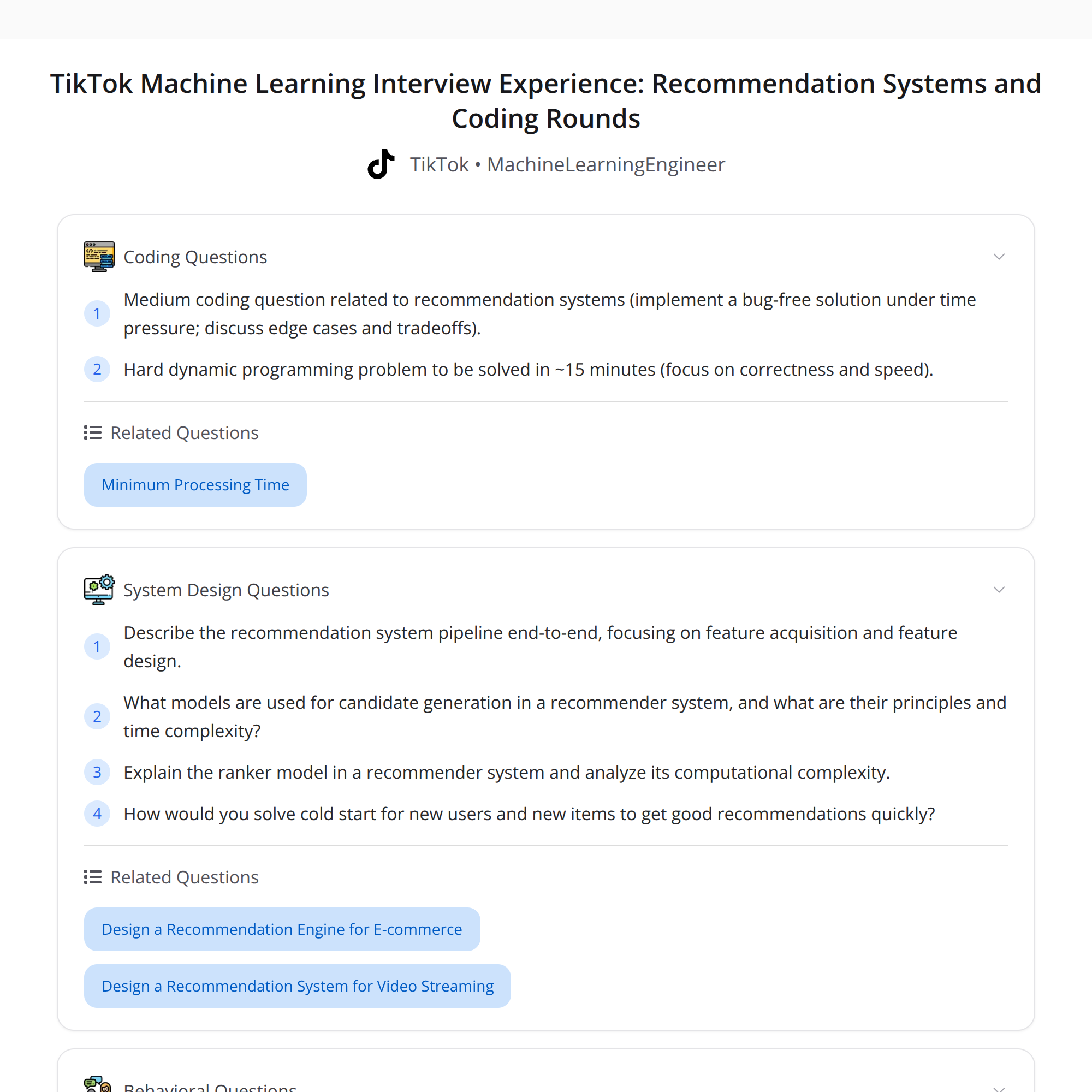
A concise, practical recap of a high-scoring TikTok ML interview experience shared by "bugfree users." The interview spanned three rounds: an HR screen, a RecSys-focused hiring manager loop with a coding task that emphasized correctness and edge-case handling, and a final panel with deep math, full pipeline design, and a timed hard DP problem.
Below you’ll find a clear breakdown of each round, key topics asked, practical tips to prepare, and an actionable checklist to maximize your chance of success.
Quick overview of rounds
- Round 1 — HR screen: background, motivation, logistics. Keep anecdotes crisp, align motivations with team mission, and confirm timelines.
- Round 2 — Hiring Manager (RecSys fundamentals + coding): candidate generation vs. ranking models, time/compute trade-offs, cold-start strategies. Ended with a medium RecSys-flavored coding problem where clean, bug-free code and edge cases mattered more than clever tricks.
- Round 3 — Dept Lead: math/derivation-level questions on a chatbot project, a full RecSys pipeline (feature acquisition & design), and a hard dynamic programming problem to be solved in ~15 minutes requiring speed and correctness.
Round 1: HR screen — what to prepare
Focus points:
- Brief career story with measurable impact (what you built, scale, metrics improved).
- Motivation for joining TikTok / the team (product alignment, domain interest).
- Logistics: salary expectations, location, timelines.
Tips:
- Prepare a 60–90 second elevator pitch that highlights a major technical achievement and your role.
- Have one or two crisp examples of cross-team collaboration and handling ambiguity.
Round 2: Hiring Manager — RecSys fundamentals + coding
What they tested:
- Candidate generation vs. ranking
- Candidate generation (recall-focused): scalable retrieval, heuristics, embedding-based ANN, inverted indices.
- Ranking (precision-focused): pointwise/pairwise/listwise models, feature engineering for personalization, online vs. offline metrics.
- Time/compute complexity
- Trade-offs: latency constraints for online serving, batch vs. streaming feature computation, model size vs. inference cost.
- Cold-start strategies
- Item cold-start: metadata-based models, content embeddings, item-side features, warm-start via editorial signals.
- User cold-start: onboarding flows, contextual bandits, collaborative warm-up, demographic priors.
Coding task characteristics:
- Medium difficulty with a RecSys flavor (could be filtering, merging ranked lists, top-K, or simple CTR prediction logic).
- Emphasis: clean, correct, robust code with explicit handling of edge cases and tests.
Practical tips for the coding task:
- Read the prompt fully; restate constraints and input/output formats aloud.
- Sketch examples and edge cases before coding (empty inputs, duplicates, ties, extreme values).
- Use clear function names and small helper functions to keep logic testable.
- Add quick, in-line checks or simple unit tests for the example cases.
- After coding: verbally explain complexity (time & space), and discuss alternative approaches.
Example micro-checklist for bug-free code during interview:
- Validate inputs early.
- Handle boundary conditions (n=0, very large n, duplicates, negative values if applicable).
- Keep loops and indices simple — prefer enumerations or iterators to manual index arithmetic.
- Return in the exact format requested and test with sample cases.
Round 3: Dept Lead — deep math, full RecSys pipeline & a hard DP
Topics covered:
- Math/derivation for a chatbot project
- Expect probability/expectation derivations, loss functions, embedding similarity math, or attention weight reasoning.
- Walk through derivations step-by-step; explain assumptions and approximations.
- Full RecSys pipeline design
- Feature acquisition: online vs. offline features, freshness constraints, streaming enrichment.
- Feature design: user/item/context features, high-cardinality handling, embeddings, cross-features.
- Serving architecture: retrieval, re-ranking, A/B experimentation, logging for offline training.
- Data quality and instrumentation: label bias, exposure logs, counterfactual issues.
- Hard DP problem (~15 minutes)
- Requires speed and correctness: quickly identify state representation and transitions.
- Communicate your state definition and why it’s sufficient; if time is tight, propose memoized recursion and explain complexity.
Strategies for the math and pipeline questions:
- For derivations: write variables, define distributions/assumptions, and proceed stepwise. Don't skip algebraic steps that justify approximations.
- For pipeline design: start with requirements (latency, throughput, freshness), list components, and highlight potential failure modes and mitigations.
- For feature design: prioritize high-signal, low-cost features first, then describe how to validate them (feature importance, ablation tests).
DP problem approach (fast checklist):
- Rapidly identify if the problem maps to DP (overlapping subproblems, optimal substructure).
- Define state compactly (what you need to remember), and write recurrence.
- Consider base cases and small examples to validate the recurrence.
- If time is limited, outline recursion + memoization, then implement iterative if possible.
- If stuck, propose a correct but slower solution, then show how to optimize.
Key takeaways from this interview experience
- Interviewers valued: deep RecSys intuition, system-level thinking, clean/bug-free code with edge-case coverage, and the ability to derive/justify math steps.
- In coding rounds, correctness and clarity beat clever one-liners. Tests and edge-case handling are high-leverage.
- For senior loops, expect full-pipeline design plus derivations. Demonstrate trade-off thinking (latency, cost, data freshness).
- Time management: allocate a few minutes to plan and test before coding; for DP, spend the first few minutes on state + recurrence.
Preparation checklist & recommended resources
- Practice medium-to-hard LeetCode DP problems and time-boxed coding interviews to build speed.
- Study recommendation system fundamentals: retrieval methods, ranking models, embedding techniques, and evaluation metrics (precision/recall/NDCG/AUC).
- Read about production considerations: online serving, feature stores, streaming vs. batch feature pipelines.
- Prepare math derivations: expected values, loss functions, gradients for simple models.
- Mock interviews with a focus on writing correct code quickly and explaining trade-offs.
Suggested topics to drill:
- Candidate generation: ANN, inverted indices, heuristics.
- Ranking models: pointwise vs. pairwise, calibration, loss choices.
- Cold-start: content-based approaches, warm-start strategies.
- System design: feature stores, feature freshness, logging & instrumentation.
- Coding hygiene: input validation, small unit tests, complexity analysis.
If you want, I can:
- Convert the coding tips into a one-week study plan focused on RecSys + DP practice.
- Walk through a sample RecSys-flavored coding problem with a step-by-step, bug-free implementation and tests.
Which would you prefer next?
About the author
bugfree.ai is an advanced AI-powered platform designed to help software engineers master system design and behavioral interviews. Whether you’re preparing for your first interview or aiming to elevate your skills, bugfree.ai provides a robust toolkit tailored to your needs. Key Features:
150+ system design questions: Master challenges across all difficulty levels and problem types, including 30+ object-oriented design and 20+ machine learning design problems. Targeted practice: Sharpen your skills with focused exercises tailored to real-world interview scenarios. In-depth feedback: Get instant, detailed evaluations to refine your approach and level up your solutions. Expert guidance: Dive deep into walkthroughs of all system design solutions like design Twitter, TinyURL, and task schedulers. Learning materials: Access comprehensive guides, cheat sheets, and tutorials to deepen your understanding of system design concepts, from beginner to advanced. AI-powered mock interview: Practice in a realistic interview setting with AI-driven feedback to identify your strengths and areas for improvement.
bugfree.ai goes beyond traditional interview prep tools by combining a vast question library, detailed feedback, and interactive AI simulations. It’s the perfect platform to build confidence, hone your skills, and stand out in today’s competitive job market. Suitable for:
New graduates looking to crack their first system design interview. Experienced engineers seeking advanced practice and fine-tuning of skills. Career changers transitioning into technical roles with a need for structured learning and preparation.
Comments
Join the discussionNo comments yet. Be the first to comment.