{:width="800px"}
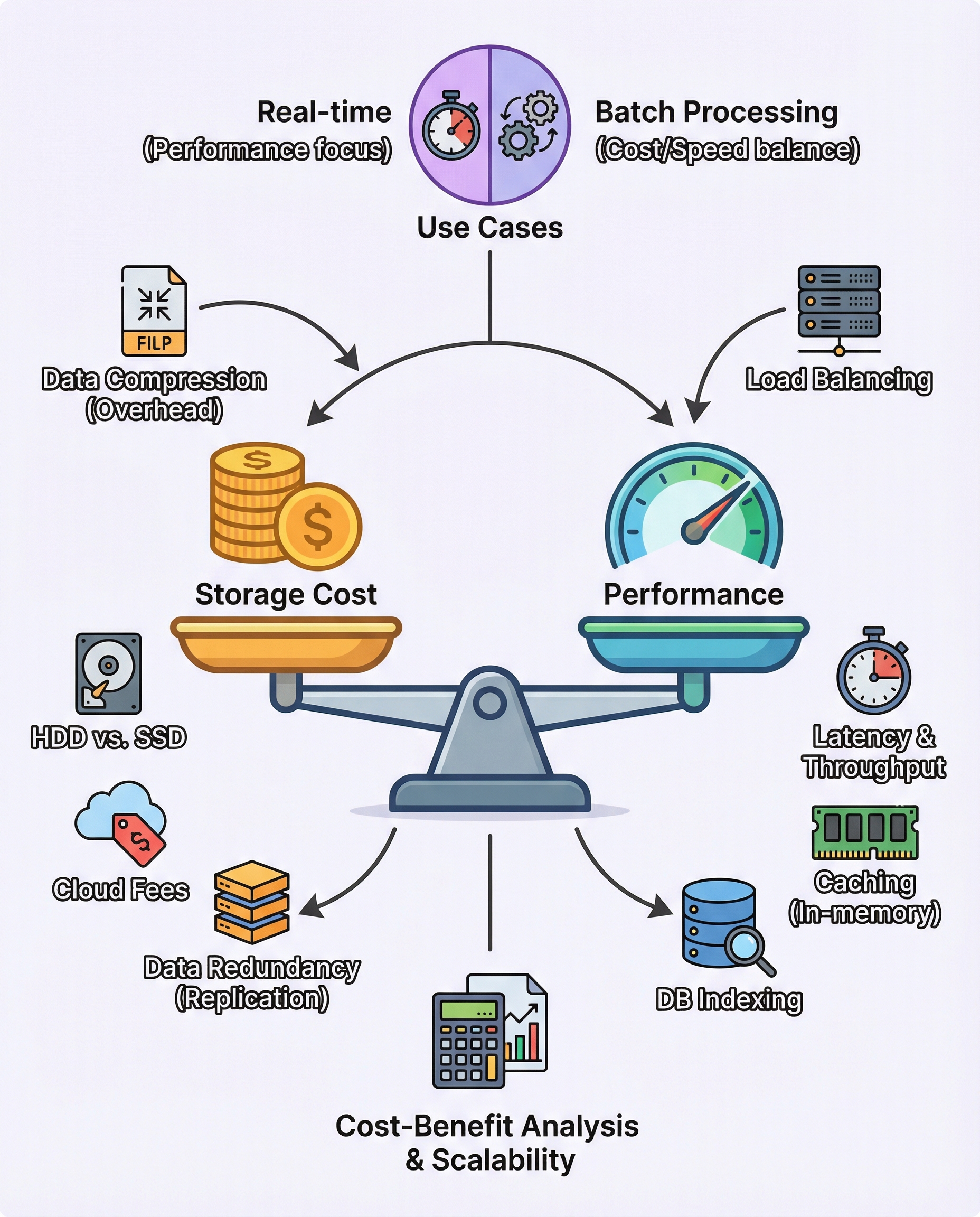
In system design interviews you won't just pick a component — you'll justify why you picked it. The most common justification centers on storage: how much are you willing to spend to get the latency, throughput, and durability you need?
This guide gives a clear, repeatable structure to defend storage cost vs performance trade-offs during interviews, with practical examples, formulas, and interview phrasing.
1) Start by clarifying the use case and SLOs
Ask targeted questions to turn vague requirements into measurable goals. Focus on:
- Latency SLOs (p99, p95, median) — e.g., "read latency < 50 ms p95".
- Throughput (requests/sec or MB/sec).
- Durability/availability requirements (RPO/RTO, replication factor).
- Access patterns (read-heavy, write-heavy, hot vs cold data).
- Data growth and retention policies.
Real-time systems pay for low latency. Batch systems can trade latency for lower cost. Always state the SLO you are optimizing for.
2) Compare the storage options (short pros/cons)
In-memory (RAM)
- Pros: Lowest latency, highest throughput.
- Cons: Highest cost per GB, volatile (unless backed), limited capacity.
- Use when: sub-ms or single-digit ms latency is mandatory for hot working set.
SSD (NVMe / provisioned IOPS)
- Pros: Low latency (ms), good random IOPS.
- Cons: Higher cost than HDD; can still be more expensive under heavy write amplification.
- Use when: low read/write latency is needed for large datasets.
HDD
- Pros: Lowest cost per GB for sequential workloads.
- Cons: Much higher random-access latency.
- Use when: cold storage, large sequential scans, or strict budget constraints.
Managed cloud tiering (hot/warm/cold)
- Pros: Cost-effective by matching access patterns to storage tiers.
- Cons: Complexity, egress costs when thawing cold data.
Always map an option back to the SLO and access pattern.
3) Call out hidden & operational costs
Don't forget these when you justify a trade-off:
- Replication and backups: multiply raw data by replication factor. Example: total_bytes = data_bytes * (replication_factor + backup_factor).
- Network egress: data reads across regions or external clients can add per-GB costs.
- Indexes and metadata: indices can add 10–50% extra storage depending on schema.
- Compression: reduces storage but adds CPU/latency on access.
- Write amplification / compaction: increases effective storage and I/O.
- Monitoring, snapshot retention, and archived logs.
- Operational overhead: more hardware types or tiers increases operational complexity and personnel cost.
4) Show practical optimizations and where they fit
- Caching: place a cache (L1/L2) in front to reduce hot read pressure on durable storage.
- Load balancing & sharding: distribute load to lower per-node latency and cost per request.
- Indexing and schema design: choose indexes that reduce I/O for the most common queries.
- Compression & columnar formats: great for cold analytics workloads; watch CPU latency impact.
- Tiering & lifecycle policies: move data to cheaper tiers when it becomes cold.
5) Always quantify your trade-offs — use simple math
Interviewers expect numbers. Use clear formulas and a short worked example.
Key formulas:
- Storage cost = data_size_GB replication_factor cost_per_GB_month
- Effective request cost = requests_per_month * cost_per_request
- Cache hit reduction: requests_to_storage = total_requests * (1 - cache_hit_rate)
Example (hypothetical numbers):
- Raw data: 10 TB = 10,000 GB
- Replication factor: 3 => stored bytes = 30,000 GB
- Storage price (SSD): $0.10/GB/month => storage cost = 30,000 * $0.10 = $3,000/month
- Move to HDD at $0.03/GB/month => cost = 30,000 * $0.03 = $900/month
- Trade-off: save $2,100/month but expect higher median read latency (e.g., +20–50 ms) and slower random reads.
If you add a cache that reduces storage reads by 80%, you can justify using cheaper storage behind the cache because effective latency for most reads stays low while the bill drops.
For CPU cost from compression: if compression adds 0.5 ms extra CPU per request and you have 1M requests/day, that's 500k ms extra CPU = ~139 CPU-hours/day. Translate CPU-hours to $ using your cloud's pricing to show the dollar impact.
6) Explain how the choice scales with data growth
Use formulas and projections. For example:
- Year-1 data: 10 TB; Year-2 growth: 3x => 30 TB
- If replication=3 and storage=$0.10/GB: cost grows from $3k/month to $9k/month.
Point out thresholds where your architecture should change:
- At X TB, SSD costs dominate — consider tiering.
- At Y IOPS, a single shard can’t handle throughput — plan sharding.
Show that your decision isn't just for now but for the next 6–24 months.
7) Interview-friendly script (how to present it)
- Clarify: "Can I confirm the SLOs? Are we optimizing for p95 latency < 50 ms and 10k req/s?"
- Propose options: "We can use in-memory caching + SSD-backed store for hot data, and HDD cold tier for infrequently accessed data."
- Quantify: "With 10 TB of raw data and replication=3, SSD costs us ~$3k/month vs HDD $900/month; adding a cache that handles 80% of reads reduces effective storage I/O by 80%, letting us move colder data to HDD while keeping p95 read latency under 50 ms for most requests."
- Discuss scaling: "If data grows 3x, storage cost scales linearly — at that point we'd add tiering and more aggressive TTLs."
- Close: "Given the SLOs and growth, I recommend X because it minimizes monthly cost while meeting the latency SLO for 95% of requests. If the product needs stricter p99 latency, we should move Y% of the working set to in-memory."
8) Quick checklist for interview answers
- Did you ask about SLOs and access patterns? ✅
- Did you compare concrete storage options and why? ✅
- Did you include hidden costs and operational complexity? ✅
- Did you show simple math and projections? ✅
- Did you suggest optimizations and how the design evolves? ✅
Summary
In system design interviews, don't treat storage vs performance as a black box. Ask questions, pick measurable SLOs, compare options, call out hidden costs, quantify with simple math, and explain how your choice scales. Saying "it's cheaper but slower" isn't enough — show exactly how much cheaper, how much slower, and why that's acceptable for the defined SLOs.
Good luck — and remember: "$X more for Y ms less" is an interview-winning sentence when backed by clear numbers and scaling logic.
About the author
bugfree.ai is an advanced AI-powered platform designed to help software engineers master system design and behavioral interviews. Whether you’re preparing for your first interview or aiming to elevate your skills, bugfree.ai provides a robust toolkit tailored to your needs. Key Features:
150+ system design questions: Master challenges across all difficulty levels and problem types, including 30+ object-oriented design and 20+ machine learning design problems. Targeted practice: Sharpen your skills with focused exercises tailored to real-world interview scenarios. In-depth feedback: Get instant, detailed evaluations to refine your approach and level up your solutions. Expert guidance: Dive deep into walkthroughs of all system design solutions like design Twitter, TinyURL, and task schedulers. Learning materials: Access comprehensive guides, cheat sheets, and tutorials to deepen your understanding of system design concepts, from beginner to advanced. AI-powered mock interview: Practice in a realistic interview setting with AI-driven feedback to identify your strengths and areas for improvement.
bugfree.ai goes beyond traditional interview prep tools by combining a vast question library, detailed feedback, and interactive AI simulations. It’s the perfect platform to build confidence, hone your skills, and stand out in today’s competitive job market. Suitable for:
New graduates looking to crack their first system design interview. Experienced engineers seeking advanced practice and fine-tuning of skills. Career changers transitioning into technical roles with a need for structured learning and preparation.
Comments
Join the discussionNo comments yet. Be the first to comment.