
Key Considerations in Designing a Voting System
Designing a voting system involves much more than just building a web application — it requires solving problems related to identity, consistency under high load, data security, and trustworthiness. Below are the core design areas you must address and the mechanisms behind them.
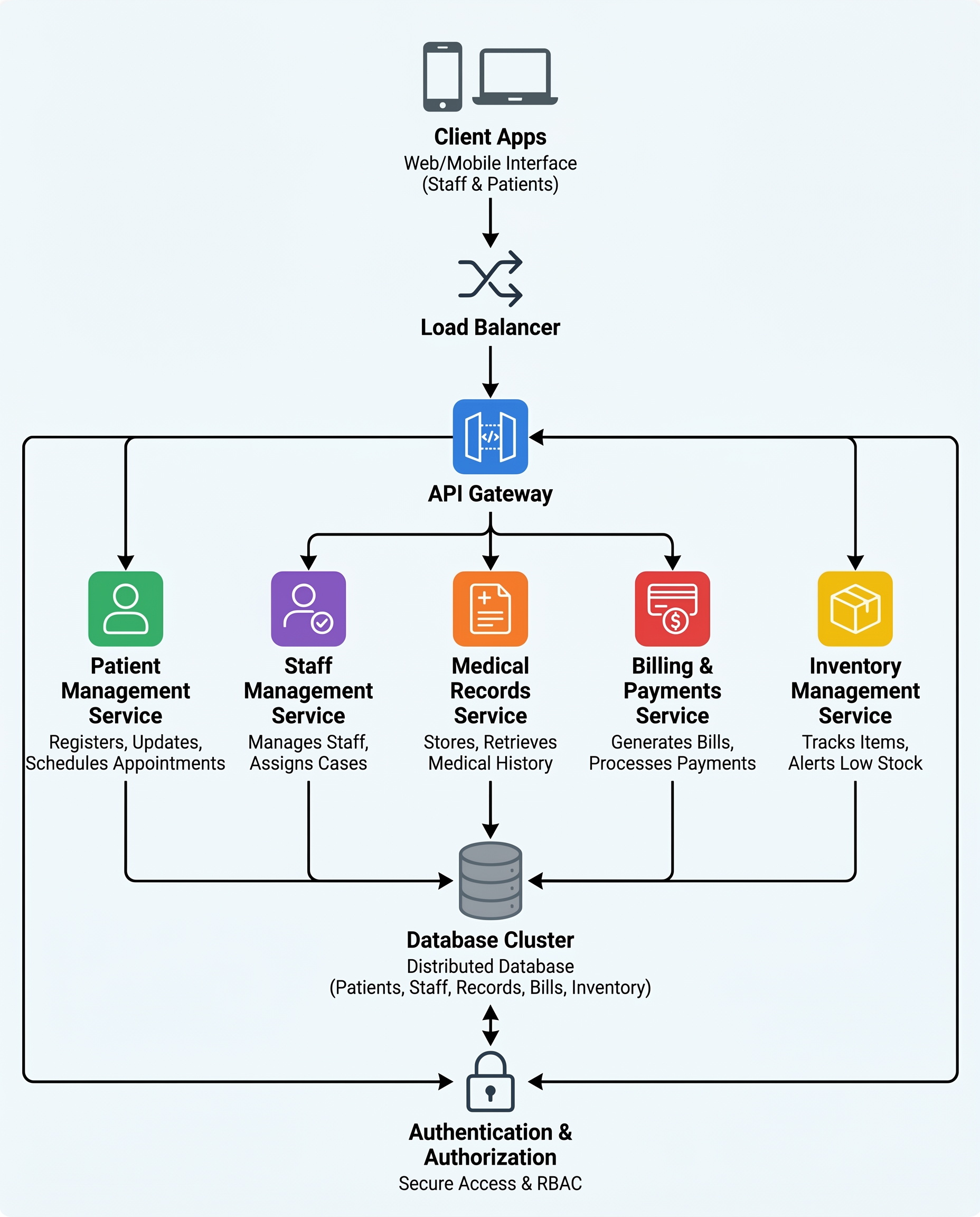
System Design Diagram — Design a Voting System
1. User Authentication & Authorization
User Verification
At its core, user verification involves establishing a unique, verifiable identity per voter while preventing duplicates.
- Two-Factor Authentication (2FA)
Internally, 2FA adds an additional verification step during login. After validating the password (typically using a salted hash like bcrypt), the server generates a one-time token (e.g., TOTP or SMS code). This token must match a value known only to the server and user’s device. Rate limiting and nonce tracking prevent brute force attacks. - Biometric Verification
Biometric inputs are typically matched against encrypted templates stored on-device or in a secure enclave. Instead of transmitting raw fingerprints, you hash and match biometric signatures using homomorphic encryption or local trusted environments to protect sensitive data. - De-duplication
A unique user must not be allowed to vote more than once. Behind the scenes, this could involve using a deterministic hash (e.g., SHA-256) of a national ID or social security number stored securely, with all operations occurring in constant time to prevent side-channel attacks.
Role Management
Roles are enforced at every access point to the system using Access Control Lists (ACLs) or Role-Based Access Control (RBAC).
- RBAC Implementation
Permissions are defined as a matrix:Role x Resource -> Allowed Actions. During request processing, middleware intercepts the user token, extracts roles, and checks the action against the matrix. This can be cached for performance. - Dynamic Role Assignment
This may be implemented using rules-based engines. For example: if a user performs more than N admin-like actions over M time units, the system may elevate privileges in a sandboxed scope and log the escalation. These decisions often use event logs or a streaming rules engine.
Session Management
- Token-Based Authentication
Rather than server-side sessions, use JWT (JSON Web Tokens) with short TTLs. The token includes the user ID, role, issued-at timestamp, and a digital signature. Since it’s stateless, the server doesn’t store anything — all validation occurs via public key signature verification. - Session Monitoring
Each token can be tagged with a session ID stored in a secure store like Redis. Actions are logged against this ID. Real-time monitoring services can flag if a single session ID appears from geographically distant IPs within a short window — triggering auto logout or CAPTCHA.
2. Scalability & Performance
Voting systems experience sudden, short-lived, and highly spiky loads — often millions of concurrent users in a narrow time window. This section breaks down how to scale such a system predictably.
2.1 Handling High Traffic
Connection Handling and Rate Limiting
Before application logic is even executed, connection-level limits protect servers:
- Use connection pools to avoid exhausting resources like DB threads.
- Apply rate limiting at the gateway or CDN level using algorithms like:
- Token Bucket: Allows bursts but enforces average throughput.
- Leaky Bucket: Enforces strict rate over time, ideal for anti-spam.
For example, a rule like “max 10 requests/sec per IP” is enforced in the gateway. Internally, Redis or a lightweight in-memory store tracks tokens per IP.
Concurrency Management
Each vote request must be:
- Accepted (queued),
- Validated (check if user already voted),
- Persisted (write to DB or log),
- Acknowledged (send confirmation to user).
To avoid contention:
- Use message queues (e.g., Kafka-style commit logs) to buffer incoming vote requests and process them sequentially per user ID or voting precinct (using consistent partitioning).
- This decouples write load from processing logic and allows back-pressure.
Horizontal Scaling
All stateless services (auth, validation, vote submission) can scale horizontally by:
- Keeping no session state in-memory.
- Using a distributed cache (e.g., Redis or Memcached) for temporary session data.
- Distributing traffic with a load balancer using round-robin, least connections, or geo-aware routing.
2.2 Data Consistency under Load
Voting systems require write-heavy consistency, unlike most read-optimized web apps. Key constraints:
- One person, one vote.
- Votes must not be lost or duplicated.
Write Serialization
Use logical sharding per precinct or region. For each shard:
- Serialize writes using single-writer queues or leader-election (e.g., Raft).
- Within a shard, use distributed locks or optimistic concurrency control (OCC) to detect conflicts (e.g., if two votes from the same voter arrive at the same time).
Optimistic Locking vs. Pessimistic Locking
- Optimistic: Read
has_voted=false, attempt update with a version number or timestamp. If another write has occurred, reject and retry. - Pessimistic: Acquire lock on
voter_id, write vote, release. Safer but lower throughput.
Use optimistic locking for scale and pessimistic for critical race-sensitive paths.
2.3 Read/Write Path Separation
Split your system into:
- Hot path: Vote submission — needs strong consistency.
- Cold path: Analytics, real-time dashboards — can tolerate eventual consistency.
Use Command Query Responsibility Segregation (CQRS):
- Write-heavy services write to master DB and publish events.
- Read replicas or materialized views update asynchronously.
This enables real-time dashboards to scale independently without affecting vote integrity.
2.4 Caching Strategies
Types of Cached Data
- User session tokens
- Public vote count (read-only, eventually consistent)
- Polling station metadata
- Voter eligibility rules (frequently read, rarely written)
Cache Coherency
Maintaining consistency between cache and DB is hard at scale:
- Write-through cache: Writes go to DB and cache together. Ensures consistency but adds latency.
- Write-around cache: Writes go to DB only, reads populate the cache. Improves write throughput but stale reads possible.
- Write-back cache: Writes go to cache, flushed to DB later. High risk in mission-critical systems like voting — generally not recommended.
For vote-related data, use write-through or no-cache at all — correctness is paramount.
3. Data Storage & Management (Expanded)
Voting data is critical infrastructure — accuracy, durability, traceability, and verifiability are non-negotiable.
3.1 Database Selection & Design
Core Data Model
Use relational databases for high-integrity data. Tables might include:
VOTERS (
voter_id UUID PRIMARY KEY,
name TEXT,
precinct_id TEXT,
has_voted BOOLEAN DEFAULT false
)
VOTES (
vote_id UUID PRIMARY KEY,
voter_id UUID REFERENCES VOTERS(voter_id),
candidate_id TEXT,
timestamp TIMESTAMP,
location TEXT
)
- Enforce
UNIQUE (voter_id)inVOTESto prevent duplicates. - Use foreign keys to maintain referential integrity.
- Use indexes on
precinct_id,candidate_idfor tally queries.
Why Not NoSQL for Vote Casting?
- NoSQL lacks strong ACID guarantees by default.
- Even with configurable consistency (e.g., quorum reads/writes in Cassandra), you’re trading performance for complexity.
- For mission-critical voting paths, use PostgreSQL or MySQL with strict isolation (Serializable level).
Use NoSQL for:
- Logs (
vote_castevents) - Audit trails
- High-throughput analytics pipelines
3.2 Write Guarantees and Idempotency
Vote submission must be idempotent — even if a user retries due to network failure, the vote must only be counted once.
Mechanism:
- Each vote carries a deduplicated idempotency token (e.g., UUID or hash of
voter_id + election_id). - Store vote with this token. If token exists, reject or return the same response.
This avoids double counting due to retries or race conditions.
3.3 Auditability and Tamper-Proofing
Immutable Audit Logs
Implement append-only logs per voting event:
- Use write-once, read-many storage (WORM).
- Use hash chains: every entry contains hash of previous log + current data.
- Periodically checkpoint these logs (e.g., every 10,000 votes) and sign the checkpoint with a private key. This makes tampering evident.
Merkle Trees for Tally Verification
Each vote can be inserted into a Merkle tree:
- Root hash is stored on-chain or in public bulletin board.
- Anyone can verify that a vote exists in the tree without revealing the vote contents (zero-knowledge proof techniques can enhance privacy).
This adds cryptographic auditability.
3.4 Redundancy, Backups, and Disaster Recovery
Multi-Zone & Multi-Region
- Use leader-follower replication across zones.
- Sync using logical replication (stream WAL logs) to read replicas.
- In cross-region DR setups, async replication is acceptable — data loss of a few seconds can be mitigated with idempotent design.
Backups
- Full snapshot daily, incremental every 5–10 minutes.
- Store backups in isolated, immutable storage with checksums.
- Backup verification job runs nightly: restores backup into a sandbox, runs consistency checks.
Disaster Recovery Testing
- Run regular chaos drills: disable primary DB, simulate network partition, verify failover.
- Use infrastructure as code (e.g., Terraform) to spin up fresh environments in case of regional failure.

System Design Answer — Design a Voting System
Full Answer: https://bugfree.ai/practice/system-design/voting-system/solutions/BbJ9EbA2sXL2C4xc
About the author
bugfree.ai is an advanced AI-powered platform designed to help software engineers master system design and behavioral interviews. Whether you’re preparing for your first interview or aiming to elevate your skills, bugfree.ai provides a robust toolkit tailored to your needs. Key Features:
150+ system design questions: Master challenges across all difficulty levels and problem types, including 30+ object-oriented design and 20+ machine learning design problems. Targeted practice: Sharpen your skills with focused exercises tailored to real-world interview scenarios. In-depth feedback: Get instant, detailed evaluations to refine your approach and level up your solutions. Expert guidance: Dive deep into walkthroughs of all system design solutions like design Twitter, TinyURL, and task schedulers. Learning materials: Access comprehensive guides, cheat sheets, and tutorials to deepen your understanding of system design concepts, from beginner to advanced. AI-powered mock interview: Practice in a realistic interview setting with AI-driven feedback to identify your strengths and areas for improvement.
bugfree.ai goes beyond traditional interview prep tools by combining a vast question library, detailed feedback, and interactive AI simulations. It’s the perfect platform to build confidence, hone your skills, and stand out in today’s competitive job market. Suitable for:
New graduates looking to crack their first system design interview. Experienced engineers seeking advanced practice and fine-tuning of skills. Career changers transitioning into technical roles with a need for structured learning and preparation.
Comments
Join the discussionNo comments yet. Be the first to comment.