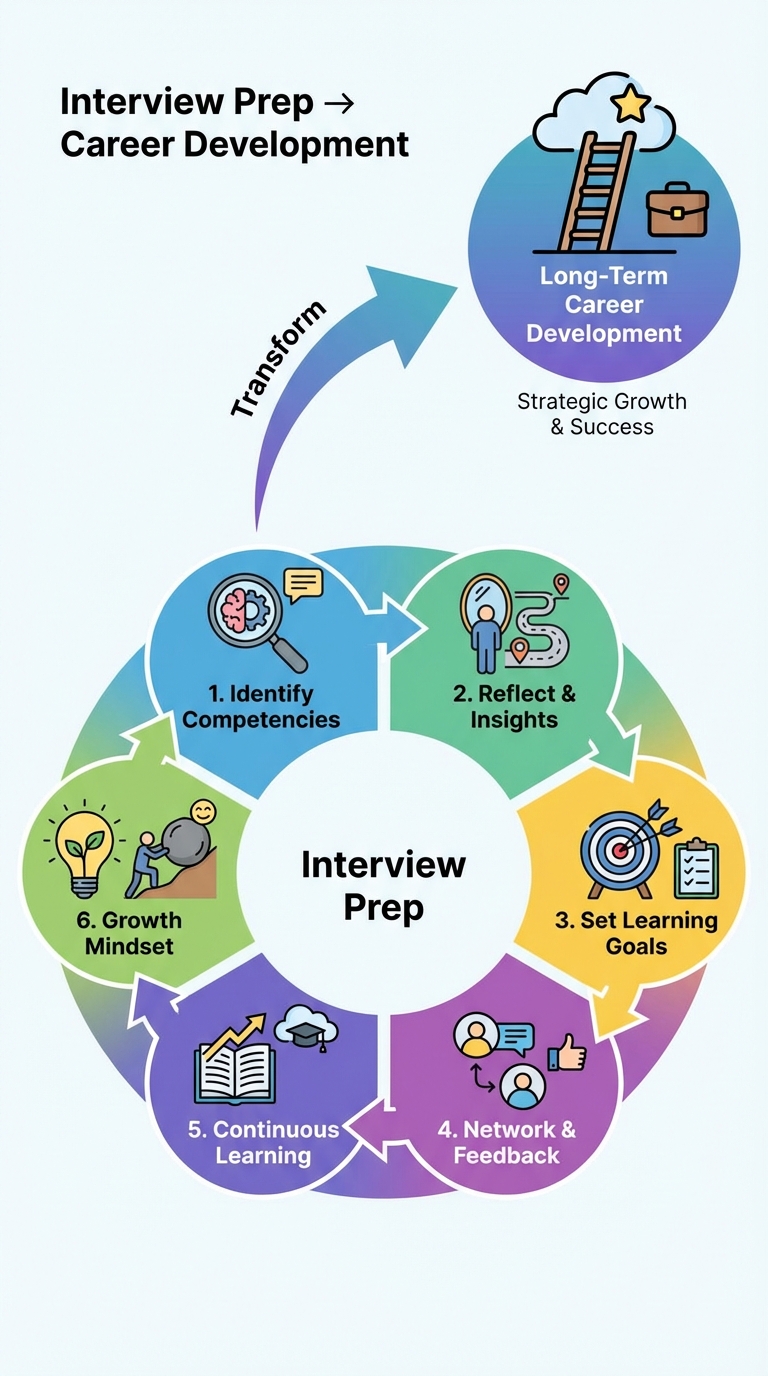
Most engineers treat interview prep as a short-term hurdle to clear. That’s a missed opportunity. Reframe interviews as ongoing career development: each one reveals strengths, gaps, and the expectations of the field. Below is a practical framework to turn interview practice into durable growth.
1) Identify core competencies
Focus on the skills employers actually evaluate: problem-solving, technical depth, communication, and collaboration. Audit yourself:
- Rate each competency 1–5.
- Cite an example that proves your rating.
- Prioritize the weakest two for action.
2) Reflect on past projects
Use the STAR (Situation, Task, Action, Result) method to extract lessons:
- What was the challenge?
- What did you do and why?
- What measurable outcome followed?
- What would you change next time? Document 5 project summaries you can adapt for behavioral interviews and your portfolio.
3) Set learning goals
Turn gaps into SMART goals (Specific, Measurable, Achievable, Relevant, Time-bound):
- Example: "Implement and deploy a production-ready microservice within 8 weeks." Tools: online courses, focused books, and timed mock problems. Track progress weekly.
4) Network + seek feedback
Mentors, peers, and hiring managers reveal expectations and blind spots. Ask:
- "What would make me a stronger candidate here?"
- Request real feedback after interviews or mock sessions. Use informational interviews to understand role-specific competencies.
5) Practice continuous learning
Keep up with tools, methods, and industry trends through:
- Small side projects that apply new tech
- Reading newsletters, RFCs, or recent papers
- Contributing to open source Rotate learning topics monthly to avoid stagnation.
6) Keep a growth mindset
Treat every interview as data, not judgment. Log outcomes:
- What questions tripped you up?
- Which explanations landed well? Use that data to iterate on answers, projects, and learning plans.
Practical next steps this week:
- Complete a 30-minute self-audit of competencies.
- Write STAR summaries for two projects.
- Schedule one mock interview and ask for targeted feedback.
When you stop prepping for single interviews and start developing your career, interview practice becomes a feedback loop that accelerates growth.
Tags: #InterviewPrep #CareerDevelopment #BehavioralInterviews #SoftwareEngineering #DataScience #ContinuousLearning #GrowthMindset
About the author
bugfree.ai is an advanced AI-powered platform designed to help software engineers master system design and behavioral interviews. Whether you’re preparing for your first interview or aiming to elevate your skills, bugfree.ai provides a robust toolkit tailored to your needs. Key Features:
150+ system design questions: Master challenges across all difficulty levels and problem types, including 30+ object-oriented design and 20+ machine learning design problems. Targeted practice: Sharpen your skills with focused exercises tailored to real-world interview scenarios. In-depth feedback: Get instant, detailed evaluations to refine your approach and level up your solutions. Expert guidance: Dive deep into walkthroughs of all system design solutions like design Twitter, TinyURL, and task schedulers. Learning materials: Access comprehensive guides, cheat sheets, and tutorials to deepen your understanding of system design concepts, from beginner to advanced. AI-powered mock interview: Practice in a realistic interview setting with AI-driven feedback to identify your strengths and areas for improvement.
bugfree.ai goes beyond traditional interview prep tools by combining a vast question library, detailed feedback, and interactive AI simulations. It’s the perfect platform to build confidence, hone your skills, and stand out in today’s competitive job market. Suitable for:
New graduates looking to crack their first system design interview. Experienced engineers seeking advanced practice and fine-tuning of skills. Career changers transitioning into technical roles with a need for structured learning and preparation.
Comments
Join the discussionNo comments yet. Be the first to comment.