High-Score SAP Labs Java Interview (5–7 YOE)
Posted by bugfree users: a concise, high-yield report of a successful SAP Labs Java Developer interview for 5–7 years of experience. The loop consisted of two focused rounds: a deep project-first technical discussion and a rapid-fire round covering core Java internals, design patterns, and DSA.
Interview structure (quick summary)
- Round 1 — Project deep-dive (design decisions, trade-offs, architecture)
- Two DSA problems during Round 1
- Round 2 — Fast-paced questions across Java internals, patterns, data structures, and REST
Key takeaway: know your project cold and be ready to switch quickly between high-level design and low-level Java internals + DSA.
Round 1 — Project deep-dive (what they focused on)
The first round focused heavily on the candidate's project. Expect detailed follow-ups on every design decision.
Main themes covered:
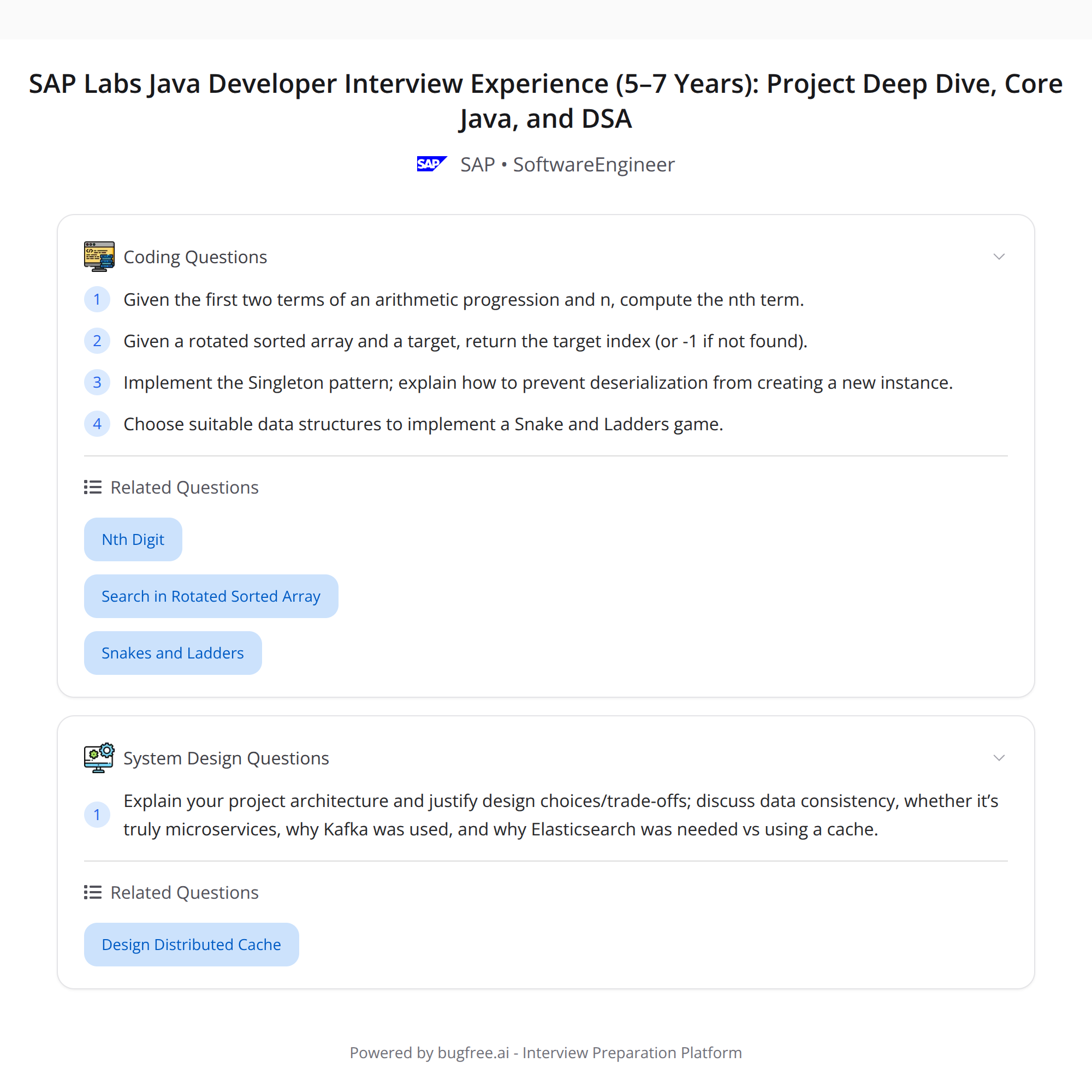
- Project design trade-offs: why certain choices were made, what alternatives were considered, and when you'd change them.
- Data consistency: how you ensured correctness across services, trade-offs between consistency and availability.
- "Is it really microservices?": boundaries, data ownership, deployment and coupling questions.
- Why Kafka?: use-cases, guarantees you relied on (e.g., ordering, at-least-once), topic design, partitioning strategy.
- Why Elasticsearch vs simpler caching?: intended queries, analytics vs fast key-value access, eventual consistency implications.
How to approach these questions:
- Start with the requirement you were solving, then state the options you evaluated.
- Mention measurable trade-offs (latency, throughput, operational complexity, cost).
- Be specific: call out components, data flows, and where consistency is relaxed or enforced.
Sample prompts they asked (paraphrased):
- Why did you choose Kafka over other messaging systems for this data flow?
- Explain how you maintain cross-service data consistency for this entity.
- How would you change the design if traffic grows 10x?
- Why Elasticsearch for search/analytics, and not Redis or a relational index?
Round 1 — DSA problems (asked during the project round)
Two algorithmic questions appeared. Understand both the idea and a correct, efficient implementation.
1) Nth term of an arithmetic progression (AP)
- Problem: Given first term a and difference d, return the n-th term.
- Formula: nth = a + (n - 1) * d
Example (Java pseudo):
long nthTerm(long a, long d, long n) {
    return a + (n - 1) * d;
}
Edge notes: watch integer overflow; use long or BigInteger when necessary.
2) Search in a rotated sorted array
- Problem: Given a rotated sorted array, find the index of target.
- Approach: Modified binary search — determine which half is sorted, then decide which half to search.
High-level algorithm:
while low <= high:
  mid = (low+high)/2
  if arr[mid] == target: return mid
  if left half is sorted:
    if target in left range: high = mid-1
    else low = mid+1
  else: // right half sorted
    if target in right range: low = mid+1
    else high = mid-1
Time complexity: O(log n). Be ready to explain edge cases (duplicates, small arrays).
Round 2 — Rapid-fire topics you must be fluent in
This round moved fast—questions tested breadth and quick recall.
Typical topics covered:
- Ownership in a stack (conceptual stack frames, call stacks, who owns memory/resources)
- Strategy pattern: use-cases and a quick code sketch
- Garbage Collection (GC): JVM GC types, what triggers GC, tuning knobs and common issues
- HashMap vs Hashtable: concurrency differences, internals (buckets, resizing, load factor)
- Singleton + deserialization safety: why enum singletons are safe and how to protect classic singletons
- Data structure design for a game like Snake & Ladders: representing board, moves, BFS for shortest path
- REST responses and appropriate HTTP status codes: idempotency, 200/201/202/204/400/401/403/404/409/500 etc.
How to answer rapid-fire well:
- Be concise and structured: definition, where it's used, a quick example or pitfall.
- If asked internals, mention complexity and key implementation details (e.g., HashMap resizing, open addressing vs chaining).
Preparation checklist (practical study plan)
- Master your project: architecture diagram, data flow, major trade-offs, deployment, and scaling stories.
- Refresh Java core internals: GC, classloading, HashMap internals, concurrency primitives, memory model basics.
- Review design patterns: Strategy, Factory, Singleton (and pitfalls like serialization), Observer, Adapter.
- Practice DSA: binary search variations, BFS/DFS, arrays, hashing, and a couple of typical problems (rotated arrays, AP, two-sum variants).
- Mock answers for REST + HTTP: errors, success codes, caching semantics, idempotency.
- Be ready to reason about trade-offs and to propose concrete changes if requirements change.
Final tips — how to win this interview
- Know your project cold: diagrams, flows, numbers (RPS, latency targets), and the reasons behind each decision.
- Switch gears fast: move from high-level architecture to low-level Java internals without long pauses.
- When asked an algorithm problem: state the approach, complexity, and then code—test with an example.
- Be honest about unknowns, but show how you'd investigate or mitigate them.
If you're prepping for SAP Labs or similar product-focused Java roles, focus on the intersection of system design, Java internals, and crisp DSA fundamentals. This combination is what the interviewers in this report emphasized.
#Java #Microservices #InterviewPrep
About the author
bugfree.ai is an advanced AI-powered platform designed to help software engineers master system design and behavioral interviews. Whether you’re preparing for your first interview or aiming to elevate your skills, bugfree.ai provides a robust toolkit tailored to your needs. Key Features:
150+ system design questions: Master challenges across all difficulty levels and problem types, including 30+ object-oriented design and 20+ machine learning design problems. Targeted practice: Sharpen your skills with focused exercises tailored to real-world interview scenarios. In-depth feedback: Get instant, detailed evaluations to refine your approach and level up your solutions. Expert guidance: Dive deep into walkthroughs of all system design solutions like design Twitter, TinyURL, and task schedulers. Learning materials: Access comprehensive guides, cheat sheets, and tutorials to deepen your understanding of system design concepts, from beginner to advanced. AI-powered mock interview: Practice in a realistic interview setting with AI-driven feedback to identify your strengths and areas for improvement.
bugfree.ai goes beyond traditional interview prep tools by combining a vast question library, detailed feedback, and interactive AI simulations. It’s the perfect platform to build confidence, hone your skills, and stand out in today’s competitive job market. Suitable for:
New graduates looking to crack their first system design interview. Experienced engineers seeking advanced practice and fine-tuning of skills. Career changers transitioning into technical roles with a need for structured learning and preparation.
Comments
Join the discussionNo comments yet. Be the first to comment.