The One Rule Interviewers Expect in a Stock Trading System: Price–Time Priority
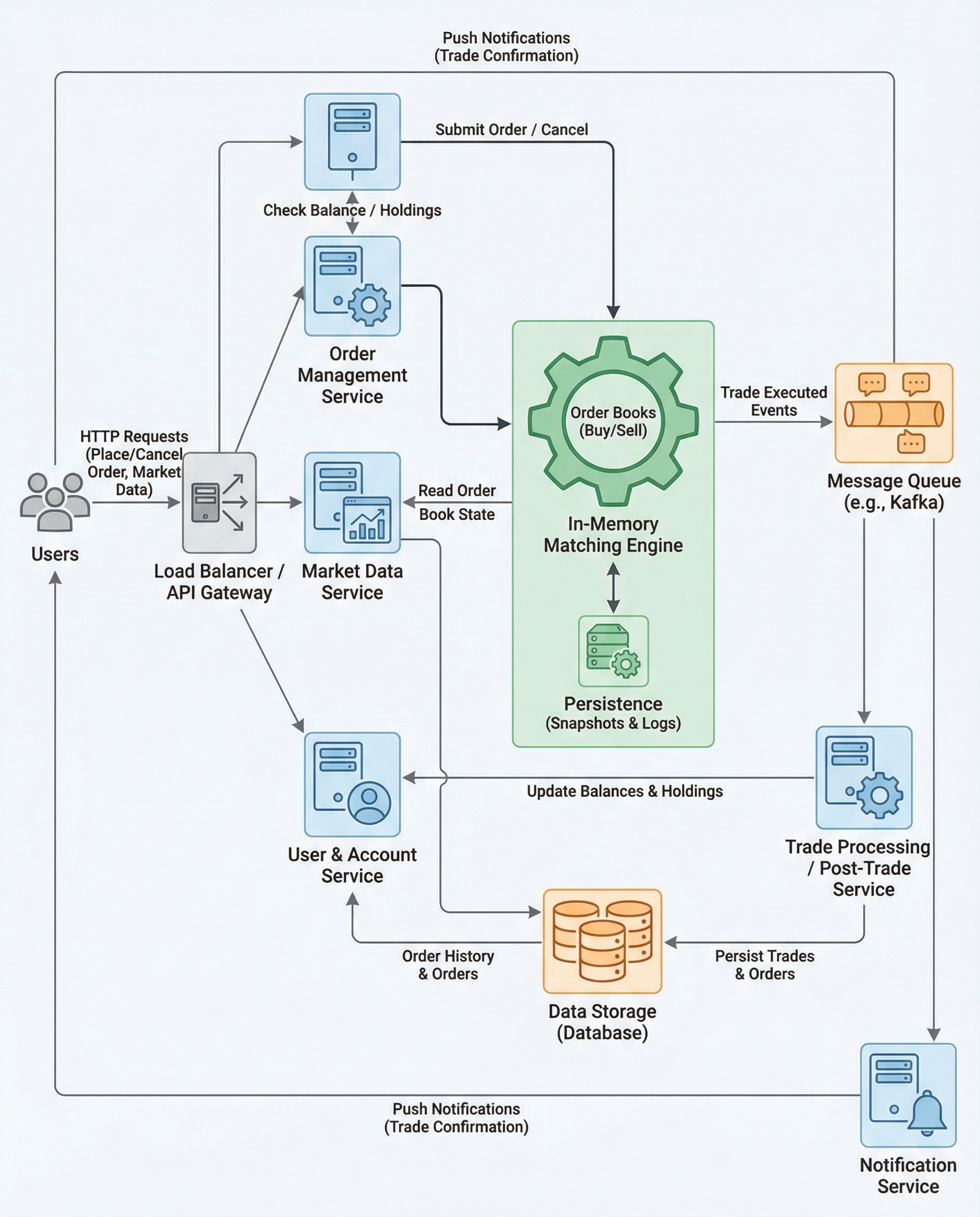
In any stock trading system the matching engine must enforce price–time priority. This is not optional — it’s the market’s fairness contract.
At its core the rule is simple:
- Better price wins. For bids, a higher price is better. For asks, a lower price is better.
- If prices tie, earlier timestamp wins — first in, first out (FIFO) within the same price level.
Because this is the law of fairness in matching, your design must guarantee both parts: quick access to the best price and strict FIFO ordering for orders at the same price.
Object-Oriented Design implications
An OrderBook cannot be a simple flat list of orders. Instead model two sides — bids and asks — each as a structure that:
- Keeps the best price immediately accessible (max for bids, min for asks).
- Preserves FIFO within each price level (queue semantics for orders that share the same price).
A common and effective representation is:
- price → queue(Order)
- a sorted index of prices to allow retrieving the best price quickly (e.g., a balanced tree or heap)
This yields efficient operations:
- Find best price: O(log P) (P = number of distinct price levels) using a tree map or heap.
- Enqueue/dequeue at a price level: O(1) using a linked queue (deque).
Typical data-structures by language
- Java: TreeMap> (bids use descendingKeySet; asks use ascendingKeySet).
- C++: std::map or std::set of price-level objects with std::deque for orders at each level.
- Python: sortedcontainers.SortedDict or bisect + list of price levels, with collections.deque for per-price queues.
Matching algorithm (high level)
When a new order arrives:
- Determine the opposite side (new bid matches existing asks; new ask matches existing bids).
- While the order has remaining quantity and there exists at least one compatible price on the opposite side:
- Pick the best price on the opposite side.
- Pop from the head of that price's queue (oldest order at that price).
- Execute a trade for the min of remaining quantities.
- If the price-level queue becomes empty, remove that price from the sorted index.
- If the incoming order still has remaining quantity, insert it at its price level's queue (newest at tail).
This preserves:
- Price priority: you always match against the best price first.
- Time priority: within a price you always consume the oldest order first.
Pseudocode
function match(incomingOrder): opposite = (incomingOrder.side == BUY) ? asks : bids while incomingOrder.qty > 0 and opposite.has_compatible_price(incomingOrder.price): bestPrice = opposite.best_price() queue = opposite.get_queue(bestPrice) restingOrder = queue.peek() tradeQty = min(incomingOrder.qty, restingOrder.qty) execute_trade(incomingOrder, restingOrder, tradeQty, tradePrice = restingOrder.price) decrease quantities accordingly if restingOrder.qty == 0: queue.pop() if queue.empty(): opposite.remove_price_level(bestPrice) if incomingOrder.qty > 0: sameSide = (incomingOrder.side == BUY) ? bids : asks sameSide.get_or_create_queue(incomingOrder.price).push(incomingOrder)
Example
- Existing asks: 100.50 → [Order A at t1], 101.00 → [Order B at t2]
- Incoming bid at 101.00 (t3): matches against 100.50 first because it's the best ask (lowest price). Within 100.50, Order A (t1) is matched before any later 100.50 orders.
Performance & concurrency notes
- Keep price-level queues lockable independently to reduce contention (per-price locks or lock-free queues where possible).
- Use a single matching thread for determinism in high-frequency engines; or partition by symbol to avoid cross-symbol locking.
- Persist trades and changes durably and in order to meet audit/regulatory needs.
Edge cases and testing
- Partial fills must leave correct quantities and timestamps.
- Orders with identical timestamps (rare) should have a deterministic tie-breaker (e.g., internal sequence number assigned on receipt).
- Verify behavior on order cancellation and replacement (ensure FIFO at price level still holds).
- Simulate high-throughput scenarios: many orders at same price, bursts, and out-of-order network delivery.
Summary
Price–time priority is the single non-negotiable rule in matching engines: best price first, then earliest order at that price. Implement an OrderBook as price→queue plus a sorted index of price levels to guarantee both fast best-price access and FIFO within a price level. This design is efficient, auditable, and preserves market fairness.
About the author
bugfree.ai is an advanced AI-powered platform designed to help software engineers master system design and behavioral interviews. Whether you’re preparing for your first interview or aiming to elevate your skills, bugfree.ai provides a robust toolkit tailored to your needs. Key Features:
150+ system design questions: Master challenges across all difficulty levels and problem types, including 30+ object-oriented design and 20+ machine learning design problems. Targeted practice: Sharpen your skills with focused exercises tailored to real-world interview scenarios. In-depth feedback: Get instant, detailed evaluations to refine your approach and level up your solutions. Expert guidance: Dive deep into walkthroughs of all system design solutions like design Twitter, TinyURL, and task schedulers. Learning materials: Access comprehensive guides, cheat sheets, and tutorials to deepen your understanding of system design concepts, from beginner to advanced. AI-powered mock interview: Practice in a realistic interview setting with AI-driven feedback to identify your strengths and areas for improvement.
bugfree.ai goes beyond traditional interview prep tools by combining a vast question library, detailed feedback, and interactive AI simulations. It’s the perfect platform to build confidence, hone your skills, and stand out in today’s competitive job market. Suitable for:
New graduates looking to crack their first system design interview. Experienced engineers seeking advanced practice and fine-tuning of skills. Career changers transitioning into technical roles with a need for structured learning and preparation.
Comments
Join the discussionNo comments yet. Be the first to comment.