Precision vs Recall vs F1 — interview-ready explanations
When you're asked about evaluation metrics in interviews, give clear definitions, show the math, and explain when to prefer each metric. Below is a compact, practical guide you can recite or use as notes.
Quick confusion-matrix recap
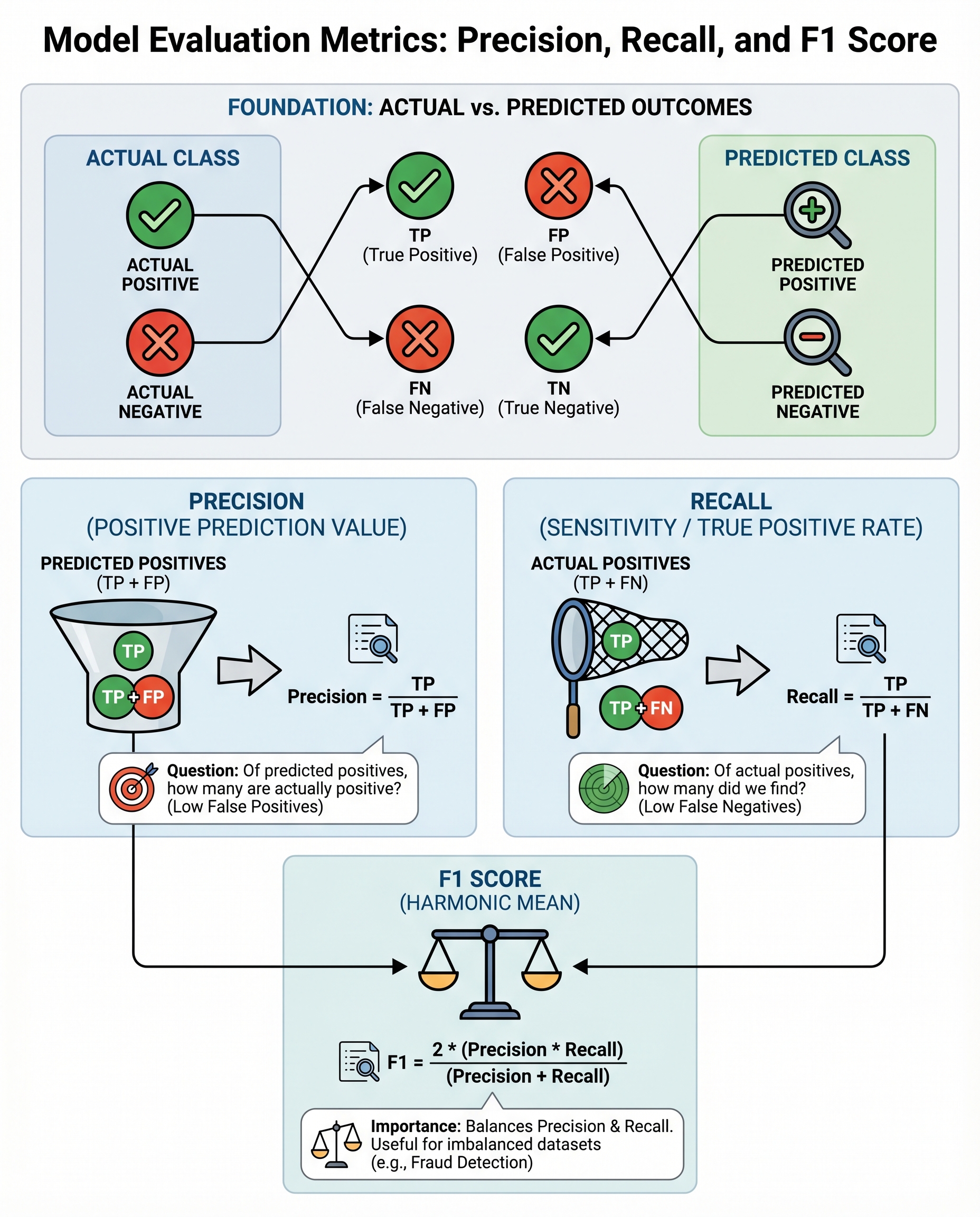
- TP (True Positive): model predicts positive and it is positive
- FP (False Positive): model predicts positive but it's negative
- TN (True Negative): model predicts negative and it's negative
- FN (False Negative): model predicts negative but it's positive
Use these to compute precision and recall.
Formulas and plain language
Precision = TP / (TP + FP)
- Of the examples predicted positive, how many are actually positive?
- Use when false positives are costly (e.g., marking a legitimate email as spam, charging a user for fraud when they’re innocent).
Recall = TP / (TP + FN)
- Of the actual positive examples, how many did you catch?
- Use when false negatives are costly (e.g., missing disease cases, failing to detect fraudulent transactions).
F1 score = 2 (Precision Recall) / (Precision + Recall)
- Harmonic mean of precision and recall. It rewards models that balance the two and penalizes extreme imbalance (very high precision and very low recall or vice versa).
- Common when classes are imbalanced and you want a single-number summary.
Intuition: precision vs recall trade-off
- Increasing the decision threshold often raises precision but lowers recall (you're stricter about predicting positives).
- Lowering the threshold raises recall but may reduce precision (you predict positives more liberally).
- Choose the operating point based on business costs: which error hurts more — FP or FN?
When to prefer each metric (practical examples)
Precision-first scenarios
- Email spam filter: avoid marking real email as spam (FP costly).
- Fraud investigations: minimize false accusations.
Recall-first scenarios
- Medical screening: you want to find as many true cases as possible (FN costly).
- Disease outbreak detection: early detection is critical.
F1 / balanced metric scenarios
- Rare-event detection like fraud or defect detection where both catching positives and avoiding false alarms matter.
- When you need a single metric for model selection and classes are imbalanced.
Interview tips
- State the formulas and the confusion-matrix definitions first — interviewers expect that.
- Give a real-world example where you'd prioritize precision and another where you'd prioritize recall.
- Mention threshold tuning (precision–recall trade-off) and that F1 is the harmonic mean, not an arithmetic mean — explain why that matters briefly (it punishes extreme imbalance).
- If relevant, note other metrics: precision-recall curve, average precision, ROC-AUC (different focus), and macro/micro averaging for multiclass problems.
Cheat sheet (one-liners to memorize)
- Precision: correctness among predicted positives.
- Recall: completeness among actual positives.
- F1: balance between precision and recall (harmonic mean).
Use these concise lines and one or two examples in interviews — you’ll sound precise, practical, and ready to apply metrics to real problems.
About the author
bugfree.ai is an advanced AI-powered platform designed to help software engineers master system design and behavioral interviews. Whether you’re preparing for your first interview or aiming to elevate your skills, bugfree.ai provides a robust toolkit tailored to your needs. Key Features:
150+ system design questions: Master challenges across all difficulty levels and problem types, including 30+ object-oriented design and 20+ machine learning design problems. Targeted practice: Sharpen your skills with focused exercises tailored to real-world interview scenarios. In-depth feedback: Get instant, detailed evaluations to refine your approach and level up your solutions. Expert guidance: Dive deep into walkthroughs of all system design solutions like design Twitter, TinyURL, and task schedulers. Learning materials: Access comprehensive guides, cheat sheets, and tutorials to deepen your understanding of system design concepts, from beginner to advanced. AI-powered mock interview: Practice in a realistic interview setting with AI-driven feedback to identify your strengths and areas for improvement.
bugfree.ai goes beyond traditional interview prep tools by combining a vast question library, detailed feedback, and interactive AI simulations. It’s the perfect platform to build confidence, hone your skills, and stand out in today’s competitive job market. Suitable for:
New graduates looking to crack their first system design interview. Experienced engineers seeking advanced practice and fine-tuning of skills. Career changers transitioning into technical roles with a need for structured learning and preparation.
Comments
Join the discussionNo comments yet. Be the first to comment.