Oracle SDE3 (IC3) Interview — High-Score Experience (Bugfree Users)
This is a first‑hand, high-score interview report from Bugfree users who cleared Oracle SDE3 (IC3). The process consisted of a screening stage and a 3‑round onsite loop. Below I rephrase and expand the original notes into a clear, actionable recap with tips for preparation.
Summary of the process
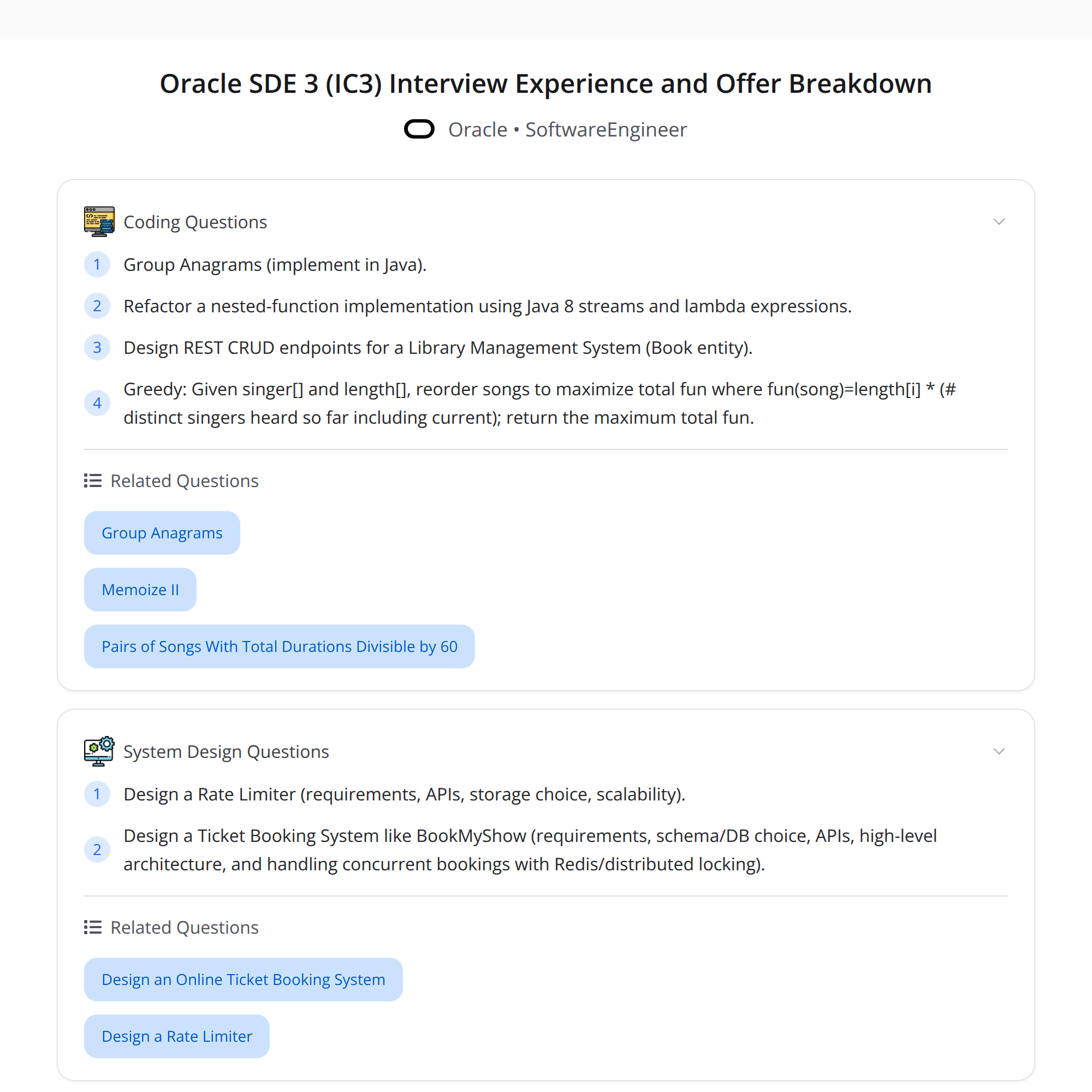
- Screening: CI/CD, testing, Group Anagrams (Java), Java 8 stream refactor, REST CRUD (Library Book), and metrics-driven decision questions.
- Loop 1: Behavioral + a greedy algorithm problem (a “maximize fun” reordering problem).
- Loop 2: System design — candidate chose Rate Limiter or Ticket Booking. Interviewers dug into requirements, APIs, DB choices, and concurrency (Redis/locks).
- Hiring Manager (HM) round: architecture ownership, integration testing, on‑call escalation, and observability.
Result: Cleared all rounds and received an offer.
Screening — what to expect and how to prepare
Screening touched both practical coding and production awareness.
Key topics covered:
- CI/CD and testing: expect questions on build pipelines, unit vs integration tests, test automation, and how you validate deployments (smoke tests, canary releases).
- Coding: Group Anagrams (Java) — common approach: normalize strings (sort or count chars) and group via a hashmap. Pay attention to complexity tradeoffs (sorting O(k log k) vs counting O(k)).
- Java 8 stream refactor: be comfortable converting loops to streams, using map/filter/collect, and handling nulls and side effects correctly.
- REST CRUD: design a simple Books API — endpoints, data model, status codes, and pagination.
- Metrics-driven decisions: reasons/metrics you would track (latency, throughput, error rates, SLOs, saturation). Be prepared to explain actions based on those metrics.
Preparation tips:
- Practice common string/array/hashmap problems and write clean Java code.
- Brush up Java 8 streams and functional idioms.
- Review CI/CD concepts and basic test strategies.
- Think about monitoring/metrics you’d add to a small service.
Loop 1 — behavioral + greedy reordering problem
Behavioral component:
- Expect questions about past ownership, tradeoffs you made, and how you interacted with teammates/stakeholders. Use the STAR format (Situation, Task, Action, Result).
Algorithmic component — “maximize fun” reordering:
- This sounds like a greedy reordering/selection problem: rearrange elements to maximize a score based on neighbor relationships or position weights. Typical strategies:
- Greedy by local benefit: sort by a heuristic and place highest value where it gives most marginal gain.
- Prove correctness or discuss counterexamples; if optimal proof is hard, discuss approximations and complexity.
Preparation tips:
- Practice greedy-design patterns and prove or justify greedy choices.
- Walk through small examples and edge cases aloud during the interview.
Loop 2 — System design (Rate Limiter or Ticket Booking)
This round focused on designing a real production service. Two common prompts were given; either Rate Limiter or Ticket Booking. Areas drilled:
1) Requirements and constraints
- Clarify functional (API contracts, expected operations) and non‑functional (throughput, latency, availability, consistency) requirements.
- Ask about scale: RPS, number of users, peak traffic, SLAs.
2) APIs and data model
- Define clear REST endpoints (e.g., /reserve, /confirm, /cancel for ticketing) and request/response shapes.
- For rate limiter: /acquire or middleware hook that returns allow/deny and remaining quota.
3) Storage choices and data modeling
- Ticket Booking:
- Use a transactional DB for reservations (strong consistency for seat allocation), or an optimistic locking approach if high concurrency is expected.
- Consider sharding by event or seat block to reduce contention.
- Rate Limiter:
- Use a fast in-memory store (Redis) for counters and token buckets.
- Consider CRDTs or approximate counters if exact counts aren’t required.
4) Concurrency and consistency
- Techniques: optimistic locking (compare-and-set), pessimistic DB locks, Redis single‑threaded ops, Lua scripts, atomic increments, or distributed locks (RedLock with caveats).
- For tickets: handle double-booking by enforcing a single writer or atomic reserve+confirm flows with timeouts.
5) Scaling and resilience
- Caching, partitioning, background reconciliation jobs, TTLs for provisional holds.
- For rate limiting at global scale: local per‑instance buckets + periodic global sync or a token service.
6) Observability and metrics
- Instrument request latencies, error rates, queue sizes, reservation failure reasons, throughput.
- Add tracing for cross-service flows and dashboards/alerts for SLO breaches.
Preparation tips:
- Practice both a simple end‑to‑end design and a deep dive on one critical component (consistency, concurrency, or scaling).
- Be ready to justify DB choices vs tradeoffs (ACID vs. availability vs performance).
Hiring Manager (HM) round — production depth & ownership
HM wanted to see end‑to‑end ownership and production mindset. Areas probed:
- Architecture ownership: decisions you made, why you chose a particular approach, how you balanced tradeoffs.
- Integration testing: approaches for testing end‑to‑end flows (contract tests, test environments, CI pipelines, staging with synthetic traffic).
- On‑call escalation: how you handle incidents, runbooks, postmortems, and communication with stakeholders.
- Observability: what metrics/logs/traces you expose and how those drive operational decisions.
How to answer:
- Use concrete past examples showing impact (what happened, how you acted, outcome).
- Describe a structured on‑call flow: detection → mitigation → root cause → fix → postmortem.
- Explain how you design for operability (health checks, graceful degradation, feature flags).
Practical preparation checklist
- Code: arrays/strings/hashmaps, greedy, heaps, two pointers, graph basics.
- Java specifics: streams, concurrency primitives (synchronized, locks, volatile), exception handling.
- System design: practice one small service and one large system; explain tradeoffs clearly.
- Production: CI/CD pipelines, test strategies, monitoring and alerting, runbooks.
- Behavioral: prepare 6–8 STAR stories about ownership, conflict, design tradeoffs, outages, and hiring/mentoring.
Final notes
This Oracle SDE3 loop emphasized not only algorithmic skill but also production readiness: CI/CD, metrics, concurrency, and on‑call responsibilities. Candidates who can combine clean coding with solid operational thinking and clear tradeoff explanations will stand out.
Good luck — focus on breadth (system thinking + production) and depth (one or two design components you can drill into).
#Hashtags
#SoftwareEngineering #SystemDesign #InterviewPrep
About the author
bugfree.ai is an advanced AI-powered platform designed to help software engineers master system design and behavioral interviews. Whether you’re preparing for your first interview or aiming to elevate your skills, bugfree.ai provides a robust toolkit tailored to your needs. Key Features:
150+ system design questions: Master challenges across all difficulty levels and problem types, including 30+ object-oriented design and 20+ machine learning design problems. Targeted practice: Sharpen your skills with focused exercises tailored to real-world interview scenarios. In-depth feedback: Get instant, detailed evaluations to refine your approach and level up your solutions. Expert guidance: Dive deep into walkthroughs of all system design solutions like design Twitter, TinyURL, and task schedulers. Learning materials: Access comprehensive guides, cheat sheets, and tutorials to deepen your understanding of system design concepts, from beginner to advanced. AI-powered mock interview: Practice in a realistic interview setting with AI-driven feedback to identify your strengths and areas for improvement.
bugfree.ai goes beyond traditional interview prep tools by combining a vast question library, detailed feedback, and interactive AI simulations. It’s the perfect platform to build confidence, hone your skills, and stand out in today’s competitive job market. Suitable for:
New graduates looking to crack their first system design interview. Experienced engineers seeking advanced practice and fine-tuning of skills. Career changers transitioning into technical roles with a need for structured learning and preparation.
Comments
Join the discussionNo comments yet. Be the first to comment.