High-Score Microsoft SDE Interview: 3 Strong Technical Rounds + AA Learnings
Posted by Bugfree Users — a high-score Microsoft SDE interview loop featuring three strong technical rounds followed by an AA (Behavioral + High-Level Design) session. Below is a concise breakdown of each round, what went well, where small mistakes happened, and concrete takeaways you can apply to your prep.
TL;DR
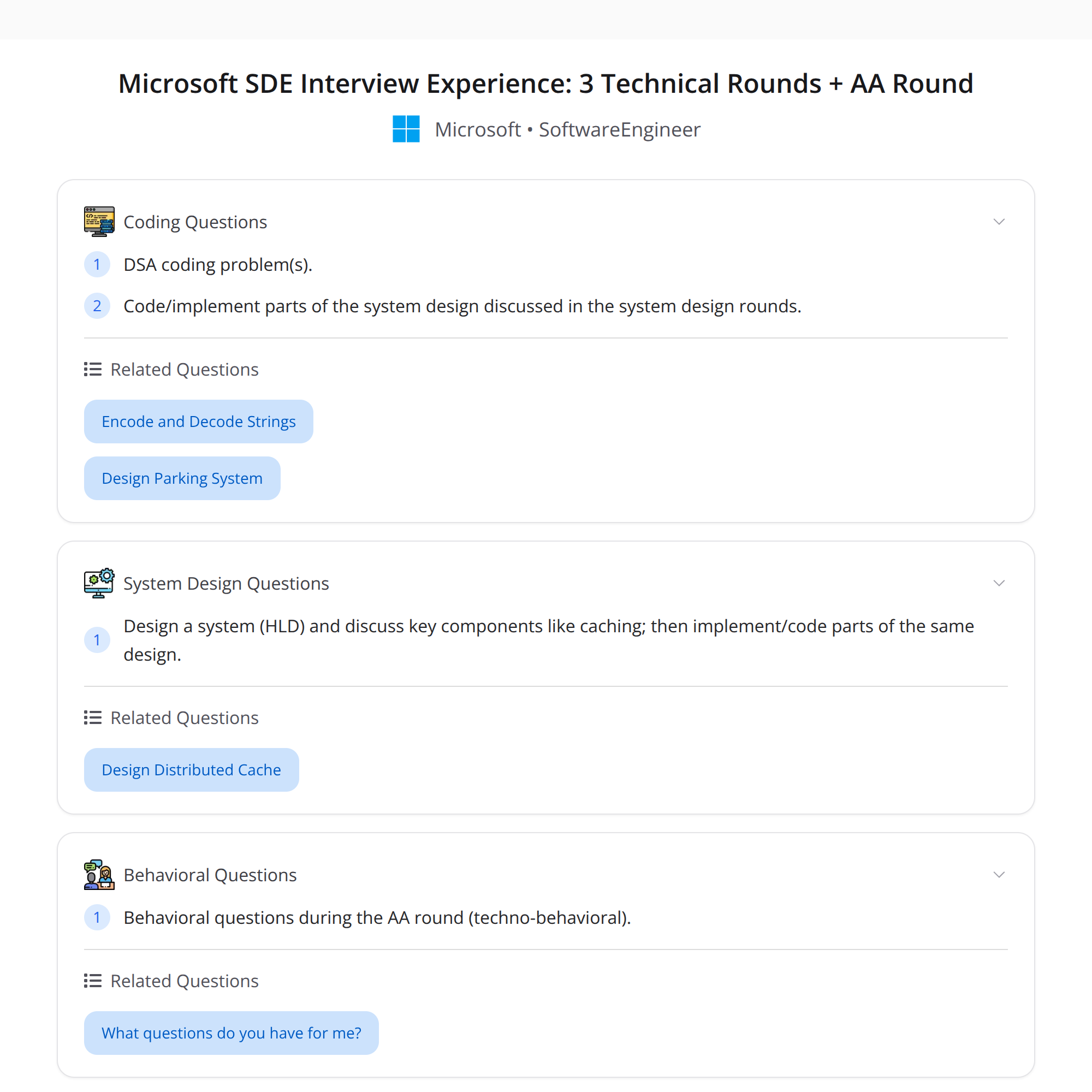
- R1: DSA + LLD — strong problem solving and design; strong-hire signal.
- R2: System design followed by implementation — designed and coded the same system; strong-hire.
- R3: System design → implement — similar flow, solid execution; hire.
- R4 (AA): Behavioral + HLD — interviewee misread a prompt and initially missed caching; interviewer helped. Key lessons: clarify requirements early, keep a caching checklist, and pace your communication.
Interview Loop Overview
Round 1 (DSA + LLD)
- Format: Data structures & algorithms problem plus a low-level design discussion.
- Outcome: Strong problem-solving approach and a solid low-level design. Interviewer reaction: strong-hire.
- Tip: For combined DSA+LLD rounds, explicitly separate the two phases: first confirm algorithm and complexity, then move to API, classes, and invariants for LLD.
Round 2 (System Design → Implement)
- Format: High-level system design followed by coding part of the designed system.
- Outcome: Designed and implemented the same system during the loop. Strong-hire.
- Tip: When asked to implement part of your design, keep interfaces/assumptions clear and implement a focused, testable component.
Round 3 (System Design → Implement)
- Format: Similar to R2.
- Outcome: Decent execution, interview decision: hire.
- Tip: Reuse patterns from prior rounds (e.g., caching layers, rate limiting, data partitioning) and show trade-offs quickly.
Round 4 (AA: Behavioral + HLD)
- Format: Behavioral questions first, then a high-level design prompt.
- Notable issue: Misread the HLD prompt and initially omitted caching. The interviewer intervened to help slow down and re-evaluate. The candidate recovered but learned important pacing and clarification lessons.
- Tip: In behavioral + HLD rounds, treat the behavioral portion as rapport-building and reserve time to ask clarifying questions for design.
What Went Well (Why this was a "High-Score")
- Clear algorithmic thinking and complexity analysis in DSA rounds.
- Ability to translate a high-level architecture into a concrete implementable component.
- Recovered from mistakes with help from the interviewer — shows adaptability and collaborative mindset.
Key Mistake & How to Avoid It
- Mistake: Rushed into design implementation and misread a requirement, which led to missing a caching component initially.
- Why it happened: Rushing, insufficient early clarifying questions, and no quick checklist for common infrastructure components.
- How to avoid:
- Pause after the prompt and repeat the requirements in your own words.
- Ask explicit constraint questions (throughput, latency, data size, consistency, cost).
- Use a mental or written checklist for common components: caching, load balancing, persistence, replication, sharding, monitoring.
A Practical Caching Checklist (use this in system design rounds)
- Does the workload have read-heavy characteristics? (Yes/No)
- Are latency requirements tight enough to require a cache?
- Which data is cacheable and for how long? (TTL / staleness tolerance)
- Cache invalidation strategy (time-based, write-through, write-back, explicit invalidate)
- Cache placement: client-side, edge (CDN), or server-side (in-memory like Redis)
- Cache size estimation and eviction policy (LRU, LFU)
- Consistency guarantees required (eventual vs strong)
- Monitoring & metrics (hit/miss rate, latency)
Communication & Pacing Tips
- Slow down: If you feel rushed, say so. Interviewers often appreciate a calm, structured approach.
- Clarify early: Repeat and confirm the problem statement before designing or coding.
- Lay out a plan: Give a 30-60 second roadmap before diving into design or code.
- Ask about trade-offs as you propose solutions instead of waiting until the end.
Actionable Prep Suggestions
- Practice mixed-format rounds: combine a short DSA question with a quick LLD to simulate R1.
- Do end-to-end exercises: design a system and implement one component (e.g., a rate limiter, consistent hashing helper, or a caching layer).
- Run mock interviews where the interviewer occasionally redirects you — practice recovering gracefully.
- Memorize a short infrastructure checklist (caching, DB choice, replication, monitoring) and run through it when you finish the first-pass design.
Final Thoughts
This loop shows the value of strong fundamentals (algorithms and system design) and the importance of good interview habits: clarify requirements, pace yourself, and keep a checklist for common system components like caching. Even when you make a small mistake, interviewers often look for how you recover and whether you're collaborative — both of which were demonstrated here.
Good luck with your Microsoft SDE prep!
#SoftwareEngineering #SystemDesign #InterviewPrep
About the author
bugfree.ai is an advanced AI-powered platform designed to help software engineers master system design and behavioral interviews. Whether you’re preparing for your first interview or aiming to elevate your skills, bugfree.ai provides a robust toolkit tailored to your needs. Key Features:
150+ system design questions: Master challenges across all difficulty levels and problem types, including 30+ object-oriented design and 20+ machine learning design problems. Targeted practice: Sharpen your skills with focused exercises tailored to real-world interview scenarios. In-depth feedback: Get instant, detailed evaluations to refine your approach and level up your solutions. Expert guidance: Dive deep into walkthroughs of all system design solutions like design Twitter, TinyURL, and task schedulers. Learning materials: Access comprehensive guides, cheat sheets, and tutorials to deepen your understanding of system design concepts, from beginner to advanced. AI-powered mock interview: Practice in a realistic interview setting with AI-driven feedback to identify your strengths and areas for improvement.
bugfree.ai goes beyond traditional interview prep tools by combining a vast question library, detailed feedback, and interactive AI simulations. It’s the perfect platform to build confidence, hone your skills, and stand out in today’s competitive job market. Suitable for:
New graduates looking to crack their first system design interview. Experienced engineers seeking advanced practice and fine-tuning of skills. Career changers transitioning into technical roles with a need for structured learning and preparation.
Comments
Join the discussionNo comments yet. Be the first to comment.