{: style="max-width:800px; height:auto;" }
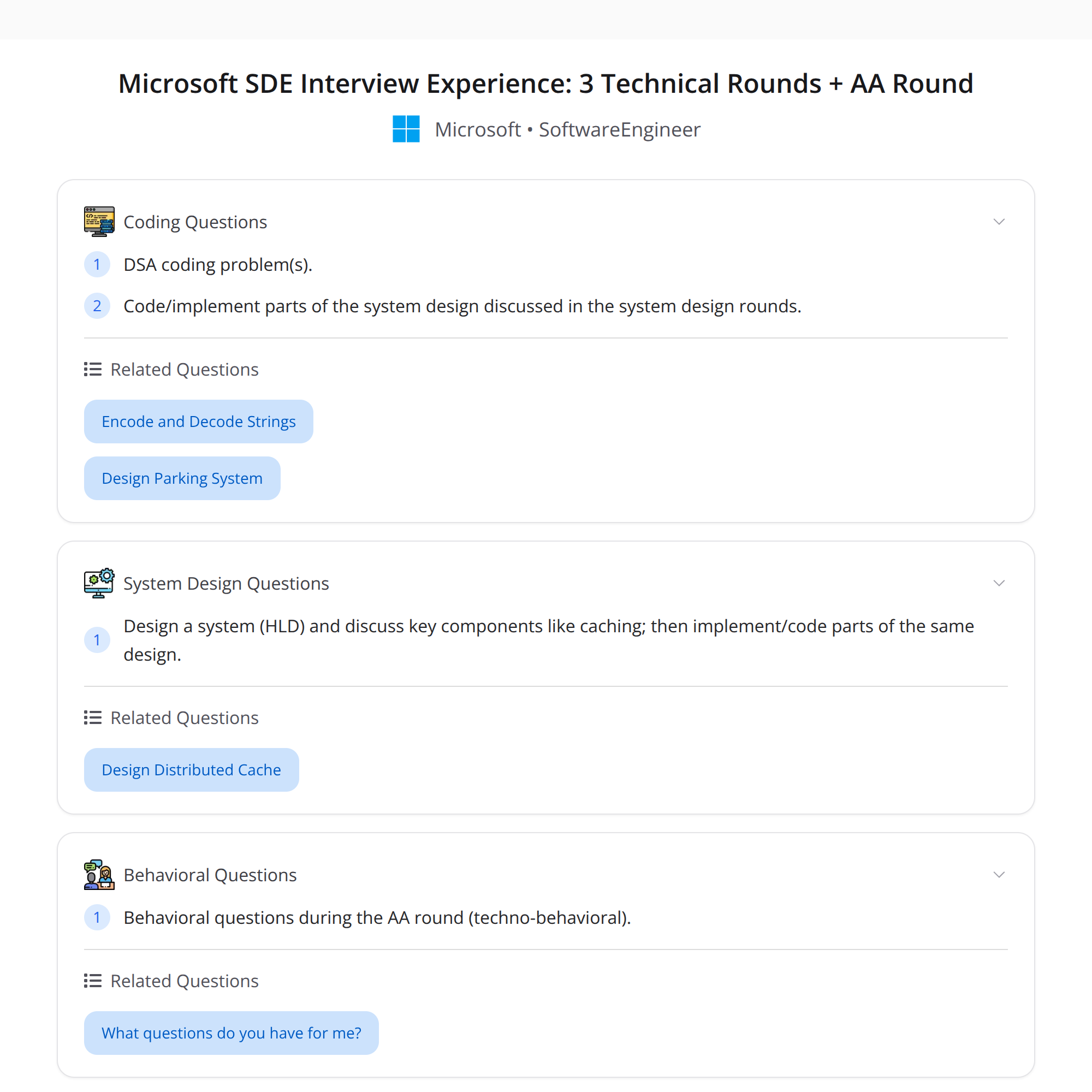
A concise, actionable recap of a high-score Microsoft SDE interview loop: three technical rounds (DSA + LLD; two system design + implementation) followed by an AA (behavioral + HLD) round. Key lessons: clarify early, use a caching checklist, and pace your communication.
Highlights at a glance
- R1 (DSA + LLD): Strong problem-solving and a thorough low-level design discussion — strong hire signal.
- R2 (System Design → Implement): Designed a system and implemented parts of it in the same interview — strong hire signal.
- R3 (System Design → Implement): Similar format as R2; solid execution and hireable outcome.
- R4 (AA — Behavioral + HLD): Behavioral questions first, then a high-level design prompt. A misread led to missing caching initially; interviewer helped course-correct. Key takeaways: clarify requirements early, maintain a caching checklist, and control the pacing of your responses.
Round-by-round breakdown
R1 — DSA + Low-Level Design
- Format: Data structures & algorithms problem followed by low-level design discussion.
- What went well: Fast, correct problem-solving and clear tradeoff discussion for the LLD. Demonstrated awareness of edge cases and complexity analysis.
- Outcome: Strong hire signal.
Tips:
- Walk through complexity (time/space) and edge cases out loud.
- For LLD, sketch class diagrams or interfaces and justify major choices (thread safety, persistence, APIs).
R2 — System Design then Implement
- Format: High-level system design followed by implementing a component or critical path.
- What went well: Designed the system, then translated design into working code during the interview. Balanced design tradeoffs and coding details.
- Outcome: Strong hire signal.
Tips:
- During design, identify the critical path you’ll implement and keep it scoped.
- Use simple, testable interfaces for implementation to reduce room for ambiguity.
R3 — System Design then Implement (again)
- Format: Another design + implement loop with a different problem.
- What went well: Decent execution; repeated the pattern effectively and demonstrated consistency.
- Outcome: Hire signal.
Tips:
- Reuse patterns you’ve practiced (e.g., queues, caches, rate limiters) so you can implement reliably under time pressure.
R4 — AA (Behavioral + High-Level Design)
- Format: Behavioral questions first, then a high-level design prompt.
- What happened: Misread a design prompt and initially omitted caching from the architecture. The interviewer asked clarifying questions and helped slow the pace, enabling a fix.
Key lesson: Clarify requirements before jumping into the architecture. A small misunderstanding can cascade into significant omissions under time pressure.
Tips:
- For behavioral: use STAR (Situation, Task, Action, Result) to keep answers structured and concise.
- For HLD: restate the problem, ask targeted clarifying questions, then outline major components.
Actionable takeaways and practical checklist
Clarify first, design second
- Restate requirements and constraints.
- Ask about expected scale, SLAs, and non-functional requirements.
Keep a caching checklist
- When should we cache? (Read-heavy paths)
- What to cache? (IDs vs. full objects)
- Cache consistency strategy (TTL, invalidation, write-through/behind)
- Cache placement (edge, application, DB level)
- Eviction policy and size estimates
Pace communication
- Think out loud but avoid monologues.
- If you get stuck, ask the interviewer to confirm assumptions rather than rushing.
Scope implementations
- Pick a critical path to implement and declare it early.
- Use simple, modular code so you can explain and adapt quickly.
Practice the design→implement pattern
- Simulate interviews where you design a system and implement core components in one sitting.
Closing notes
This loop demonstrates that consistent, clear execution across multiple formats (DSA, LLD, HLD, implementation, and behavioral) leads to strong hire signals. The AA round highlights a common pitfall: misreading or under-clarifying prompts under time pressure. Build quick checklists (especially for caching) and practice pacing to avoid similar issues.
Good luck with your interviews — clarify early, keep a checklist for common components, and pace your communication.
#SoftwareEngineering #SystemDesign #InterviewPrep
About the author
bugfree.ai is an advanced AI-powered platform designed to help software engineers master system design and behavioral interviews. Whether you’re preparing for your first interview or aiming to elevate your skills, bugfree.ai provides a robust toolkit tailored to your needs. Key Features:
150+ system design questions: Master challenges across all difficulty levels and problem types, including 30+ object-oriented design and 20+ machine learning design problems. Targeted practice: Sharpen your skills with focused exercises tailored to real-world interview scenarios. In-depth feedback: Get instant, detailed evaluations to refine your approach and level up your solutions. Expert guidance: Dive deep into walkthroughs of all system design solutions like design Twitter, TinyURL, and task schedulers. Learning materials: Access comprehensive guides, cheat sheets, and tutorials to deepen your understanding of system design concepts, from beginner to advanced. AI-powered mock interview: Practice in a realistic interview setting with AI-driven feedback to identify your strengths and areas for improvement.
bugfree.ai goes beyond traditional interview prep tools by combining a vast question library, detailed feedback, and interactive AI simulations. It’s the perfect platform to build confidence, hone your skills, and stand out in today’s competitive job market. Suitable for:
New graduates looking to crack their first system design interview. Experienced engineers seeking advanced practice and fine-tuning of skills. Career changers transitioning into technical roles with a need for structured learning and preparation.
Comments
Join the discussionNo comments yet. Be the first to comment.