
High-Score Oracle SDE3 (IC3) Interview Experience
This write-up summarizes a successful Oracle SDE3 (IC3) interview loop shared by Bugfree users. The loop consisted of an initial screening followed by a three-round onsite loop. The emphasis ranged from coding (DSA + Java 8), to system design, to production-readiness topics like observability and on-call handling.
Below is a clean breakdown of each stage, what was asked, how to think about it, and practical tips to prepare.
Screening: what came up and how to approach it
The screening covered a mix of practical software engineering and coding tasks:
CI/CD and testing questions
- Expect questions about pipelines, stages (build/test/deploy), unit vs integration tests, and test automation strategies.
- Be ready to explain how you would make a pipeline robust, rollback strategies, and test flakiness mitigation.
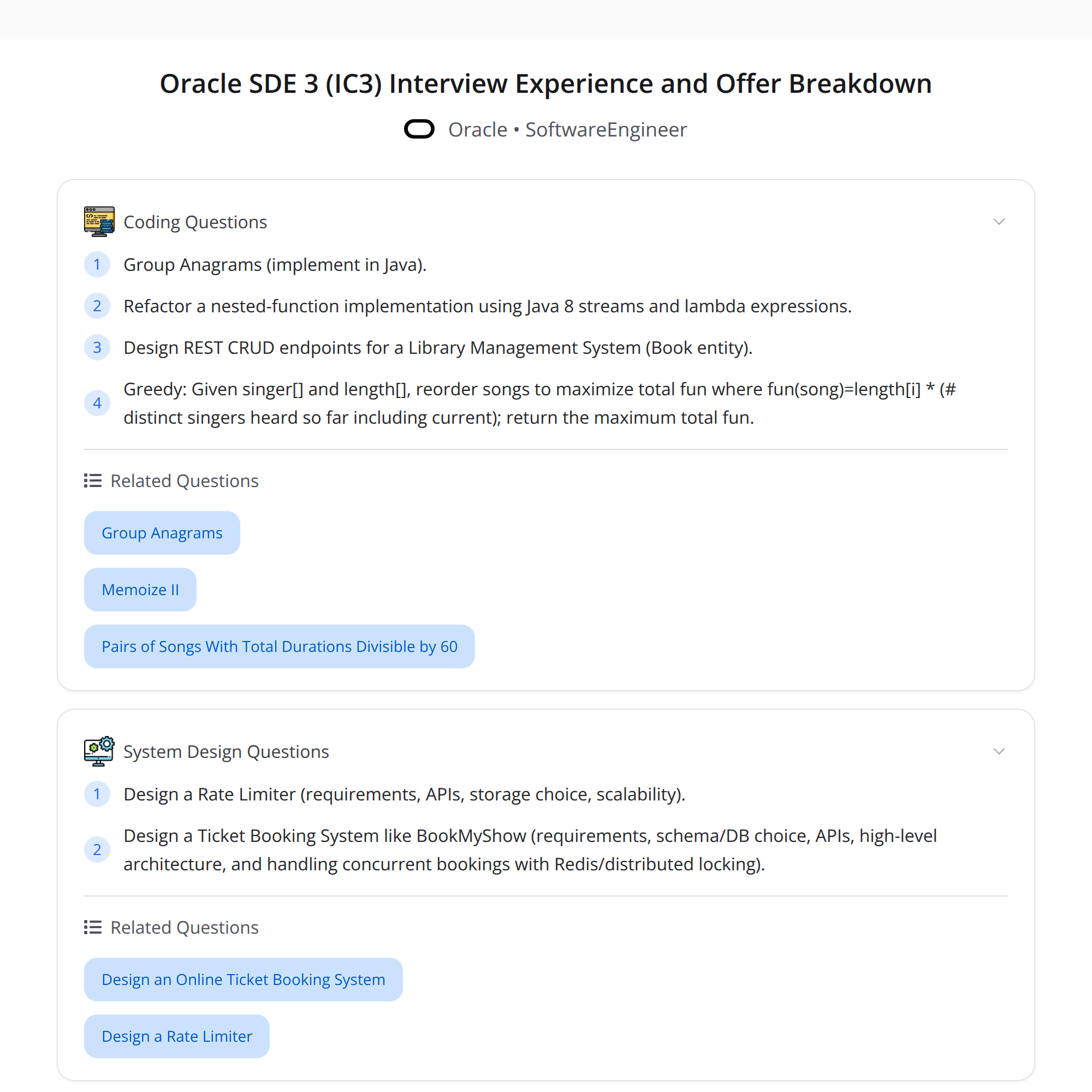
Group Anagrams (Java)
- Typical approach: normalize words (sort chars or use char-frequency signature) and group using a HashMap.
- Discuss complexity: O(n k log k) for sorting approach, or O(n k) with counting signature (k = avg word length).
Java 8 stream refactor
- You may be given imperative code and asked to rewrite using streams (map/filter/collect).
- Emphasize readability, immutability, and potential performance implications.
REST CRUD for a Library (Book)
- Design basic endpoints: GET /books, GET /books/{id}, POST /books, PUT/PATCH /books/{id}, DELETE /books/{id}.
- Discuss request/response shapes, validation, pagination, filtering, and error handling.
Metrics-driven decisions
- You might be asked to choose an approach based on metrics (latency, error rate, throughput). Explain which metrics matter for the problem and how they'd influence design or rollout decisions.
Preparation tips:
- Be fluent with Java collections and Java 8 streams.
- Review REST design basics and common API patterns.
- Know CI/CD basics and what makes a pipeline production-ready.
Loop 1: behavioral + a greedy “maximize fun” problem
This round combined behavioral questions with a coding problem that required a greedy approach (a “maximize fun” reordering problem).
Behavioral: expect questions that probe impact, trade-offs, ownership, and communication. Use the STAR format (Situation, Task, Action, Result) and emphasize measurable outcomes.
Greedy problem (typical pattern and tips):
- Problem flavor: reorder items/events to maximize some aggregate metric (e.g., total happiness, score, or reward under constraints).
- Typical solution approach:
- Identify a locally optimal choice and prove it leads to a globally optimal solution (or justify with counterexamples if not greedy).
- Common patterns: sort by value, sort by ratio (value/weight), or use a priority queue to choose best next item.
- Consider edge cases and show correctness reasoning and complexity analysis.
Example hints you could present:
- If each item gives a gain that depends on its position, try sorting by a comparator that captures the marginal benefit.
- If choosing items under a capacity, consider a knapsack-like greedy or dynamic programming fallback.
Loop 2: System Design — Rate Limiter or Ticket Booking
This round was a deep dive into system design with a focus on concurrency, APIs, DB choices, and production correctness.
Two possible prompts were discussed: a Rate Limiter and a Ticket Booking system. Key topics to cover for either:
Common design steps:
- Clarify requirements (functional+non-functional)
- Define APIs and data models
- Choose storage and caching strategies
- Discuss concurrency, consistency, and scaling
- Address failure modes and monitoring
Rate Limiter (design highlights):
- Requirements: per-user or global limits, burst handling, sliding window vs token bucket, low-latency checks.
- API example: POST /request -> 200/429 based on allowance.
- Implementation choices:
- In-memory token bucket for a single node.
- Redis-based token bucket or sliding window using INCR with expirations or Lua scripts for atomicity.
- Use consistent hashing and client-side sticky routing or a shared Redis for cross-node limits.
- Trade-offs: accuracy vs performance, memory footprint, and horizontal scaling.
Ticket Booking (design highlights):
- Requirements: seat availability, reservation window, payment/booking, and eventual consistency for high load events.
- API example: POST /events/{id}/reserve, POST /events/{id}/confirm, POST /events/{id}/cancel.
- Data stores:
- Use relational DB for strong consistency (transactions) or a hybrid: RDBMS for booking state + cache for read-heavy endpoints.
- Consider optimistic concurrency (version checks) or pessimistic locking for seat allocation.
- Concurrency strategies:
- Use DB transactions for final confirmation.
- Use Redis (atomic decrement / Lua script) for a fast reservation counter, then reconcile with DB.
- Use queues for eventual consistency flows (e.g., payment processing) and background reconciliation.
Practical points:
- Show diagrams (high level): clients -> API layer -> service layer -> DB/Redis -> async workers/queue.
- Discuss scaling: read replicas, sharding keys (userId/eventId), cache invalidation patterns.
Hiring Manager (HM) Round: ownership, integration testing & on-call
This round drilled into production ownership and observability.
Interview focus areas and how to handle them:
Architecture ownership
- Explain how you make design decisions, prioritize technical debt, and balance product deadlines with long-term maintainability.
- Provide examples where you owned a subsystem and the measurable impact (latency, reliability, cost savings).
Integration testing
- Discuss types: unit, integration, end-to-end, contract tests.
- Show a test strategy: mocking boundaries, test data management, CI gating, and canary deployments.
On-call escalation & incidents
- Describe runbooks, paging policies, SLOs/SLA, and postmortems.
- Explain how you triage incidents: gather metrics, traces, logs, mitigate quickly, and follow up with root-cause analysis.
Observability
- Metrics (Prometheus), tracing (OpenTelemetry/Jaeger), structured logging, dashboards, and alerts.
- Talk about meaningful SLIs (latency p50/p95/p99, error rate) and alert thresholds to avoid alert fatigue.
HM rounds test your ability to not just design systems, but to operate them reliably at scale.
Outcome
Result: Cleared the loop and received an offer.
Key takeaways & preparation checklist
- Be fluent in core coding patterns: hashing, sorting, greedy, two-pointers, and common data structures. Practice on LeetCode/Algo platforms.
- Know Java well (collections, Java 8 streams) and be able to explain trade-offs when refactoring imperative code to streams.
- For system design:
- Always clarify requirements and constraints first.
- Discuss APIs, data model, scaling, consistency, and failure modes.
- Be ready to propose multiple approaches and compare trade-offs.
- For production topics:
- Understand CI/CD basics, testing strategies, observability, on-call practices, and incident management.
- Be able to tie design decisions back to measurable metrics (latency, throughput, cost, error rate).
Recommended resources:
- LeetCode (medium/hard practice)
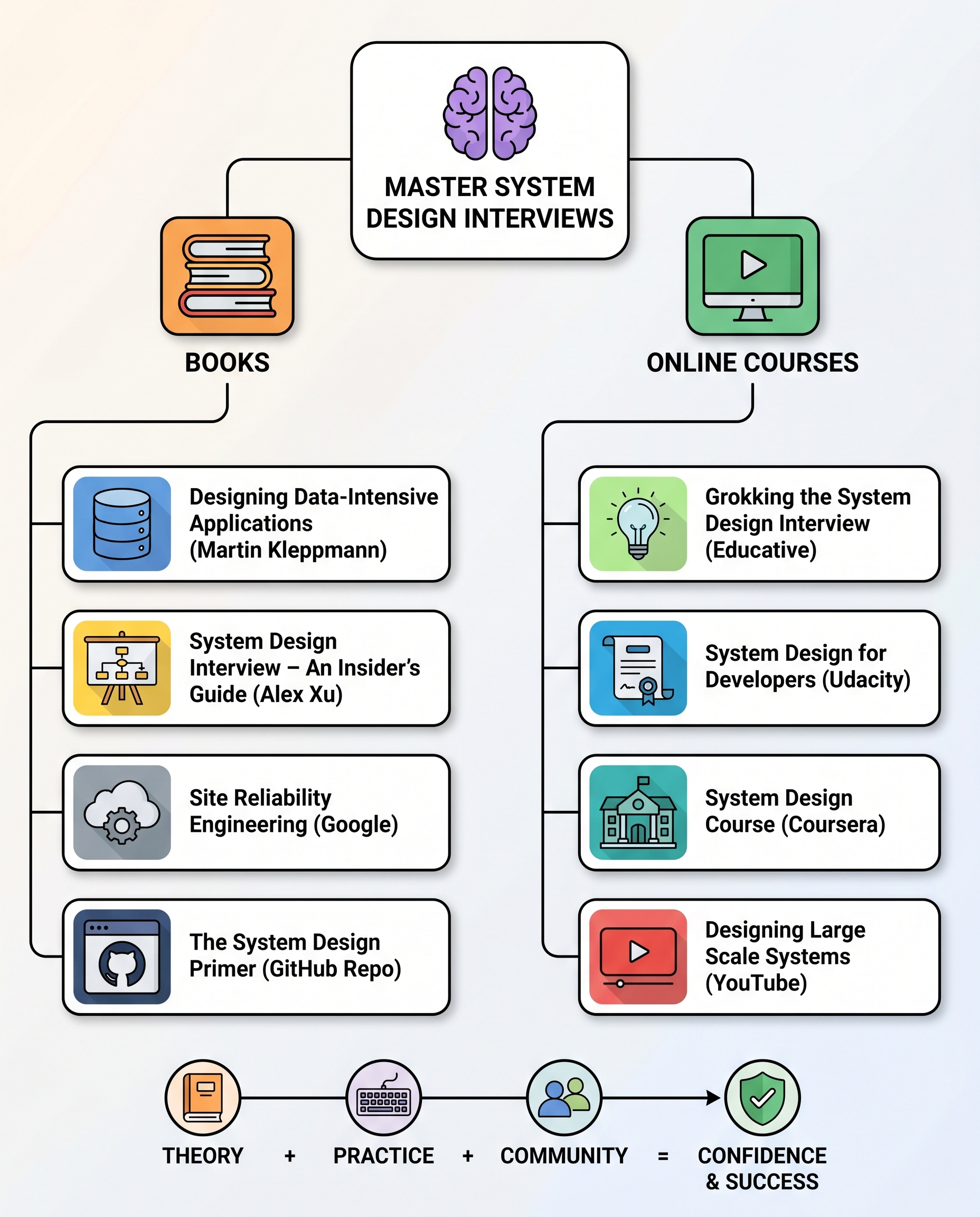
- System Design Primer (GitHub)
- Redis docs (Lua scripts, atomic ops)
- Blogs on production readiness, SRE practices, and observability (e.g., Google SRE book)
If you'd like, I can:
- Turn one of the system design prompts (Rate Limiter or Ticket Booking) into a detailed design doc with diagrams.
- Provide a step-by-step solution for the greedy reordering problem with code examples in Java.
About the author
bugfree.ai is an advanced AI-powered platform designed to help software engineers master system design and behavioral interviews. Whether you’re preparing for your first interview or aiming to elevate your skills, bugfree.ai provides a robust toolkit tailored to your needs. Key Features:
150+ system design questions: Master challenges across all difficulty levels and problem types, including 30+ object-oriented design and 20+ machine learning design problems. Targeted practice: Sharpen your skills with focused exercises tailored to real-world interview scenarios. In-depth feedback: Get instant, detailed evaluations to refine your approach and level up your solutions. Expert guidance: Dive deep into walkthroughs of all system design solutions like design Twitter, TinyURL, and task schedulers. Learning materials: Access comprehensive guides, cheat sheets, and tutorials to deepen your understanding of system design concepts, from beginner to advanced. AI-powered mock interview: Practice in a realistic interview setting with AI-driven feedback to identify your strengths and areas for improvement.
bugfree.ai goes beyond traditional interview prep tools by combining a vast question library, detailed feedback, and interactive AI simulations. It’s the perfect platform to build confidence, hone your skills, and stand out in today’s competitive job market. Suitable for:
New graduates looking to crack their first system design interview. Experienced engineers seeking advanced practice and fine-tuning of skills. Career changers transitioning into technical roles with a need for structured learning and preparation.
Comments
Join the discussionNo comments yet. Be the first to comment.