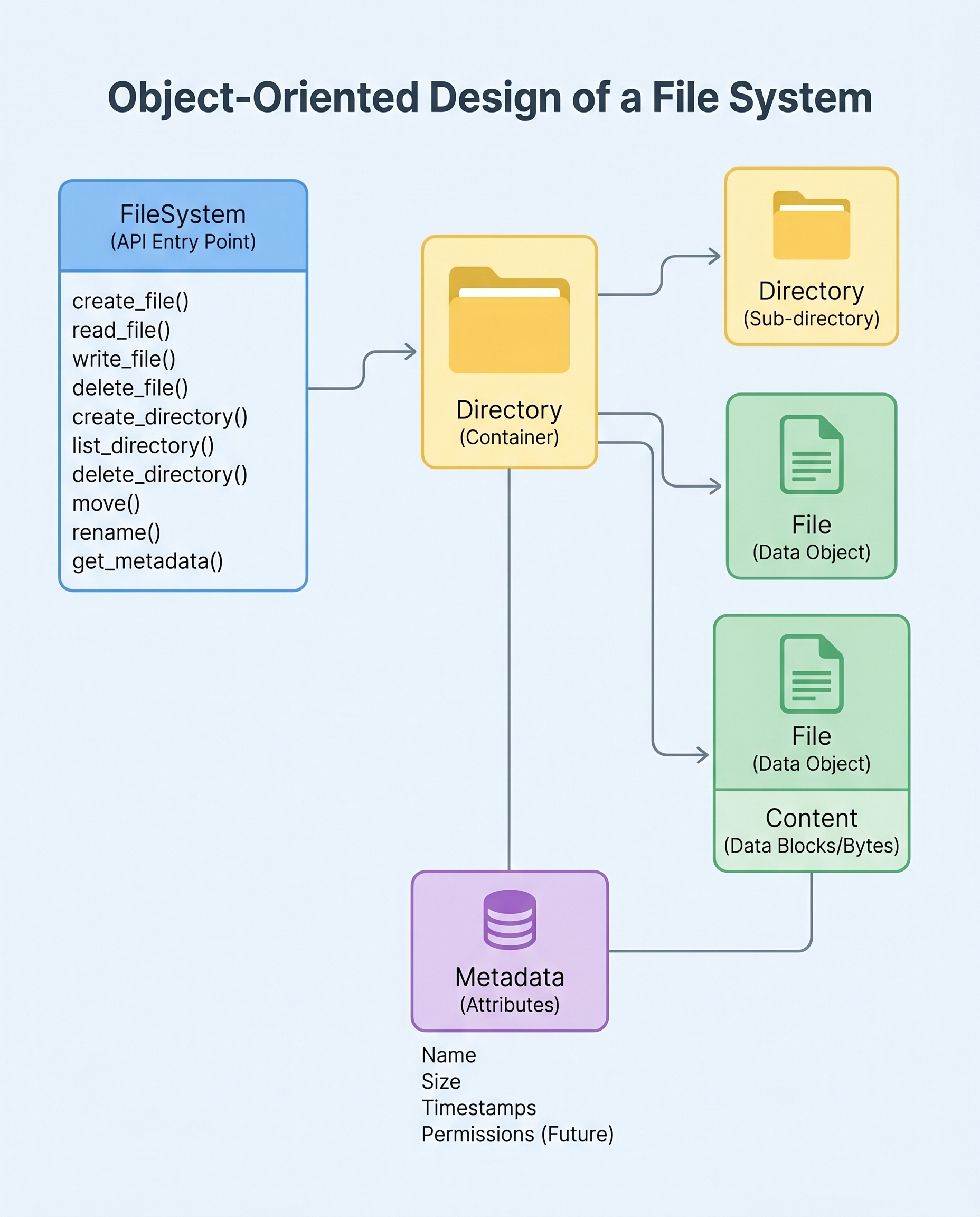

In file system design, the devil is in directory lookups. Every operation begins with path resolution: parse "/a/b/c", walk directories, and at each step find the next child fast and safely.
Why a directory must not be “just a list”
A directory conceptually holds a mapping from names to nodes (files or subdirectories). If you model a directory as a naive list, every lookup becomes O(n) for the directory size — too slow for real workloads. Instead, treat a directory as a container with an efficient name → node index mapping (e.g., hash map or B-tree).
This choice affects the complexity and correctness of all higher-level operations: create, read, move, rename, and delete. Interviewers expect you to reason about lookup complexity, conflict detection, and consistency.
Core model (simple and explicit)
- Directory: map
- Node: { type: file|dir, parent: NodeIndex, metadata }
Key invariants:
- Each directory contains unique names (no duplicates in one directory)
- Parent pointers are consistent (node.parent points to the directory that contains the entry)
Path resolution: the common starting point
To operate on "/a/b/c":
- Parse components ["a", "b", "c"].
- Starting from the root, for each component except possibly the last, perform a directory lookup (fast map/B-tree lookup).
- If any component lookup fails (missing component or wrong type), abort with an error.
Complexity: let k be the number of path components and L be the complexity of a single directory lookup. Total is O(k * L). With a hash map L is average O(1) (subject to hashing), with a B-tree L = O(log n).
How core operations reduce to lookups and simple updates
- Create: resolve parent directory P, check name doesn’t exist, insert mapping name → new_node_index, set new_node.parent = P.
- Read (open/stat): resolve parent (or resolve full path), locate node, verify permissions.
- Rename/Move: resolve source parent Ps and destination parent Pd, ensure destination name doesn’t conflict, update Ps map to remove name, update Pd map to add name → same node index, update node.parent = Pd.
If you can’t explain lookup complexity and the conflict checks performed during these steps, your design is incomplete.
Concurrency and consistency (what candidates frequently miss)
Candidates commonly forget to describe how these updates are made safe under concurrency and crashes. Important points to mention:
- Locking: use fine-grained per-directory locks (or reader/writer locks). For multi-directory ops (rename across directories), acquire locks in a global order (e.g., path lexicographic) to avoid deadlocks.
- Atomicity: perform changes in an order that preserves invariants even if a crash occurs. For example, when moving a node, add the destination entry first (or use a journal/transaction) then remove the source entry to avoid losing the node.
- Parent pointer consistency: ensure node.parent is updated in the same atomic operation as the directory mappings, or make the system tolerant of transient inconsistency until the operation commits.
- Conflict detection: always check existence and type at the resolved parent before making changes. Handle races where an entry is created between your check and your insert (use locks or atomic compare-and-swap style operations).
Example pseudocode (rename/move)
function move(sourcePath, destDirPath, newName):
  srcParent, srcName = resolveParent(sourcePath)
  dstParent = resolve(destDirPath)

  acquire_locks_in_order(srcParent, dstParent)
  if not srcParent.contains(srcName): fail
  if dstParent.contains(newName): fail  # conflict check

  node = srcParent.remove(srcName)
  dstParent.insert(newName, node)
  node.parent = dstParent
  release_locks(srcParent, dstParent)
Discuss how to make this crash-safe (use journaling/transactions or write ordering guarantees) and how to avoid deadlock via deterministic lock ordering.
Interview checklist — what to say out loud
- Describe your directory data structure and lookup complexity (hash map vs B-tree).
- Walk through path resolution step-by-step and show its complexity as O(k * L).
- Explain conflict checks: existence, type mismatch, permission checks.
- Describe how to keep parent pointers consistent.
- Discuss concurrency: locking strategy, deadlock avoidance, and crash recovery (journaling/transactions).
- Mention special cases: symlinks, hard links, caching, large directories (sharding), and permission/ACLs.
TL;DR
Directories are not just lists. Model them as name → node mappings and make path resolution, lookup complexity, conflict checks, and consistency explicit. If you can't explain those pieces and how operations reduce to lookups plus a small number of updates, your file system design explanation is incomplete.
#SystemDesign #OOP #SoftwareEngineering
About the author
bugfree.ai is an advanced AI-powered platform designed to help software engineers master system design and behavioral interviews. Whether you’re preparing for your first interview or aiming to elevate your skills, bugfree.ai provides a robust toolkit tailored to your needs. Key Features:
150+ system design questions: Master challenges across all difficulty levels and problem types, including 30+ object-oriented design and 20+ machine learning design problems. Targeted practice: Sharpen your skills with focused exercises tailored to real-world interview scenarios. In-depth feedback: Get instant, detailed evaluations to refine your approach and level up your solutions. Expert guidance: Dive deep into walkthroughs of all system design solutions like design Twitter, TinyURL, and task schedulers. Learning materials: Access comprehensive guides, cheat sheets, and tutorials to deepen your understanding of system design concepts, from beginner to advanced. AI-powered mock interview: Practice in a realistic interview setting with AI-driven feedback to identify your strengths and areas for improvement.
bugfree.ai goes beyond traditional interview prep tools by combining a vast question library, detailed feedback, and interactive AI simulations. It’s the perfect platform to build confidence, hone your skills, and stand out in today’s competitive job market. Suitable for:
New graduates looking to crack their first system design interview. Experienced engineers seeking advanced practice and fine-tuning of skills. Career changers transitioning into technical roles with a need for structured learning and preparation.
Comments
Join the discussionNo comments yet. Be the first to comment.