Microsoft SDE Interview Experience — OA → DSA → System Design
A concise, high-score interview walkthrough shared by a Bugfree community user. This candidate had ~1.1 years of experience and graduated from a tier-2 college. The interview flow included an online assessment (OA), a DSA round, and a combined high-level + low-level design round.
Background
- Experience: ~1.1 years
- Education: Tier‑2 college
- Outcome: Strong performance across rounds
Round-by-round breakdown
1) Online Assessment (OA)
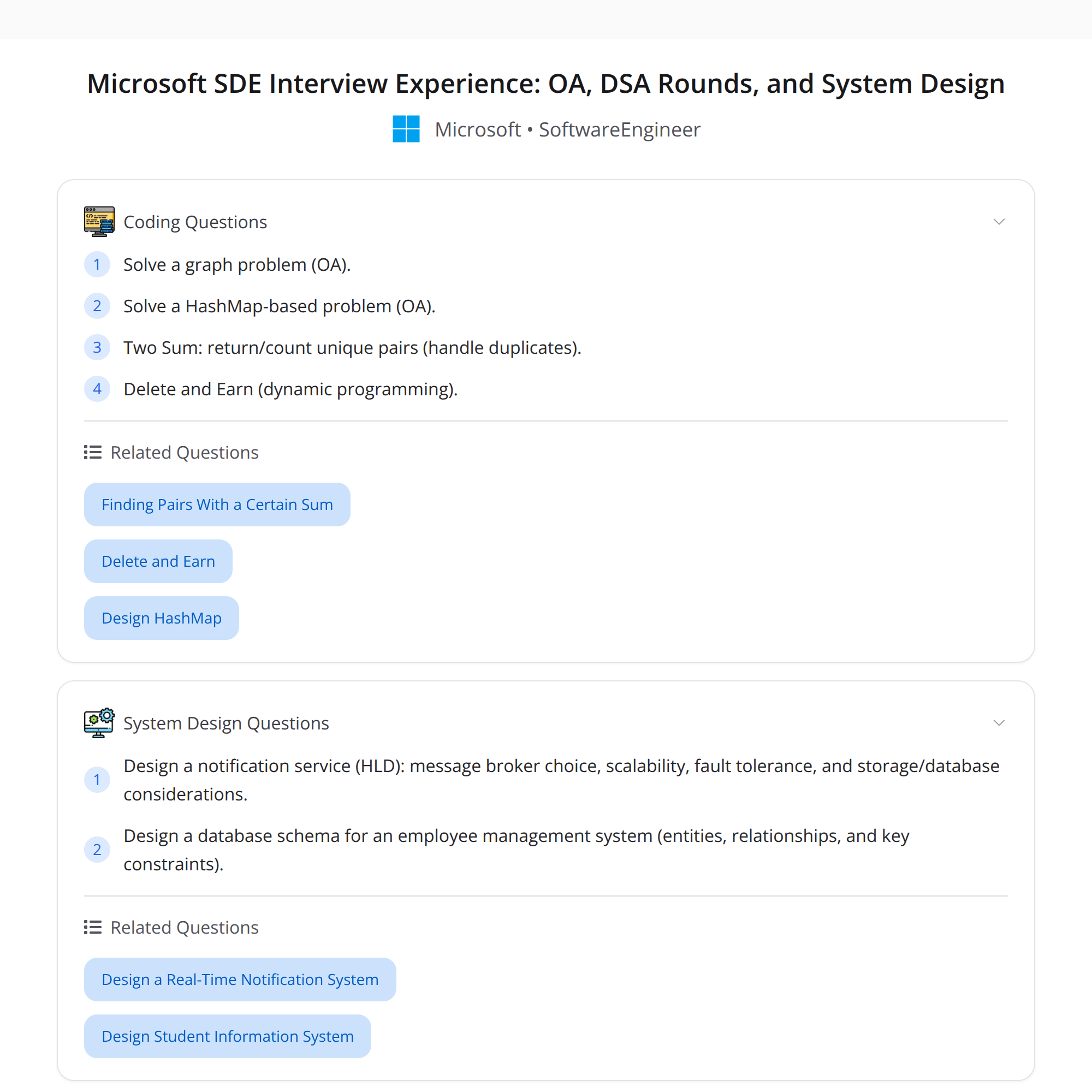
- Topics: Graph problem and a HashMap problem.
- Tip: For OA, focus on correctness first, then optimize. Practice common graph patterns (BFS/DFS, shortest-path, connected components) and hashing-based counting/lookups.
2) DSA (Coding) Round
Problems asked:
- Two Sum variant: count unique pairs — must handle duplicates correctly.
- Approach: Sort + two pointers or use a hashmap with careful duplicate handling (e.g., store seen numbers and ensure pairs counted once).
- Delete and Earn (Leetcode-style): DP problem reducible to House Robber pattern.
- Approach: Aggregate points per value into an array keyed by number, then run the House Robber DP that decides to take or skip each value.
Tips for DSA:
- Read constraints first (n, value ranges) to decide between sorting, hashing, or DP.
- For duplicate-sensitive pair problems, explicitly reason about how you deduplicate (set/hash) or sweep in sorted order.
- For DP problems, write the recurrence and base cases before coding. If you map the problem to a known pattern (like House Robber), mention that aloud.
3) HLD + LLD (High-level + Low-level Design)
Two components covered:
- Notification Service
- Discussed requirements: brokers, scaling, fault tolerance, storage and delivery guarantees.
Key design decisions to cover:
- Architecture: producer → broker(s) → consumer(s)
- Broker choices and tradeoffs (e.g., Kafka vs RabbitMQ): throughput vs ordering vs persistence
- Partitioning and consumer groups for scale
- Persistence/retention strategy and when to use durable storage vs ephemeral
- Failure modes and recovery (replication, leader election, retries, dead-letter queues)
- Delivery semantics: at-most-once, at-least-once, exactly-once (and when each is appropriate)
Employee Management DB Schema (LLD / schema modeling)
- Entities and relations to think about: Employee, Department, Role, Manager (self-relation), Employment history, Access control/permissions.
- Normalization vs denormalization tradeoffs depending on read/write patterns.
- Indexing strategies for common queries (by employee_id, department_id, manager_id).
Tips for HLD/LLD:
- LLD is not only design patterns — you must model the schema, entities and relationships when asked.
- Talk through scale assumptions (QPS, data volume, retention) — they guide storage and partitioning choices.
- Draw clear component boundaries and mention operational concerns (monitoring, alerts, backups).
Key learnings & interview advice
- Don’t skip Dynamic Programming: it's commonly evaluated; know base patterns (0/1 knapsack, house robber, LIS, etc.).
- LLD includes schema modeling: be ready to define entities, relations and indexes — not just class diagrams or patterns.
- Vocalize your thoughts: explain tradeoffs, assumptions and next steps. Interviewers want to hear your reasoning — don’t self-reject early.
- Clarify requirements and constraints before diving into design or code.
Quick prep checklist
- Practice 100–200 problems covering hashing, two pointers, graph traversal, and DP patterns.
- Revisit design patterns for distributed systems (pub/sub, load balancing, sharding, replication).
- Practice schema design: model common business problems and justify indices and normalization.
- Mock interviews: focus on communicating assumptions and walking through solutions step-by-step.
If you’re prepping for Microsoft SDE or similar interviews, concentrate on these core areas and practice explaining your choices clearly. Good luck!
#SoftwareEngineering #SystemDesign #DataStructures
About the author
bugfree.ai is an advanced AI-powered platform designed to help software engineers master system design and behavioral interviews. Whether you’re preparing for your first interview or aiming to elevate your skills, bugfree.ai provides a robust toolkit tailored to your needs. Key Features:
150+ system design questions: Master challenges across all difficulty levels and problem types, including 30+ object-oriented design and 20+ machine learning design problems. Targeted practice: Sharpen your skills with focused exercises tailored to real-world interview scenarios. In-depth feedback: Get instant, detailed evaluations to refine your approach and level up your solutions. Expert guidance: Dive deep into walkthroughs of all system design solutions like design Twitter, TinyURL, and task schedulers. Learning materials: Access comprehensive guides, cheat sheets, and tutorials to deepen your understanding of system design concepts, from beginner to advanced. AI-powered mock interview: Practice in a realistic interview setting with AI-driven feedback to identify your strengths and areas for improvement.
bugfree.ai goes beyond traditional interview prep tools by combining a vast question library, detailed feedback, and interactive AI simulations. It’s the perfect platform to build confidence, hone your skills, and stand out in today’s competitive job market. Suitable for:
New graduates looking to crack their first system design interview. Experienced engineers seeking advanced practice and fine-tuning of skills. Career changers transitioning into technical roles with a need for structured learning and preparation.
Comments
Join the discussionNo comments yet. Be the first to comment.