LSP Isn’t Theory—It’s How You Stop Inheritance Bugs in Interviews
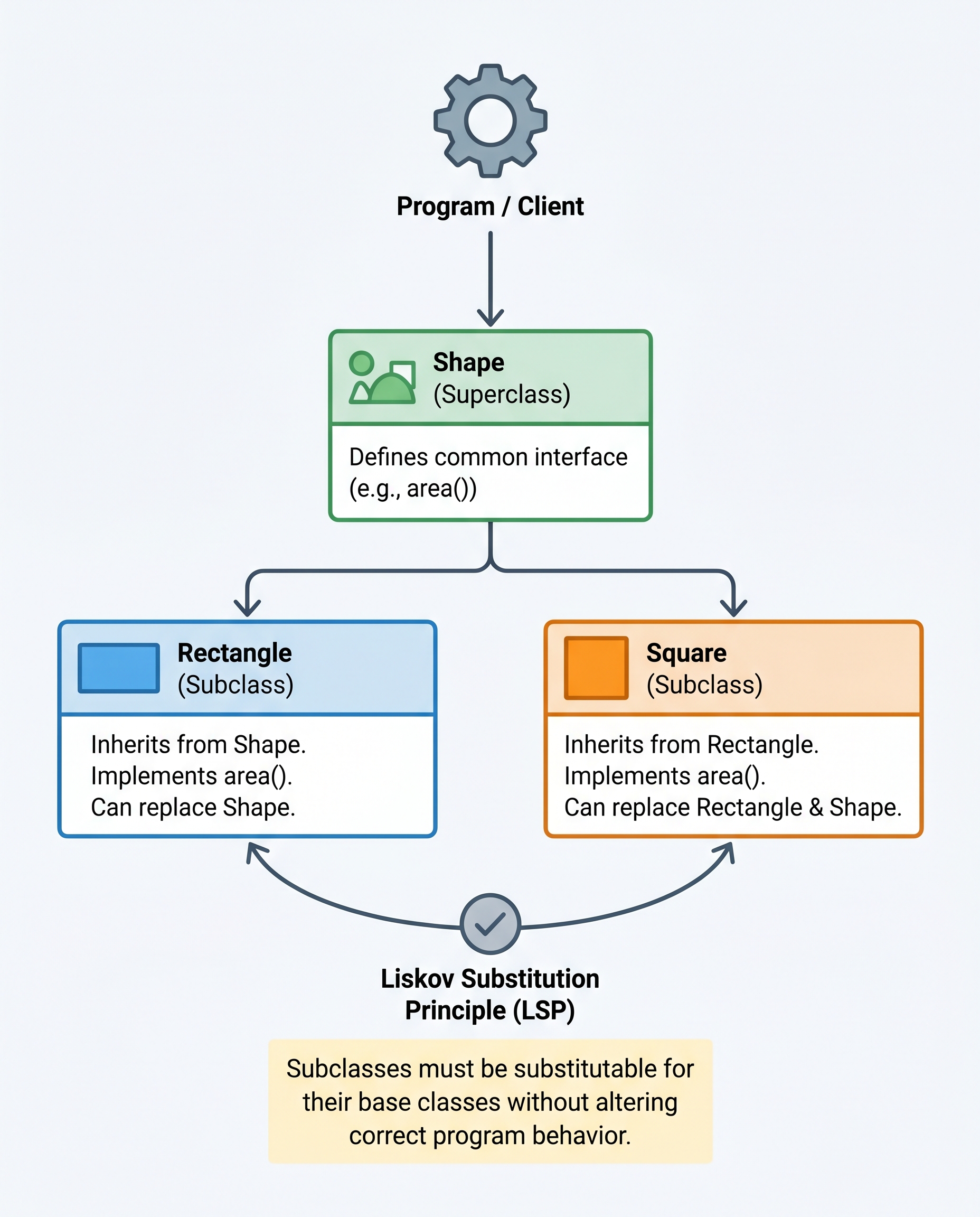
The Liskov Substitution Principle (LSP) is simple and practical: if type S extends type T, you must be able to use S anywhere T is expected without breaking correctness. In other words, a subtype must preserve the behavior (contract) of its parent.
This isn't academic nitpicking—it's the rule that prevents a common and deceptively sneaky bug in interviews and code reviews: the Square–Rectangle problem.
The classic trap: Square inheriting Rectangle
At first glance, it makes sense: a square is a rectangle with equal sides, so why not subclass Rectangle? The problem shows up when Rectangle exposes mutating operations like setWidth and setHeight. A Rectangle lets you change one side independently; a Square doesn't. If your Square subclass overrides these methods to keep sides equal, substituting a Square where a Rectangle is expected can break client code that relies on independent width/height changes.
Example (pseudo-code):
class Rectangle {
  int width, height;
  void setWidth(int w) { width = w; }
  void setHeight(int h) { height = h; }
}

class Square extends Rectangle {
  void setWidth(int w) {
    width = w; height = w; // breaks Rectangle's contract
  }
  void setHeight(int h) {
    width = h; height = h;
  }
}

// Client code expecting Rectangle:
Rectangle r = new Square();
r.setWidth(5);
r.setHeight(10);
// Client expected width=5, height=10, but Square forces width=height
The client’s expectations (the parent contract) are violated by the subclass behavior. That’s an LSP violation.
Interview rule of thumb
When asked about inheritance or asked to design types in an interview, treat LSP as a go/no-go check:
- Ask: what invariants and behaviors does the parent type guarantee? (mutability, side effects, method semantics)
- If a candidate subtype cannot uphold those guarantees, it must not inherit.
- If inheritance would require overriding to change or restrict behaviors in ways that break clients, prefer composition or redesign.
Practical alternatives
- Use composition: a Square can hold a Rectangle (or a Dimensions object) and expose a clearer API.
- Make the parent immutable or provide a different abstraction (e.g., Shape with area/perimeter, or Separate Width/Height types).
- Introduce separate hierarchies: MutableRectangle vs ImmutableRectangle, or Rectangle and Square as different branches that don't extend one another.
Quick checklist for interviews (and code reviews)
- Does the subclass honor all public method contracts of the parent?
- Will client code relying on the parent’s behavior still work with the subclass?
- Are there methods in the parent that the subclass cannot implement without changing semantics?
- If the answer is no, prefer composition or redesign the abstraction.
Bottom line
LSP is not an abstract rule you can ignore in interviews—it's the practical guardrail that keeps inheritance from introducing subtle, correctness-breaking bugs. When a subclass cannot preserve the parent's contract, don’t force inheritance: redesign or compose instead.
#SOLID #SoftwareEngineering #SystemDesign
About the author
bugfree.ai is an advanced AI-powered platform designed to help software engineers master system design and behavioral interviews. Whether you’re preparing for your first interview or aiming to elevate your skills, bugfree.ai provides a robust toolkit tailored to your needs. Key Features:
150+ system design questions: Master challenges across all difficulty levels and problem types, including 30+ object-oriented design and 20+ machine learning design problems. Targeted practice: Sharpen your skills with focused exercises tailored to real-world interview scenarios. In-depth feedback: Get instant, detailed evaluations to refine your approach and level up your solutions. Expert guidance: Dive deep into walkthroughs of all system design solutions like design Twitter, TinyURL, and task schedulers. Learning materials: Access comprehensive guides, cheat sheets, and tutorials to deepen your understanding of system design concepts, from beginner to advanced. AI-powered mock interview: Practice in a realistic interview setting with AI-driven feedback to identify your strengths and areas for improvement.
bugfree.ai goes beyond traditional interview prep tools by combining a vast question library, detailed feedback, and interactive AI simulations. It’s the perfect platform to build confidence, hone your skills, and stand out in today’s competitive job market. Suitable for:
New graduates looking to crack their first system design interview. Experienced engineers seeking advanced practice and fine-tuning of skills. Career changers transitioning into technical roles with a need for structured learning and preparation.
Comments
Join the discussionNo comments yet. Be the first to comment.