Unlocking Real-Time Insights: The Power of Incremental Aggregation
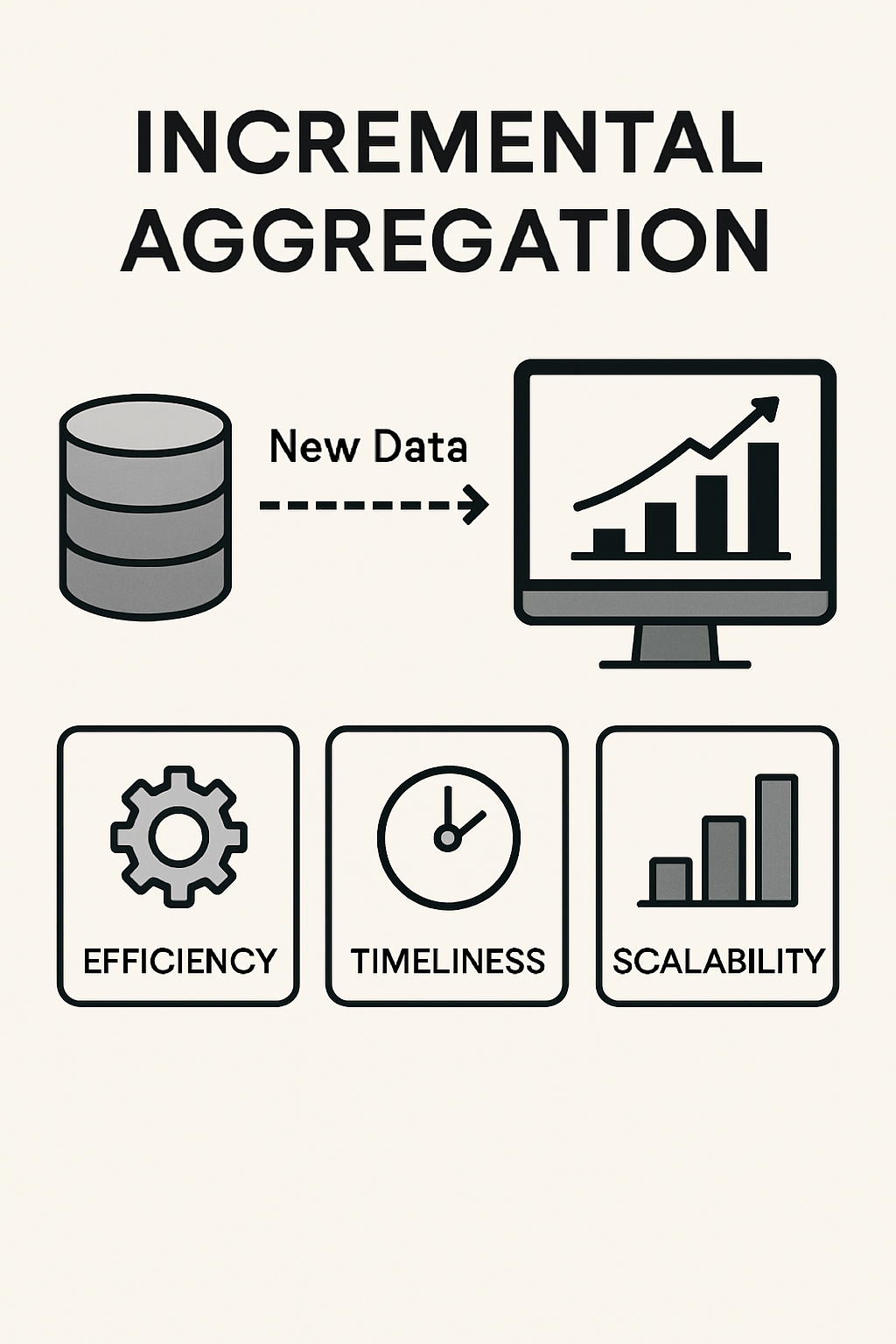
Incremental aggregation is a design pattern for producing up-to-date analytics without recomputing everything from scratch. Rather than reprocessing full datasets every time new events arrive, incremental aggregation updates previously computed results using only the incoming changes. This approach drastically reduces compute, storage, and latency—making it ideal for dashboards, alerts, and business intelligence that demand near real-time answers.
Why it matters
- Lower latency: Aggregates are updated immediately as new data arrives, enabling interactive dashboards and fast alerting.
- Efficient resource use: Avoid expensive full-table scans or full re-aggregation over large historical datasets.
- Scalability: Systems can handle higher event rates by maintaining incremental state instead of recalculating global aggregates.
- Practical for interviews and system design: Demonstrates knowledge of stateful streaming, correctness, and trade-offs.
Common techniques
Change Data Capture (CDC)
- Capture row-level changes from OLTP or databases and stream them to consumers.
- Useful for synchronizing materialized aggregates or feeding stream processors.
Windowed aggregation
- Tumbling windows: non-overlapping, fixed-size buckets.
- Sliding windows: overlapping windows for continuous trends.
- Session windows: group events by activity gaps.
- Handle late or out-of-order events with watermarks and allowed lateness.
Materialized views
- Precompute and store aggregated results in a table or cache.
- Update incrementally when source data changes (via CDC, triggers, or stream processors).
Stream processing engines
- Stateful processors like Apache Flink, Kafka Streams, or Spark Structured Streaming provide facilities for keyed state, timers, exactly-once semantics, and windowing.
Typical architecture patterns
- CDC -> Stream Processor -> Materialized View -> Serving Layer
- Real-time stream (Kafka) with stateful operators maintained per key
- Hybrid (Lambda/Kappa) where batch recomputation complements streaming aggregates for corrections
Implementation sketch (simple example)
Maintain a running sum and count to compute average per key:
state[key] = {sum: 0, count: 0}

onEvent(key, value):
    state[key].sum += value
    state[key].count += 1
    emit(key, state[key].sum / state[key].count)

onRetract(key, value):  # for CDC deletions or corrections
    state[key].sum -= value
    state[key].count -= 1
    emit(key, state[key].count ? state[key].sum / state[key].count : null)
Key engineering details: checkpoint and persist state, make updates idempotent or support exactly-once delivery, and handle out-of-order or late events.
Challenges and trade-offs
- Correctness vs. performance: Choosing between eventual, at-least-once, or exactly-once semantics affects complexity and cost.
- State size: Large distinct keys require careful partitioning, TTLs, or state compression.
- Late/out-of-order events: Use watermarks, buffering windows, or correction passes.
- Complexity of updates: Some aggregates (e.g., approximate distinct counts) require specific algorithms (HyperLogLog, sketches) to update efficiently.
Practical use cases
- Real-time business dashboards (revenue, active users, conversion rates)
- Monitoring and anomaly detection (error rates, latency percentiles)
- Streaming ETL and materialized views for BI tools
- Cost- and capacity-sensitive analytics where reprocessing full history is impractical
Interview tips (system design & data engineering)
- Start with requirements: latency, throughput, accuracy, retention, and allowed staleness.
- Choose aggregation primitives and window semantics explicitly.
- Discuss state management: storage, checkpointing, recovery, and partitioning strategy.
- Address correctness: exactly-once vs. at-least-once, handling duplicates, and retractions.
- Consider operational concerns: scaling, observability, backpressure, and disaster recovery.
Conclusion
Incremental aggregation is a cornerstone of modern real-time analytics. By updating only what changed, systems achieve low latency and high efficiency—enabling timely business insights and scalable architectures. Mastering the techniques and trade-offs around incremental aggregation is valuable both for building production systems and for demonstrating sound system design knowledge in interviews.
Tags: #SystemDesign #DataEngineering #Analytics #RealTimeData
About the author
bugfree.ai is an advanced AI-powered platform designed to help software engineers master system design and behavioral interviews. Whether you’re preparing for your first interview or aiming to elevate your skills, bugfree.ai provides a robust toolkit tailored to your needs. Key Features:
150+ system design questions: Master challenges across all difficulty levels and problem types, including 30+ object-oriented design and 20+ machine learning design problems. Targeted practice: Sharpen your skills with focused exercises tailored to real-world interview scenarios. In-depth feedback: Get instant, detailed evaluations to refine your approach and level up your solutions. Expert guidance: Dive deep into walkthroughs of all system design solutions like design Twitter, TinyURL, and task schedulers. Learning materials: Access comprehensive guides, cheat sheets, and tutorials to deepen your understanding of system design concepts, from beginner to advanced. AI-powered mock interview: Practice in a realistic interview setting with AI-driven feedback to identify your strengths and areas for improvement.
bugfree.ai goes beyond traditional interview prep tools by combining a vast question library, detailed feedback, and interactive AI simulations. It’s the perfect platform to build confidence, hone your skills, and stand out in today’s competitive job market. Suitable for:
New graduates looking to crack their first system design interview. Experienced engineers seeking advanced practice and fine-tuning of skills. Career changers transitioning into technical roles with a need for structured learning and preparation.
Comments
Join the discussionNo comments yet. Be the first to comment.