Overview
A Bugfree user shared a high-score interview experience for Expedia SDE-2 (Bengaluru). Candidate profile: ~3 years of experience, interviewed via referral. The on-site/process had four rounds in total (note: no HLD round for SDE-2). The final two rounds were scheduled only after clearing the first two.
Quick summary of rounds:
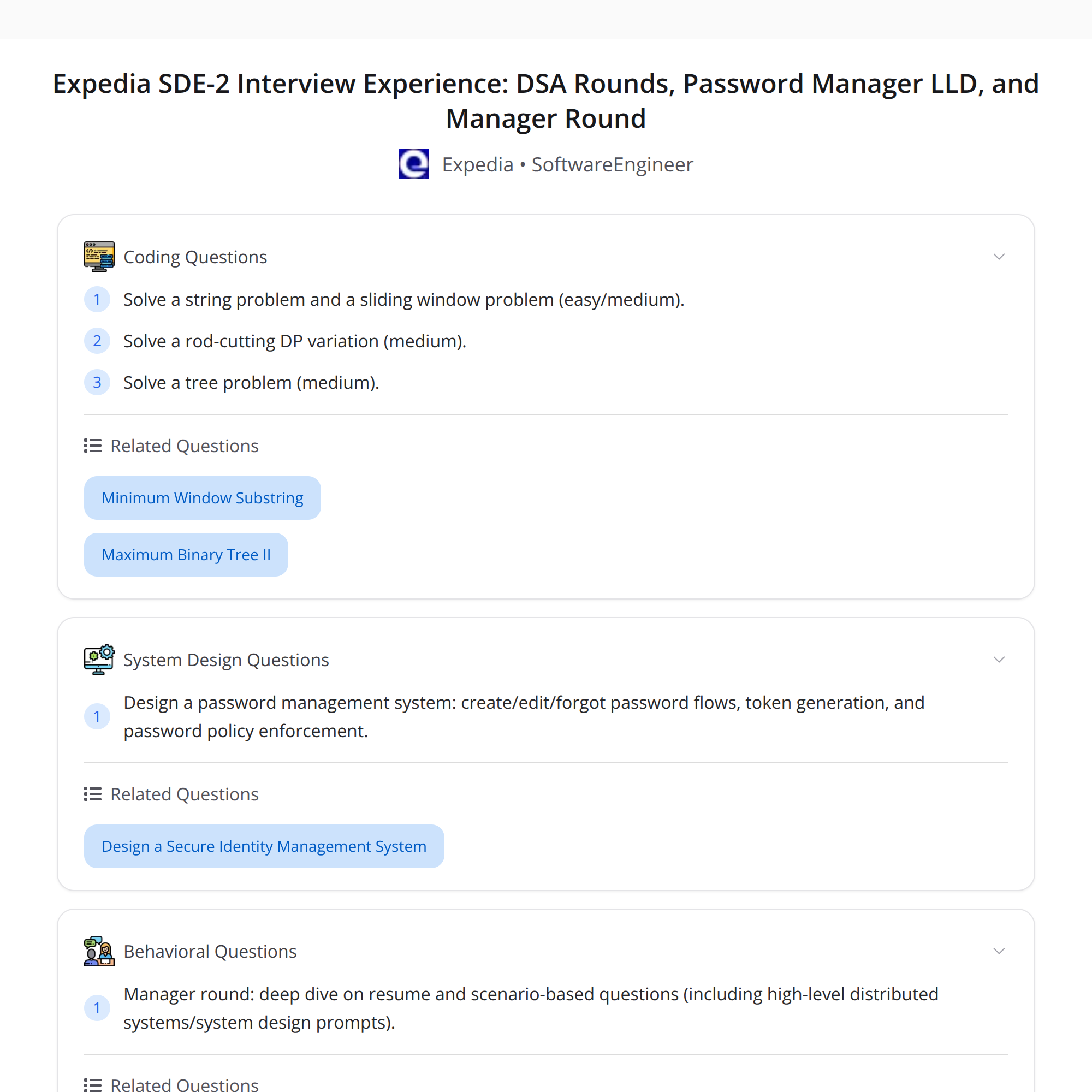
- R1 (DSA): 2 problems — a string problem and a sliding-window problem.
- R2 (DSA): A rod-cutting DP variant and a tree problem; got positive feedback.
- R3 (LLD): Design a password manager (create/edit/forgot flows), token generation, password policies. Used SOLID principles and patterns (Singleton / Strategy / Observer), but feedback was weak.
- R4 (Manager): Deep resume dive plus scenario questions on distributed systems.
Outcome: Rejected. The stated reason: weaker LLD feedback. Key lesson: strong DSA is necessary but not sufficient — end-to-end clarity in low-level design matters.
What happened in each round (details & takeaways)
Round 1 — DSA
- Problems: one string problem and one sliding-window problem.
- Takeaway: Classic pattern recognition (sliding window) and careful implementation win here. Focus on clean code and test edge cases.
Round 2 — DSA
- Problems: rod-cutting dynamic programming variant and a tree problem.
- Outcome: Received positive feedback. DP and tree fundamentals were handled well.
- Takeaway: Practice variants of standard DP problems and common tree traversals/transformations.
Round 3 — Low-Level Design (LLD)
- Prompt: Design a password manager supporting create, edit, forgot-password flows; design token generation and password policy enforcement.
- Approach used: Applied SOLID principles and patterns (Singleton, Strategy for policies, Observer for notifications). However, feedback suggested the design lacked clarity or end-to-end completeness.
- Likely gaps: API contracts, data models, token lifecycle/expiry, encryption/storage details, failure modes, scaling considerations, and clear flow diagrams.
- Takeaway: In LLD you must be explicit and cover the whole flow — request/response shapes, database schema, sample APIs, edge cases, and how components interact in failure scenarios.
Round 4 — Manager Round
- Focus: Deep resume walkthrough and scenario-based questions (distributed systems, tradeoffs, operational concerns).
- Takeaway: Be ready to justify design decisions, discuss tradeoffs, and show ownership and impact from your prior work.
Why the rejection (and what to improve)
The candidate performed well on algorithmic rounds but the LLD round lacked the end-to-end clarity interviewers expect. For SDE-2, interviewers want to see:
- Clear API design and contracts (request/response examples)
- Concrete data model and schema decisions (tables/fields, indexes)
- Security considerations (encryption at rest/in transit, token structure)
- Token lifecycle: generation, storage, validation, expiry, revocation
- Error handling and edge cases (concurrent edits, rate limits)
- Component interactions and sequence flows (how requests move across services)
- Reasoned tradeoffs and complexity estimates
In short: DSA correctness helps you get to later rounds, but LLD communication and completeness often decide the outcome.
Actionable prep checklist
DSA
- Practice sliding window, DP variants, and tree problems.
- Write correct, testable code; narrate complexity and edge cases.
LLD
- Practice end-to-end designs for small services: auth, payments, notifications, password management.
- Always draw a sequence diagram or step-by-step flow.
- Define APIs (example request/response), DB schema, and important indexes.
- Explain security: hashing, salting, encryption, token format (JWT vs opaque), refresh/revocation.
- Discuss failure modes, scaling (caching, sharding), and monitoring/alerts.
- Use SOLID and design patterns where they add clarity, but avoid overusing patterns for their own sake.
Manager/Behavioral
- Prepare a concise resume walkthrough: technical decisions, tradeoffs, measurable outcomes.
- Expect scenario questions on system reliability, scaling, and team processes.
Example checklist for the Password Manager LLD
- Scope: create/edit/forgot-password flows, token generation & validation, password policy enforcement.
- APIs: POST /users, PUT /users/{id}/password, POST /auth/forgot, POST /auth/reset
- Data model: Users table (id, email, password_hash, salt, reset_token, reset_expiry, created_at)
- Security: bcrypt/argon2 for hashing, TLS in transit, encrypt sensitive fields at rest.
- Token: use opaque reset tokens stored server-side (or signed JWT with short expiry + revocation list).
- Flow: diagram the forgot -> send token -> validate token -> reset password -> invalidate token.
- Edge cases: multiple reset requests, token reuse, expired tokens, brute-force protection, rate limiting.
- Observability: logs (no plaintext secrets), metrics on reset attempts, alerts on spikes.
Final takeaway
Cracking DSA problems is essential to move forward, but for SDE-2 roles you must pair algorithmic strength with crisp, end-to-end low-level design communication. Practice small-service LLDs with concrete APIs, data models, token flows, and failure scenarios — and narrate them clearly during the interview.
Good luck — focus on clarity and completeness for LLD, and the rest will fall into place.
#SoftwareEngineering #InterviewPrep #SystemDesign
About the author
bugfree.ai is an advanced AI-powered platform designed to help software engineers master system design and behavioral interviews. Whether you’re preparing for your first interview or aiming to elevate your skills, bugfree.ai provides a robust toolkit tailored to your needs. Key Features:
150+ system design questions: Master challenges across all difficulty levels and problem types, including 30+ object-oriented design and 20+ machine learning design problems. Targeted practice: Sharpen your skills with focused exercises tailored to real-world interview scenarios. In-depth feedback: Get instant, detailed evaluations to refine your approach and level up your solutions. Expert guidance: Dive deep into walkthroughs of all system design solutions like design Twitter, TinyURL, and task schedulers. Learning materials: Access comprehensive guides, cheat sheets, and tutorials to deepen your understanding of system design concepts, from beginner to advanced. AI-powered mock interview: Practice in a realistic interview setting with AI-driven feedback to identify your strengths and areas for improvement.
bugfree.ai goes beyond traditional interview prep tools by combining a vast question library, detailed feedback, and interactive AI simulations. It’s the perfect platform to build confidence, hone your skills, and stand out in today’s competitive job market. Suitable for:
New graduates looking to crack their first system design interview. Experienced engineers seeking advanced practice and fine-tuning of skills. Career changers transitioning into technical roles with a need for structured learning and preparation.
Comments
Join the discussionNo comments yet. Be the first to comment.