Master Data Validation & Monitoring — Practical Guide for Interviews
Data validation and monitoring are fundamentals for building reliable data pipelines and a frequent focus in data engineering interviews. Knowing the concepts, tools, and how to articulate trade-offs will help you stand out. This guide summarizes key ideas, practical checks, tools, and sample talking points you can use in interviews.
Why it matters
- Prevent bad downstream decisions: flawed data can break analytics, ML models, and business reporting.
- Reduce incident cost: early detection lowers time-to-repair and operational overhead.
- Enable trust: SLAs, data contracts, and observability create confidence in datasets.
Types of validation (what to implement)
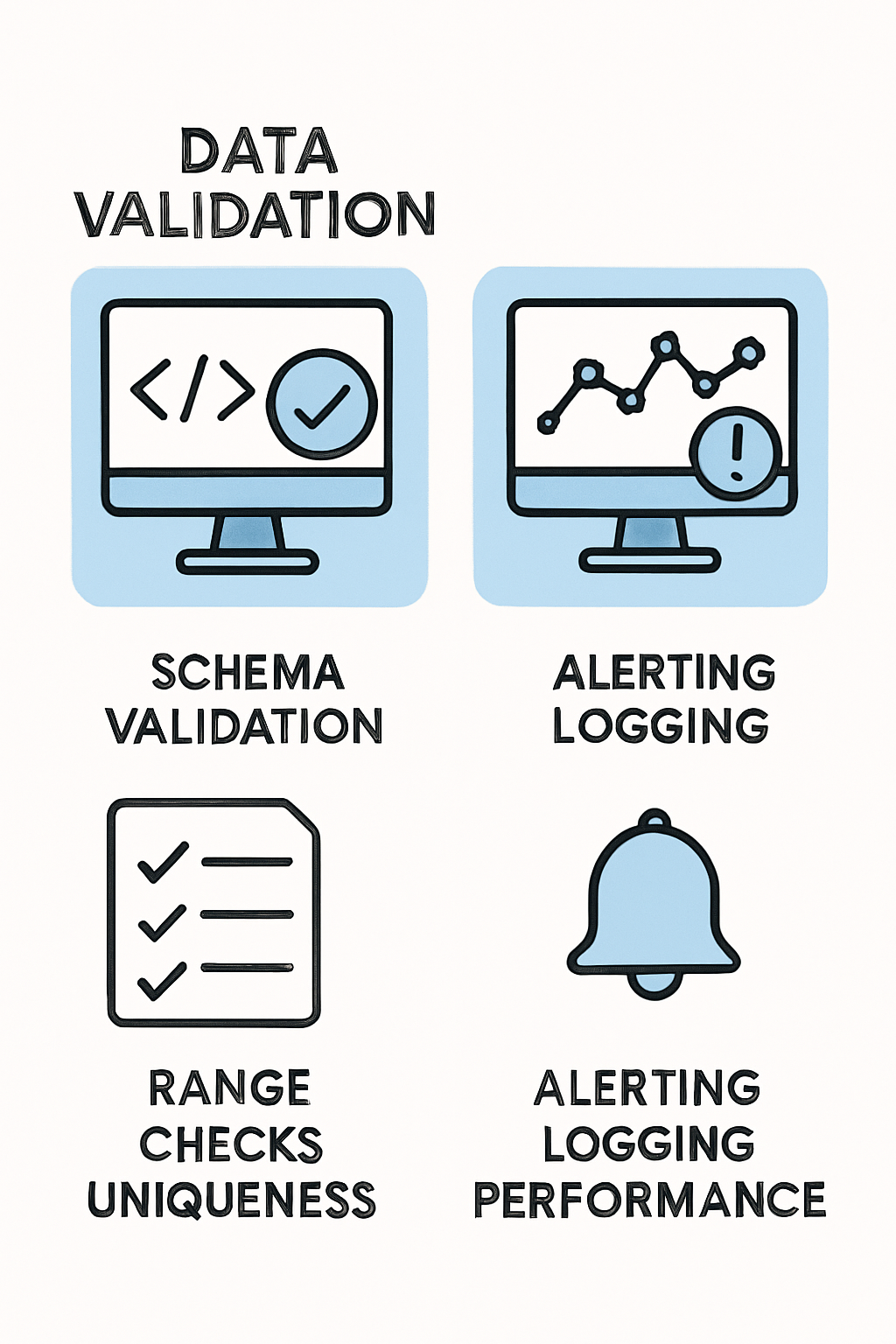
- Schema & type checks: enforce expected columns, types, and nullability.
- Completeness checks: compare row counts to expected volumes or previous runs.
- Range and constraint checks: numeric ranges, allowed enums, dates within windows.
- Uniqueness & deduplication: primary key and unique constraint validation.
- Referential integrity: foreign key existence between related tables.
- Statistical checks & anomaly detection: distribution drift, mean/median shifts, cardinality changes.
- Sampling & canary validation: validate a sample of records or a small canary dataset before full roll-out.
Monitoring & observability (how to watch pipelines)
- Metrics to track: run success/failure, latency, data freshness, row counts, error rates, drift metrics.
- Alerts & SLAs/SLOs: set actionable alerts (e.g., data freshness > threshold) and define SLOs for dataset availability.
- Logging & traces: capture detailed logs and distributed traces for job failures and bottlenecks.
- Dashboards: surface pipeline health, lineage, and business KPIs for stakeholders.
- Incident workflow: automated alerting, runbooks, and postmortems to learn from failures.
Tools & ecosystem (common picks to mention)
- Orchestration: Apache Airflow, Dagster
- Validation & testing: Great Expectations, Soda, dbt tests
- Monitoring & metrics: Prometheus + Grafana, Datadog
- Logging & search: ELK Stack (Elasticsearch, Logstash, Kibana)
- Observability & data quality platforms: Monte Carlo, Bigeye
- Lineage & metadata: OpenLineage, Amundsen, DataHub
When discussing tools in interviews, explain why you'd choose one: e.g., "Great Expectations for schema/expectations + Airflow for orchestration + Prometheus/Grafana for operational metrics." Mention trade-offs like cost, integration, and ease of ownership.
Automate and document (how to show maturity)
- Automate checks in CI/CD: include dataset/unit tests in pull requests and pipeline CI.
- Define clear metrics and ownership: data owners, SLOs, SLA documents, and runbooks.
- Document expected behaviors: playbooks for common failures and escalation paths.
- Keep golden/seed datasets: deterministic fixtures for regression tests.
Interview-ready talking points & sample answers
- Short summary: "I validate data via schema and statistical checks, monitor pipeline health with metrics and alerts, and automate tests in CI to prevent regressions."
- Example incident: "We saw a schema drift that broke downstream reports. I added schema checks and a canary run with instant alerts, reducing time-to-detect from hours to minutes." (Include metrics: before vs after.)
- Trade-offs: "Real-time validation increases latency and cost; for high-throughput streams I use lightweight checks and async deep-validation."
Quick checklist to memorize
- Implement schema checks and nullability rules
- Add row-count/freshness alerts and SLOs
- Track distributional metrics to detect drift
- Automate tests in CI and have a canary path
- Maintain runbooks, ownership, and dashboards
Final tips
- Be concrete: give examples with numbers (row counts, percent change) and name specific tools.
- Show trade-offs: cost, latency, false positives vs. false negatives.
- Demonstrate process: monitoring + alerting + postmortem closes the loop.
Use this as a concise framework to answer interview questions about data quality and observability. Walk through an example system architecture or past incident to make your knowledge tangible.
About the author
bugfree.ai is an advanced AI-powered platform designed to help software engineers master system design and behavioral interviews. Whether you’re preparing for your first interview or aiming to elevate your skills, bugfree.ai provides a robust toolkit tailored to your needs. Key Features:
150+ system design questions: Master challenges across all difficulty levels and problem types, including 30+ object-oriented design and 20+ machine learning design problems. Targeted practice: Sharpen your skills with focused exercises tailored to real-world interview scenarios. In-depth feedback: Get instant, detailed evaluations to refine your approach and level up your solutions. Expert guidance: Dive deep into walkthroughs of all system design solutions like design Twitter, TinyURL, and task schedulers. Learning materials: Access comprehensive guides, cheat sheets, and tutorials to deepen your understanding of system design concepts, from beginner to advanced. AI-powered mock interview: Practice in a realistic interview setting with AI-driven feedback to identify your strengths and areas for improvement.
bugfree.ai goes beyond traditional interview prep tools by combining a vast question library, detailed feedback, and interactive AI simulations. It’s the perfect platform to build confidence, hone your skills, and stand out in today’s competitive job market. Suitable for:
New graduates looking to crack their first system design interview. Experienced engineers seeking advanced practice and fine-tuning of skills. Career changers transitioning into technical roles with a need for structured learning and preparation.
Comments
Join the discussionNo comments yet. Be the first to comment.