
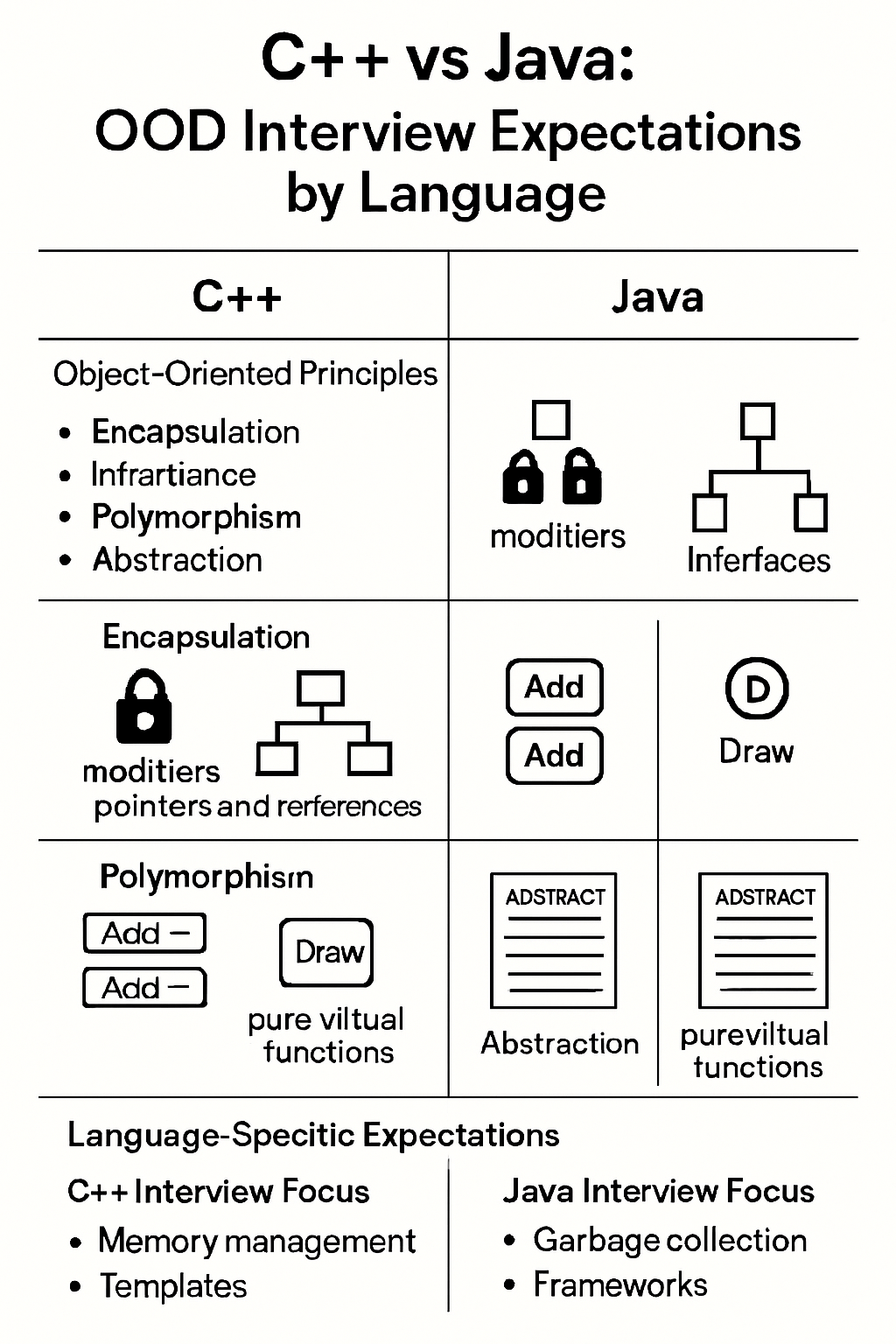
C++ vs Java: Mastering OOD Interview Expectations
Preparing for object-oriented design (OOD) interviews? Both C++ and Java implement the core OOP principles — encapsulation, inheritance, polymorphism, and abstraction — but they expose different tools and trade-offs. Knowing where they diverge helps you focus your preparation and demonstrate language-specific fluency in interviews.
OOD fundamentals (common ground)
- Encapsulation, inheritance, polymorphism, and abstraction are central in both languages.
- Interviewers expect clear design thinking: responsibilities, interfaces, separation of concerns, and trade-offs.
- Be ready to draw UML-like diagrams, describe class responsibilities, and justify design choices.
Key language differences that matter for interviews
Encapsulation
- Java enforces stricter encapsulation (private fields + getters/setters, package visibility) and makes it idiomatic to expose behavior via interfaces.
- C++ provides fine-grained control (public/protected/private, friend, and free functions) and lets you optimize layout and access for performance.
Multiple inheritance
- C++: direct multiple inheritance of classes is allowed (careful with the diamond problem, virtual inheritance).
- Java: uses interfaces (multiple inheritance of behavior via default methods in modern Java) — simpler semantics.
Memory management
- C++: manual/RAII-based management. Interviewers often ask about ownership, lifetime, smart pointers (unique_ptr, shared_ptr), stack vs heap, and undefined behavior.
- Java: garbage-collected. Expect questions about garbage collection, memory leaks caused by lingering references, and JVM memory tuning (heap, metaspace).
Templates vs Generics
- C++ templates are compile-time, Turing-complete, and can generate specialized code (no type erasure).
- Java generics use type erasure and operate at the JVM level; they provide runtime type safety differently than C++ templates.
Pointers and references
- C++ gives raw pointers, references, and pointer arithmetic — interviews may probe dangling pointers, aliasing, and pointer semantics.
- Java exposes references only (no pointer arithmetic), so questions focus on object references, null handling, and reference types (weak/soft references).
Runtime and libraries
- C++: performance and deterministic destruction (destructors). Expect STL (containers, iterators), move semantics, and modern C++ idioms.
- Java: JVM behaviors, JIT, standard libraries (Collections, concurrency utilities), and common frameworks (Spring) may come up in application-design contexts.
What interviewers typically focus on (by language)
C++-focused OOD interviews
- Memory ownership and lifetime: new/delete, RAII, smart pointers
- Undefined behavior, pointer/null safety, const-correctness
- Templates and generic programming (SFINAE, type traits in advanced rounds)
- Move semantics, copy/move constructors, and efficient resource handling
- STL design choices and complexity trade-offs
- Low-level performance and data layout considerations
Java-focused OOD interviews
- Garbage collection, memory leaks via references, and JVM tuning basics
- Interfaces, default methods, and idiomatic use of the Collections framework
- Generics and type erasure nuances
- Concurrency primitives (synchronized, java.util.concurrent) and the Java Memory Model
- Framework-aware design (how OOD principles apply in Spring/Enterprise contexts)
Small illustrative examples
C++ multiple inheritance example:
struct Logger { virtual void log(const std::string&); };
struct Persistable { virtual void save(); };
struct Widget : public Logger, public Persistable { /* implement both */ };
Java interface approach:
interface Logger { void log(String msg); }
interface Persistable { void save(); }
class Widget implements Logger, Persistable { /* implement both */ }
Both achieve similar design goals; C++ offers direct multiple inheritance of implementation, while Java uses interfaces for clearer, safer composition.
Prep checklist & practical tips
- Master OOD fundamentals: SOLID, design patterns (Factory, Strategy, Decorator, Adapter), and how they map to your language.
- Practice whiteboard-style designs and narrate trade-offs: why choose composition over inheritance, memory vs clarity, etc.
- Know idiomatic constructs: smart pointers, move semantics, and templates for C++; interfaces, streams, and concurrency utilities for Java.
- Bring examples: show a small, well-thought-out class design in your chosen language and discuss extensibility/testability.
- Practice language-specific pitfalls: memory leaks and undefined behavior in C++; GC pauses, reference leaks, and classloading quirks in Java.
- Review standard libraries: STL (algorithms, containers) vs Java Collections and concurrency helpers.
Final advice
Tailor your prep to the language of the interview: emphasize memory ownership, templates, and low-level performance for C++; focus on garbage collection, the JVM, frameworks, and idiomatic design in Java. Above all, demonstrate clear OOD thinking and justify trade-offs — that’s what interviewers want to see.
Good luck — design clearly, code idiomatically, and explain your choices.
About the author
bugfree.ai is an advanced AI-powered platform designed to help software engineers master system design and behavioral interviews. Whether you’re preparing for your first interview or aiming to elevate your skills, bugfree.ai provides a robust toolkit tailored to your needs. Key Features:
150+ system design questions: Master challenges across all difficulty levels and problem types, including 30+ object-oriented design and 20+ machine learning design problems. Targeted practice: Sharpen your skills with focused exercises tailored to real-world interview scenarios. In-depth feedback: Get instant, detailed evaluations to refine your approach and level up your solutions. Expert guidance: Dive deep into walkthroughs of all system design solutions like design Twitter, TinyURL, and task schedulers. Learning materials: Access comprehensive guides, cheat sheets, and tutorials to deepen your understanding of system design concepts, from beginner to advanced. AI-powered mock interview: Practice in a realistic interview setting with AI-driven feedback to identify your strengths and areas for improvement.
bugfree.ai goes beyond traditional interview prep tools by combining a vast question library, detailed feedback, and interactive AI simulations. It’s the perfect platform to build confidence, hone your skills, and stand out in today’s competitive job market. Suitable for:
New graduates looking to crack their first system design interview. Experienced engineers seeking advanced practice and fine-tuning of skills. Career changers transitioning into technical roles with a need for structured learning and preparation.
Comments
Join the discussionNo comments yet. Be the first to comment.


