{:width="700px"}
Consistency vs Availability — Choose Like an Engineer
In distributed systems interviews you'll often be asked to pick between Consistency and Availability under the constraints of the CAP theorem. Here's a practical, interview-ready approach to make that decision and explain it clearly.
Quick definitions
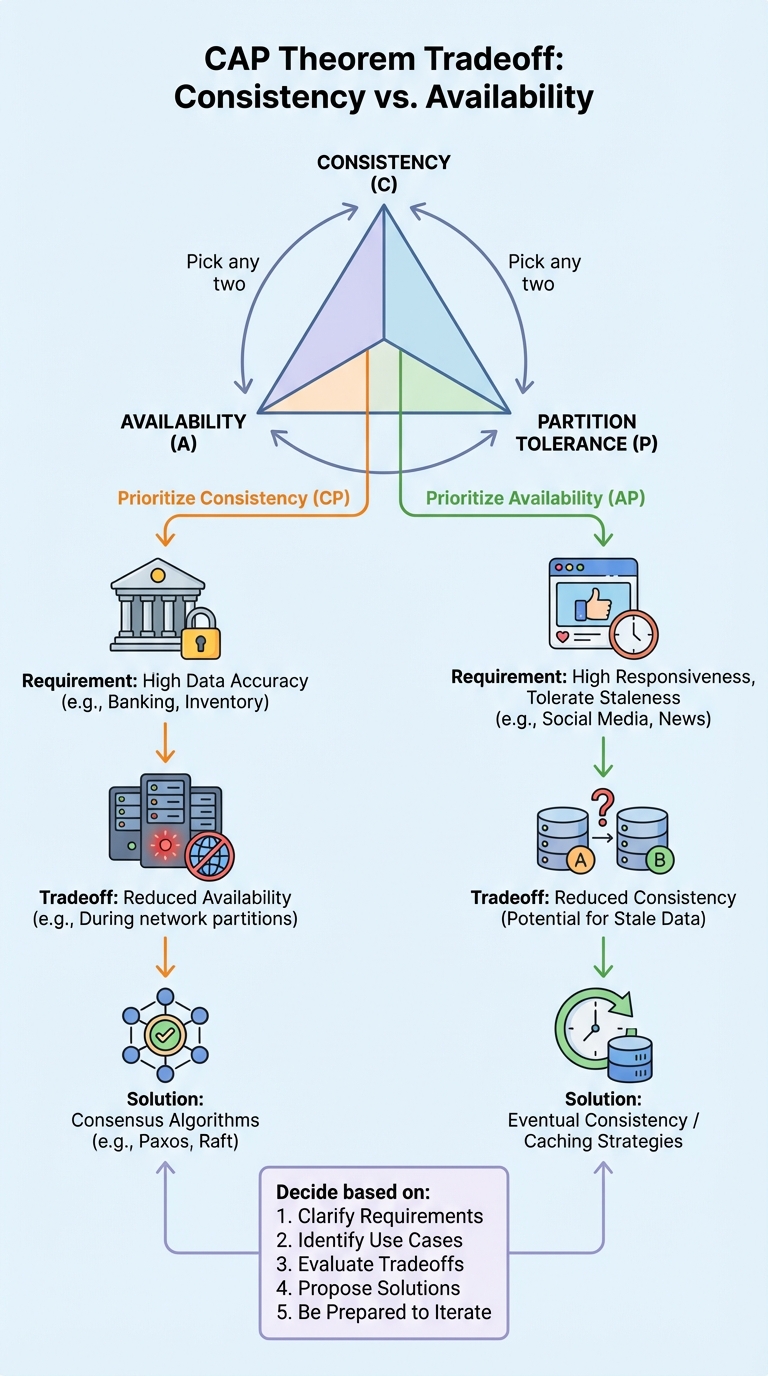
- Consistency (C): Every read returns the most recent write. Strong consistency implies linearizability.
- Availability (A): Every request receives a response (non-error) — even if the returned data is stale.
- Partition Tolerance (P): The system continues to operate despite network partitions. Since partitions happen in real systems, you effectively must trade off C vs A when partitions occur.
How to decide (step-by-step)
Clarify product requirements
- Ask what must be correct on every request and what can tolerate staleness.
- Questions to ask: Is money involved? Can users see temporarily inconsistent views? What are SLAs (latency, uptime)?
Map core use cases to correctness needs
- Strong consistency required: banking transfers, inventory reservation at checkout, billing, authentication state.
- High availability preferred: social feeds, analytics dashboards, recommendation systems, news feeds.
State the cost of choosing each side
- Choosing Consistency (CP): During partitions you may reject or timeout some requests (reduced availability). Users may see errors or delays, but data stays correct.
- Choosing Availability (AP): During partitions you continue to serve requests (high availability) but replicas can diverge and some reads may be stale.
Propose mechanisms and concrete implementation options
- For consistency (CP):
- Use consensus algorithms (Raft, Paxos) or primary/leader sync replication.
- Synchronous replication or quorum reads/writes to ensure latest data.
- Strong guarantees like linearizability where needed.
- For availability (AP):
- Use asynchronous replication, eventual consistency, caching layers.
- Conflict resolution strategies (last-write-wins, application-level merges, CRDTs).
- Read-repair, background reconciliation, and TTL-driven consistency.
- Middle-ground / flexible approaches:
- Tunable consistency (e.g., Cassandra's read/write consistency levels) so you can pick per-operation guarantees.
- Hybrid designs: strong consistency for critical operations, eventual consistency for non-critical reads.
- For consistency (CP):
Be ready to iterate
- Propose monitoring, metrics (latency, error rates, staleness), and rollback/mitigation strategies.
- Discuss how you'd adjust consistency levels or fallback behaviors when you observe real-world failures.
Interview checklist (short script)
- Clarify requirements: "Which operations must be correct immediately? Which can be eventual?"
- Pick default: justify CP or AP with 1–2 crisp examples.
- Explain costs: what fails under partition and how the system responds.
- Give concrete tech choices: Raft/Paxos or async replication + CRDTs/caching.
- Offer hybrid or tunable solutions and how you'd monitor them.
Concrete examples
- Banking transfer: CP. Use leader-based consensus, synchronous commit, and strict ordering to avoid double-spends. Expect some availability loss during partitions.
- Product inventory for checkout: CP for the final reservation step; AP for browsing and catalog reads.
- Social feed: AP. Serve rapidly from caches or replicas; use eventual reconciliation and versioning.
Additional considerations
- Client-side strategies: idempotent operations, retries with backoff, and read-your-writes guarantees where necessary.
- Observability: track staleness windows, divergence rates, and error vs success ratios.
- Business impact: measure user tolerance for stale data vs downtime — use that to justify design choices.
TL;DR (what to say in interviews)
"Because partitions happen, we must pick C or A for the affected operations. Let's clarify which operations require immediate correctness. If it's money or inventory, favor consistency (CP) and accept reduced availability during partitions. If it's user-facing feeds or analytics, favor availability (AP) and reconcile divergence later. I'll propose concrete mechanisms (Raft/Paxos or eventual consistency + CRDTs), explain failure modes, and offer hybrid/tunable options and monitoring to iterate after launch."
#SystemDesign #CAPTheorem #DistributedSystems #InterviewPrep
About the author
bugfree.ai is an advanced AI-powered platform designed to help software engineers master system design and behavioral interviews. Whether you’re preparing for your first interview or aiming to elevate your skills, bugfree.ai provides a robust toolkit tailored to your needs. Key Features:
150+ system design questions: Master challenges across all difficulty levels and problem types, including 30+ object-oriented design and 20+ machine learning design problems. Targeted practice: Sharpen your skills with focused exercises tailored to real-world interview scenarios. In-depth feedback: Get instant, detailed evaluations to refine your approach and level up your solutions. Expert guidance: Dive deep into walkthroughs of all system design solutions like design Twitter, TinyURL, and task schedulers. Learning materials: Access comprehensive guides, cheat sheets, and tutorials to deepen your understanding of system design concepts, from beginner to advanced. AI-powered mock interview: Practice in a realistic interview setting with AI-driven feedback to identify your strengths and areas for improvement.
bugfree.ai goes beyond traditional interview prep tools by combining a vast question library, detailed feedback, and interactive AI simulations. It’s the perfect platform to build confidence, hone your skills, and stand out in today’s competitive job market. Suitable for:
New graduates looking to crack their first system design interview. Experienced engineers seeking advanced practice and fine-tuning of skills. Career changers transitioning into technical roles with a need for structured learning and preparation.
Comments
Join the discussionNo comments yet. Be the first to comment.