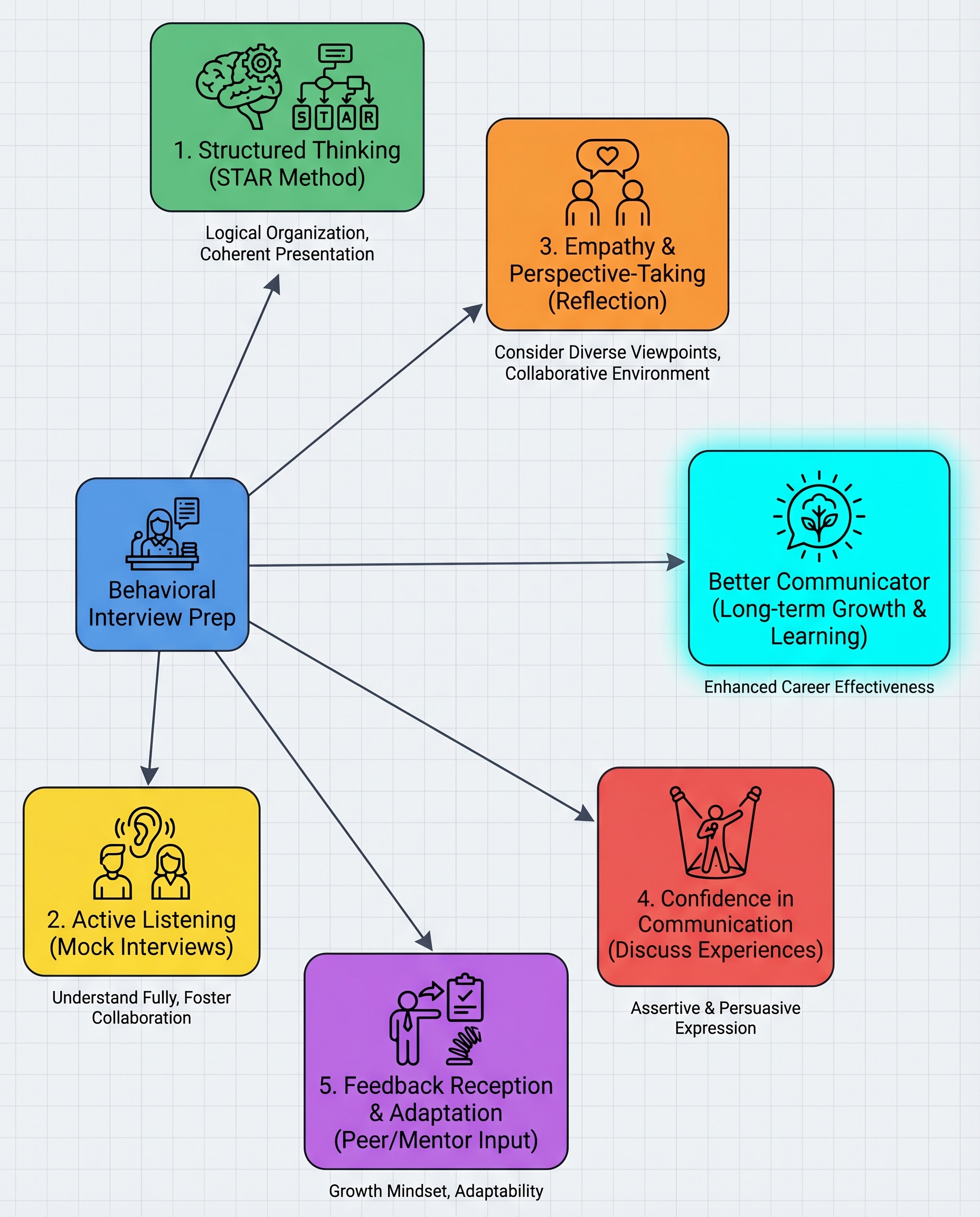
Behavioral interview prep is often dismissed as a checkbox to “pass interviews.” That’s the wrong way to see it. The skills you practice there are exactly the communication habits that make you effective and credible at work — especially if you’re an engineer or data scientist.
Below are five core communication abilities behavioral prep builds, with short examples and practical ways to practice each one.
1) Structured thinking (use STAR)
- What it is: Organizing your ideas so others follow your reasoning.
- Why it matters: Clear structure helps busy stakeholders quickly grasp tradeoffs and decisions.
- How to apply: Use STAR — Situation, Task, Action, Result — for short, complete stories.
- Example: “Situation: Our ETL job kept failing during spikes. Task: Reduce failures and downtime. Action: I added exponential backoff + circuit breaker; instrumented monitoring. Result: Failures dropped 80% and mean time to detect improved by 3x.”
- Quick practice: Write three 60–90 second STAR stories about your recent projects and time-box yourself when delivering them.
2) Active listening
- What it is: Making sure you understand the question or concern before answering.
- Why it matters: Prevents misalignment and wasted work.
- How to apply: Paraphrase the ask: “So you’re asking…?” or ask a clarifying question before you answer.
- Example: In a design meeting, repeat the acceptance criteria you heard and ask, “Is minimizing latency the primary goal, or is predictability more important?”
- Quick practice: During meetings, deliberately paraphrase one person’s point before responding.
3) Empathy (impact on others)
- What it is: Framing your work in terms of users, teammates, and business impact — not just code.
- Why it matters: People fund and prioritize work based on impact, not internal complexity.
- How to apply: When describing work, say who benefits and how: customers, product teams, ops, etc.
- Example: “Refactoring this service reduces on-call page noise, so the SRE team can focus on real incidents and feature teams won’t be blocked.”
- Quick practice: Add one sentence about “who benefits and why” to every status update or demo.
4) Confidence (concise ownership)
- What it is: Stating outcomes and ownership clearly without hedging or rambling.
- Why it matters: Confidence builds trust; excessive hedging creates doubt.
- How to apply: Use decisive language for facts and trade-offs; call out unknowns separately.
- Example: “I led the migration; it decreased cold-starts by 40%. We still need to validate performance under peak load.”
- Quick practice: Record a 90-second update with a clear opening sentence: what you did, why it mattered, next step.
5) Feedback (receive and adapt)
- What it is: Taking critique constructively and iterating your approach.
- Why it matters: Feedback loops accelerate learning and improve collaboration.
- How to apply: Ask for specifics, summarize the feedback you heard, and state your next actions.
- Example: “Thanks — I heard that the dashboard is confusing. I’ll simplify the metrics and share a mock by Friday.”
- Quick practice: After a review, write one sentence summarizing the feedback and the change you’ll make.
How to practice intentionally
- Build a 2-minute STAR story bank (3–6 stories) and review them weekly.
- Do mock behavioral interviews with peers or record yourself to spot rambling.
- Bring structured updates to meetings (Situation → Action → Outcome) and invite feedback.
- Treat every design review as a micro-interview: practice active listening, empathy, and concise ownership.
If you’re an engineer or data scientist, this is how you become credible in meetings — not just on LeetCode. Behavioral prep isn’t optional; it’s communication training that pays off every day.
#SoftwareEngineering #DataScience #CareerGrowth
About the author
bugfree.ai is an advanced AI-powered platform designed to help software engineers master system design and behavioral interviews. Whether you’re preparing for your first interview or aiming to elevate your skills, bugfree.ai provides a robust toolkit tailored to your needs. Key Features:
150+ system design questions: Master challenges across all difficulty levels and problem types, including 30+ object-oriented design and 20+ machine learning design problems. Targeted practice: Sharpen your skills with focused exercises tailored to real-world interview scenarios. In-depth feedback: Get instant, detailed evaluations to refine your approach and level up your solutions. Expert guidance: Dive deep into walkthroughs of all system design solutions like design Twitter, TinyURL, and task schedulers. Learning materials: Access comprehensive guides, cheat sheets, and tutorials to deepen your understanding of system design concepts, from beginner to advanced. AI-powered mock interview: Practice in a realistic interview setting with AI-driven feedback to identify your strengths and areas for improvement.
bugfree.ai goes beyond traditional interview prep tools by combining a vast question library, detailed feedback, and interactive AI simulations. It’s the perfect platform to build confidence, hone your skills, and stand out in today’s competitive job market. Suitable for:
New graduates looking to crack their first system design interview. Experienced engineers seeking advanced practice and fine-tuning of skills. Career changers transitioning into technical roles with a need for structured learning and preparation.
Comments
Join the discussionNo comments yet. Be the first to comment.