High-Score (Bugfree) Amazon SDE-2 Interview Experience: In-Person Loop + Virtual Bar Raiser
This is a concise, structured write-up of a high-scoring (bug-free) Amazon SDE-2 interview experience. The candidate had ~2 years of fintech full-stack experience and applied via referral. Below is the timeline, round-by-round breakdown, and practical takeaways for others preparing for Amazon interviews.
Timeline & logistics
- Applied via referral with ~2 years of fintech full-stack experience.
- Online assessment (OA): straightforward.
- There was a temporary recruiter pause due to location issues; later the recruiter reconnected and scheduled an in-person loop in Hyderabad.
- Final step: a virtual bar-raiser interview.
Interview loop (round-by-round)
Each round combined Leadership Principles (LP) questions with either coding or design. I focused on clear communication, assumption-setting, and quick dry runs to catch bugs early.
Round 1 — LP + Coding
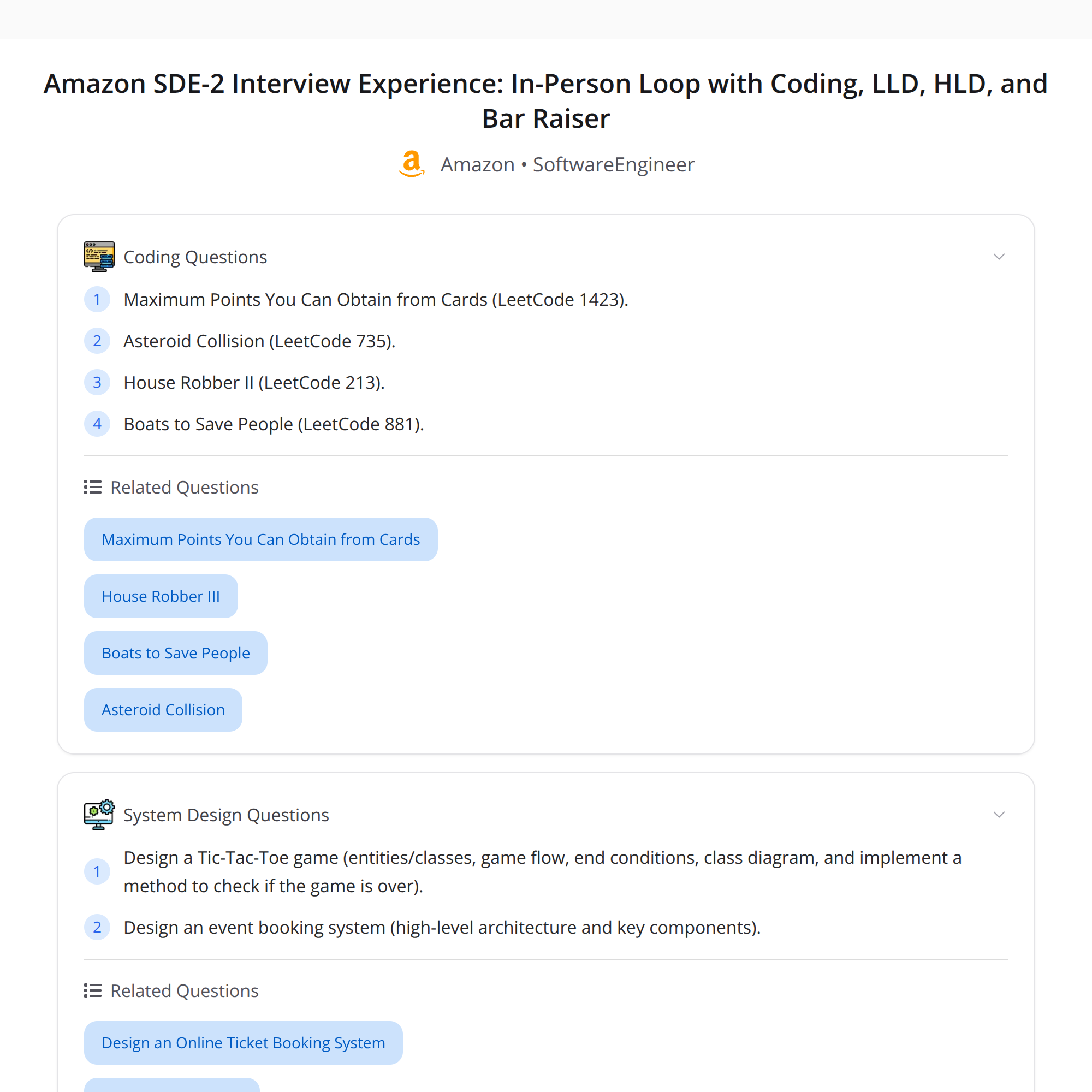
- Problems: "Max Points from Cards" and "Asteroid Collision."
- Approach: clarified constraints and edge cases before coding. Performed a dry run on sample inputs and caught a bug early in the Asteroid Collision solution, then fixed it.
- Tip: always walk through at least one non-trivial example out loud before finalizing code.
Round 2 — LP + Low-Level Design (LLD)
- Problem: Design a Tic-Tac-Toe implementation.
- Focus areas: identify core entities (Board, Player, GameController), sketch a simple class diagram, and implement the game-over method in C++.
- Tip: for LLD, highlight responsibilities, data members, and key public methods; discuss complexity trade-offs.
Round 3 — LP + High-Level Design (HLD)
- Problem: Design an Event Booking System.
- Focus areas: define major components (API gateway, auth, booking service, availability service, database schema, caching), data flow, and scalability considerations.
- Tip: start with requirements (functional and non-functional), then propose components and trade-offs (consistency vs. availability, single source of truth, caching strategies).
Round 4 — Bar Raiser (virtual) — LP + Coding
- Problems: "House Robber II" and "Boats to Save People."
- Focus areas: solid algorithmic reasoning, edge-case handling, and demonstrating ownership and rigor in LP answers.
- Note: bar-raiser interviews often probe depth — be prepared to justify design choices and optimizations.
Recruiter conversation & offer logistics
- Recruiter asked about compensation expectations, notice period, and preferred location.
- Candidate selected the offered option and proceeded.
What helped in this process
- Referral got the resume noticed; however, interview performance was decisive.
- Preparing to speak the Leadership Principles fluently and weaving them into answers.
- Doing dry runs and test-cases during coding to catch bugs early (this caught a real bug in Asteroid Collision).
- For LLD/HLD, sketching diagrams and walking the interviewer through interactions and failure modes.
- Time management: allocate time to clarify, design, code, and run at least one example.
Practical preparation checklist
- Master the 14 Amazon Leadership Principles and practice short STAR stories.
- Regularly solve medium-hard algorithm problems and practice explaining solutions aloud.
- Practice LLD: identify entities, responsibilities, and simple class diagrams; implement key methods.
- Practice HLD: start from requirements, propose components, and discuss scalability and trade-offs.
- Do mock interviews and simulate dry runs to expose logical bugs early.
Key takeaways
- Combine technical correctness with clear communication and LP alignment.
- Small practices like doing a dry run or explicitly stating assumptions can turn a borderline solution into a clean, bug-free one.
- Expect a mixture of coding, LLD, HLD, and behavioral questions; prepare for each and practice transitioning between them.
If you'd like, I can expand any round with more details (example walk-throughs, sample class diagrams, or code snippets) or suggest a tailored prep plan based on your experience level.
#AmazonInterview #SystemDesign #SoftwareEngineering
About the author
bugfree.ai is an advanced AI-powered platform designed to help software engineers master system design and behavioral interviews. Whether you’re preparing for your first interview or aiming to elevate your skills, bugfree.ai provides a robust toolkit tailored to your needs. Key Features:
150+ system design questions: Master challenges across all difficulty levels and problem types, including 30+ object-oriented design and 20+ machine learning design problems. Targeted practice: Sharpen your skills with focused exercises tailored to real-world interview scenarios. In-depth feedback: Get instant, detailed evaluations to refine your approach and level up your solutions. Expert guidance: Dive deep into walkthroughs of all system design solutions like design Twitter, TinyURL, and task schedulers. Learning materials: Access comprehensive guides, cheat sheets, and tutorials to deepen your understanding of system design concepts, from beginner to advanced. AI-powered mock interview: Practice in a realistic interview setting with AI-driven feedback to identify your strengths and areas for improvement.
bugfree.ai goes beyond traditional interview prep tools by combining a vast question library, detailed feedback, and interactive AI simulations. It’s the perfect platform to build confidence, hone your skills, and stand out in today’s competitive job market. Suitable for:
New graduates looking to crack their first system design interview. Experienced engineers seeking advanced practice and fine-tuning of skills. Career changers transitioning into technical roles with a need for structured learning and preparation.
Comments
Join the discussionNo comments yet. Be the first to comment.