High-Score Amazon Front-End Engineer Interview Experience (Bugfree Users)
A concise, practical walkthrough of a high-scoring Amazon Front-End Engineer interview from a candidate who identifies as a "bugfree" user. Flow: Online Assessment (OA) → Phone Screen → 5-round Virtual Onsite (VO). This write-up highlights what was asked, what interviewers evaluated, and how to prepare.
Quick summary
- Format: OA + Phone + 5-round VO
- Focus areas: UI implementation and state management, behavioral / leadership principles, system design for front-end features, coding (DOM/UI components & algorithms), and log/usage analysis reasoning
- Big takeaway: behavioral stories and ownership examples matter as much as coding correctness
Online Assessment (OA)
What to expect
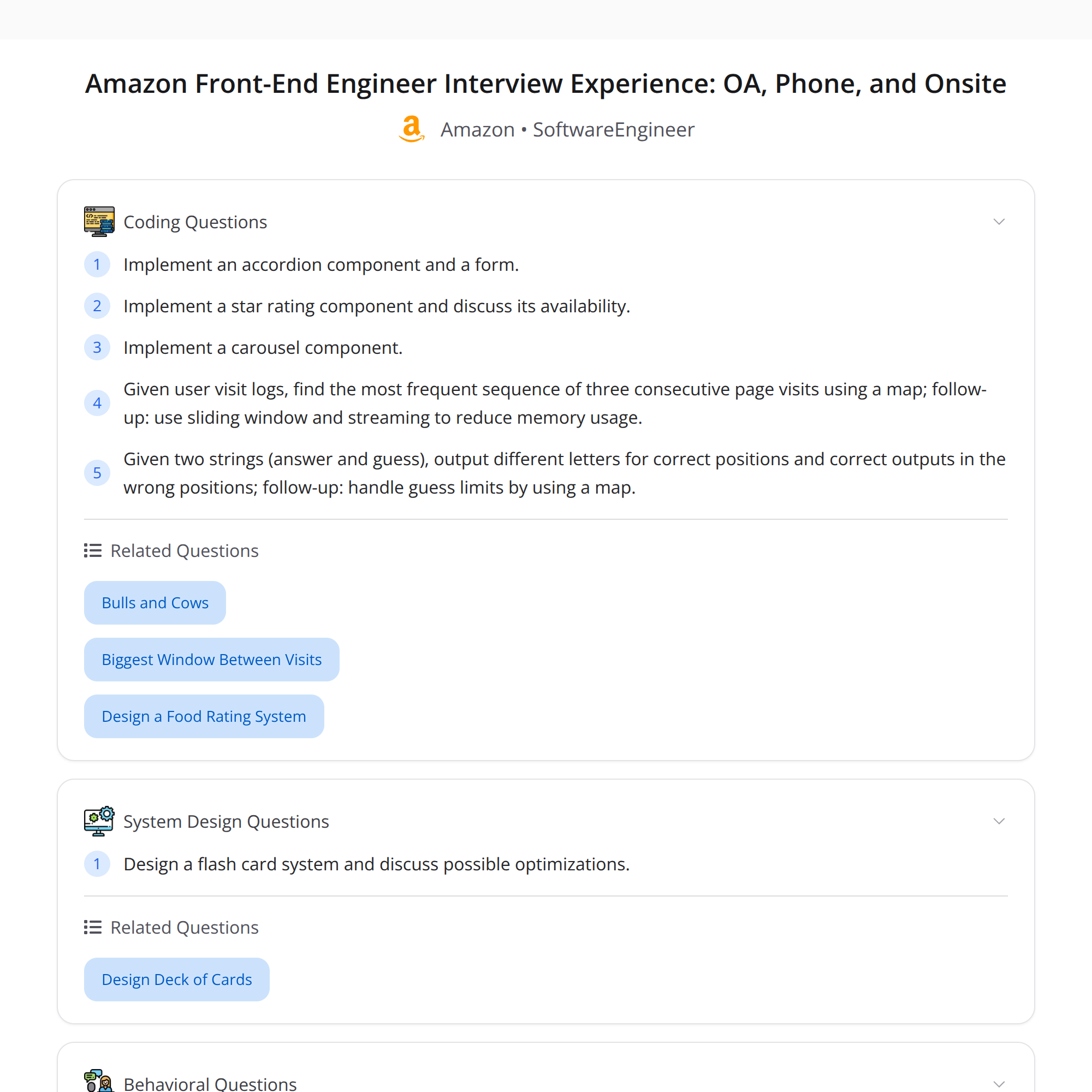
- Two classic UI-building tasks (example: accordion component, a multi-field form).
- Evaluation concentrated on UI correctness, state management, edge cases, and code clarity.
Tips
- Implement clean component state separation (controlled vs uncontrolled where applicable).
- Handle accessibility (keyboard interactions, ARIA attributes) when building interactive UI elements.
- Validate form flows and edge cases (empty states, validation messages, partial input).
- Keep code modular and comment any non-obvious decisions.
Phone Screen
Format
- Behavioral (leadership principles / STAR-format stories).
- One small front-end task (e.g., build a star-rating component).
- Quick architecture / availability & scalability discussion (trade-offs, caching, client-server responsibilities).
What interviewers look for
- Clear, concise behavioral answers demonstrating ownership and impact.
- Component-level thinking: props/state, reusability, accessibility.
- Awareness of performance and scale for front-end features (lazy loading, debounce/throttle, pagination, caching strategies).
Prep tips
- Prepare 4–6 STAR stories mapping to Amazon leadership principles.
- Practice building small components from scratch and explaining trade-offs.
Virtual Onsite (5 rounds)
Round-by-round breakdown
1) Behavioral + Flashcard System Design
- High-level: design a flashcard app (create/edit decks, review flow, spaced repetition considerations).
- Evaluated on scoping, state management, client-server boundaries, offline behavior, and UX choices.
2) Behavioral + Carousel Coding
- Implement a carousel UI: next/previous, responsive behavior, indicators, and accessibility.
- Focus on DOM manipulations, animation strategy, and interaction edge cases.
3) Hiring Manager Deep Dive (Behavioral)
- In-depth questions about career goals, team fit, challenging projects, trade-offs you made.
- Expect follow-ups probing leadership, mentorship, and cross-team collaboration.
4) Bar Raiser: Behavioral + Log Analysis Problem
- Behavioral probing (leadership principles under pressure).
- A reasoning problem: given logs, find the most frequent 3-page sequence. Follow-ups on streaming and sliding-window approaches were asked.
- Assessors want clarity in approach, correctness, and thoughtfulness about scale.
5) Algorithmic / Logic Problem: String-Guessing with Limited Guesses
- Problem framed as: deduce a target string with limited guesses; use map-based counting to infer characters/frequencies and strategy to maximize information per guess.
- Evaluated for algorithmic thinking, correctness, and ability to explain trade-offs.
What the VO emphasized
- Behavioral stories were revisited in many rounds. Be consistent and specific.
- Clear communication and incremental problem solving are essential—talk through assumptions and test cases.
Concrete technical hints (high-level)
Sliding-window / streaming for most frequent k-page sequence:
- Use a fixed-length sliding window over the stream of pages; maintain a hashmap of windowed-sequence counts.
- For high-throughput streams, consider hashing sequences (or using a rolling hash) and approximate heavy-hitter algorithms when memory is constrained.
String-guessing with limited guesses (strategy overview):
- Use character-frequency maps to prioritize guesses that maximize information gain.
- Greedy strategies: guess characters or strings that help partition the remaining solution space most effectively.
- Always validate assumptions and discuss worst-case vs average-case performance.
Key takeaways
- Behavioral and leadership-principle stories matter as much as coding and design. Have specific outcomes, your role, trade-offs, and measurable impact for each story.
- For front-end roles, implementation correctness + accessibility + state-management clarity are highly valued.
- For design and log/scale questions, emphasize clear scoping, incremental design, and trade-offs.
- Communicate continuously: state assumptions, walk through examples, and validate with test cases.
How to prepare (checklist)
- Prepare 6–8 STAR-format behavioral stories mapped to Amazon principles.
- Practice building small UI components (accordion, carousel, rating widget, forms) including tests and accessibility.
- Review client-server responsibilities for front-end features (caching, offline, pagination, performance).
- Brush up on sliding-window algorithms, hash-based counting, and streaming/heavy-hitter concepts.
- Practice explaining trade-offs and measuring impact of your technical decisions.
If you want, I can:
- Draft 4 STAR stories tailored to typical Amazon leadership questions based on your experience.
- Create a step-by-step implementation plan for a carousel or flashcard app with code structure and state diagrams.
Good luck — preparation that balances polished behavioral stories and focused front-end/practical coding will pay off.
About the author
bugfree.ai is an advanced AI-powered platform designed to help software engineers master system design and behavioral interviews. Whether you’re preparing for your first interview or aiming to elevate your skills, bugfree.ai provides a robust toolkit tailored to your needs. Key Features:
150+ system design questions: Master challenges across all difficulty levels and problem types, including 30+ object-oriented design and 20+ machine learning design problems. Targeted practice: Sharpen your skills with focused exercises tailored to real-world interview scenarios. In-depth feedback: Get instant, detailed evaluations to refine your approach and level up your solutions. Expert guidance: Dive deep into walkthroughs of all system design solutions like design Twitter, TinyURL, and task schedulers. Learning materials: Access comprehensive guides, cheat sheets, and tutorials to deepen your understanding of system design concepts, from beginner to advanced. AI-powered mock interview: Practice in a realistic interview setting with AI-driven feedback to identify your strengths and areas for improvement.
bugfree.ai goes beyond traditional interview prep tools by combining a vast question library, detailed feedback, and interactive AI simulations. It’s the perfect platform to build confidence, hone your skills, and stand out in today’s competitive job market. Suitable for:
New graduates looking to crack their first system design interview. Experienced engineers seeking advanced practice and fine-tuning of skills. Career changers transitioning into technical roles with a need for structured learning and preparation.
Comments
Join the discussionNo comments yet. Be the first to comment.