5 Common System Design Interview Mistakes—and How to Avoid Them
System design interviews test your ability to build scalable, maintainable systems under constraints. Candidates often stumble on a handful of recurring mistakes. Below are five of the most common pitfalls, how they reveal themselves, and practical ways to avoid them.
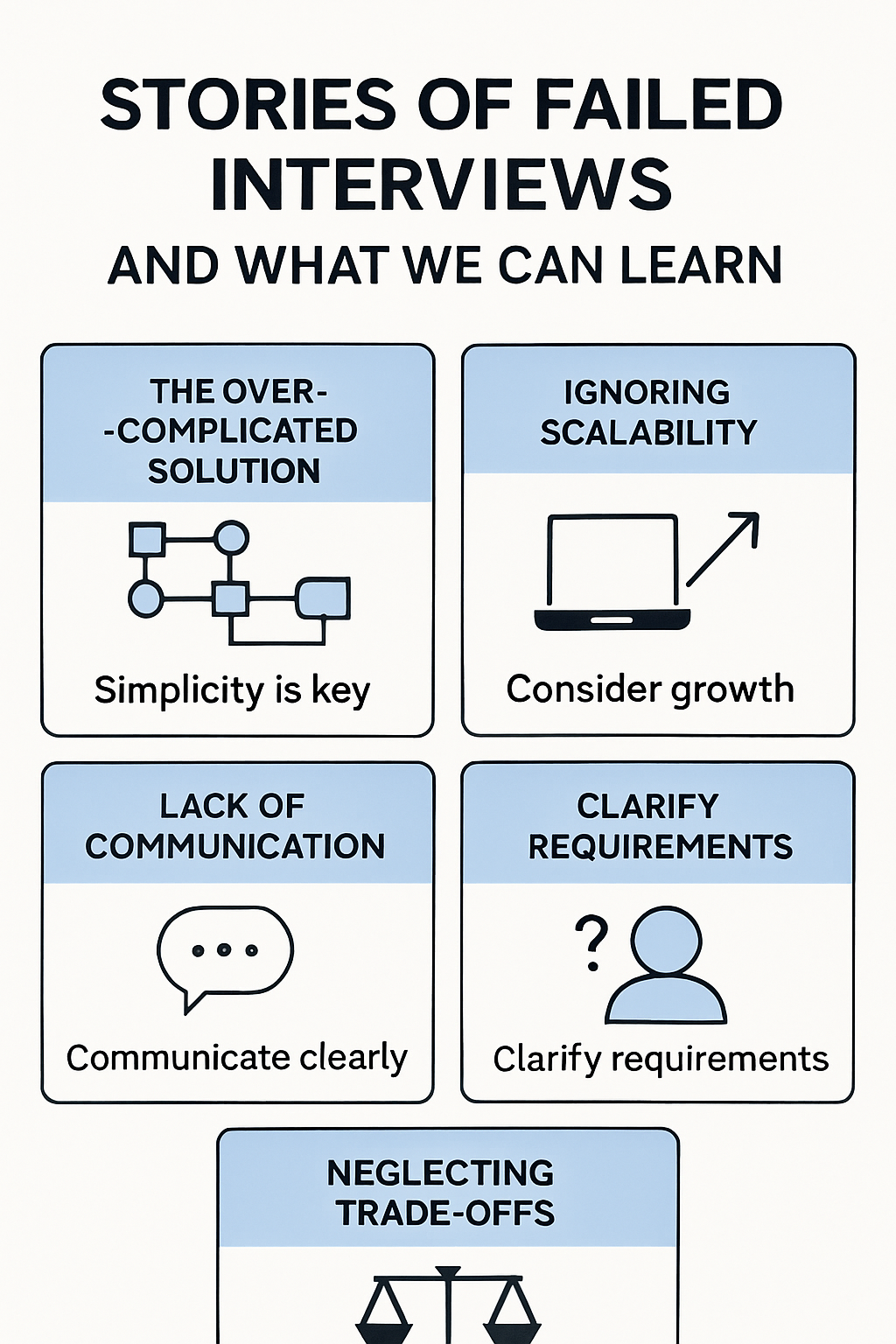
1) Over‑complicating the solution
Symptoms:
- Jumping to microservices, distributed consensus, or too many components right away.
- Adding advanced patterns before the requirements justify them.
Why it hurts:
- Wastes time in interviews, obscures core ideas, and increases the chance of mistakes.
How to avoid it:
- Start with the simplest workable design (monolith or single service) and iterate.
- Ask: "What's the minimal viable design that satisfies the requirements?" Then add complexity only to address specific bottlenecks.
- Use simple building blocks first: load balancer, cache, database, queue.
Quick tip: Sketch the simple end‑to‑end path (client → server → storage) before adding scaling layers.
2) Ignoring scalability and growth patterns
Symptoms:
- Designing for current load without considering growth or traffic patterns.
- Not addressing hotspots (e.g., single DB shard or heavy write contention).
Why it hurts:
- Interviewers want to see that you can reason about future constraints, not just a working prototype.
How to avoid it:
- Ask about expected traffic, data size, and growth rate.
- Discuss vertical vs horizontal scaling, sharding, caching, batching, and async processing.
- Identify potential bottlenecks and propose concrete mitigations (e.g., read replicas, partition keys, CQRS).
Quick tip: When you introduce a component, mention how it will behave at 10x or 100x traffic.
3) Poor communication and unclear diagrams
Symptoms:
- Talking silently, skipping steps, or producing a messy diagram that you don't explain.
- Jargon without context or failing to narrate trade‑offs.
Why it hurts:
- Interviewers need visibility into your thought process. Clear communication is as important as the design.
How to avoid it:
- Narrate each step: explain what each component does and why it's there.
- Keep diagrams tidy: label services, data flows, and failure/retry paths.
- Pause for confirmation: "Does this match what you're expecting so far?"
Quick tip: Use a consistent visual language—boxes for services, arrows for requests, cylinders for storage.
4) Not asking clarifying questions
Symptoms:
- Making assumptions about requirements (consistency, SLAs, read/write ratios, user expectations) without verifying.
- Designing features that contradict the product intent.
Why it hurts:
- Wrong assumptions lead to irrelevant or poor designs.
How to avoid it:
- Start with 4–6 clarifying questions: expected traffic, latency/availability targets, data consistency needs, read/write mix, durability requirements, and failure tolerance.
- Reframe the problem: repeat your understanding and confirm any constraints.
Quick tip: Prioritize unknowns that affect architecture decisions (e.g., strict consistency vs eventual consistency).
5) Neglecting trade‑offs and alternatives
Symptoms:
- Treating decisions as binary and never discussing costs, complexity, or operational burden.
- Picking a fancy tech without comparing it to simpler options.
Why it hurts:
- Real systems are about balancing latency, throughput, consistency, cost, and ease of operation.
How to avoid it:
- For each major choice, state the trade‑offs (e.g., strong consistency vs availability, caching vs data freshness, synchronous vs async).
- Mention alternatives and explain why you chose one approach for the problem and traffic assumptions given.
Quick tip: Use a short table or bullet list to compare 2–3 approaches for a critical problem.
A short checklist to use in interviews
- Ask clarifying questions first (traffic, SLAs, data size, consistency).
- Sketch a minimal end‑to‑end flow.
- Add scalability improvements only as needed; explain why.
- Narrate and label your diagram clearly.
- Discuss trade‑offs and alternatives for key choices.
Master these fundamentals and you'll not only design better systems but also demonstrate the communication and judgment interviewers want to see.
If you'd like, I can create a printable one‑page checklist or a sample whiteboard script you can practice with.
About the author
bugfree.ai is an advanced AI-powered platform designed to help software engineers master system design and behavioral interviews. Whether you’re preparing for your first interview or aiming to elevate your skills, bugfree.ai provides a robust toolkit tailored to your needs. Key Features:
150+ system design questions: Master challenges across all difficulty levels and problem types, including 30+ object-oriented design and 20+ machine learning design problems. Targeted practice: Sharpen your skills with focused exercises tailored to real-world interview scenarios. In-depth feedback: Get instant, detailed evaluations to refine your approach and level up your solutions. Expert guidance: Dive deep into walkthroughs of all system design solutions like design Twitter, TinyURL, and task schedulers. Learning materials: Access comprehensive guides, cheat sheets, and tutorials to deepen your understanding of system design concepts, from beginner to advanced. AI-powered mock interview: Practice in a realistic interview setting with AI-driven feedback to identify your strengths and areas for improvement.
bugfree.ai goes beyond traditional interview prep tools by combining a vast question library, detailed feedback, and interactive AI simulations. It’s the perfect platform to build confidence, hone your skills, and stand out in today’s competitive job market. Suitable for:
New graduates looking to crack their first system design interview. Experienced engineers seeking advanced practice and fine-tuning of skills. Career changers transitioning into technical roles with a need for structured learning and preparation.
Comments
Join the discussionNo comments yet. Be the first to comment.