High-Score (Bugfree Users) TikTok ML Scientist NG Interview Experience: What to Expect in 3 Rounds
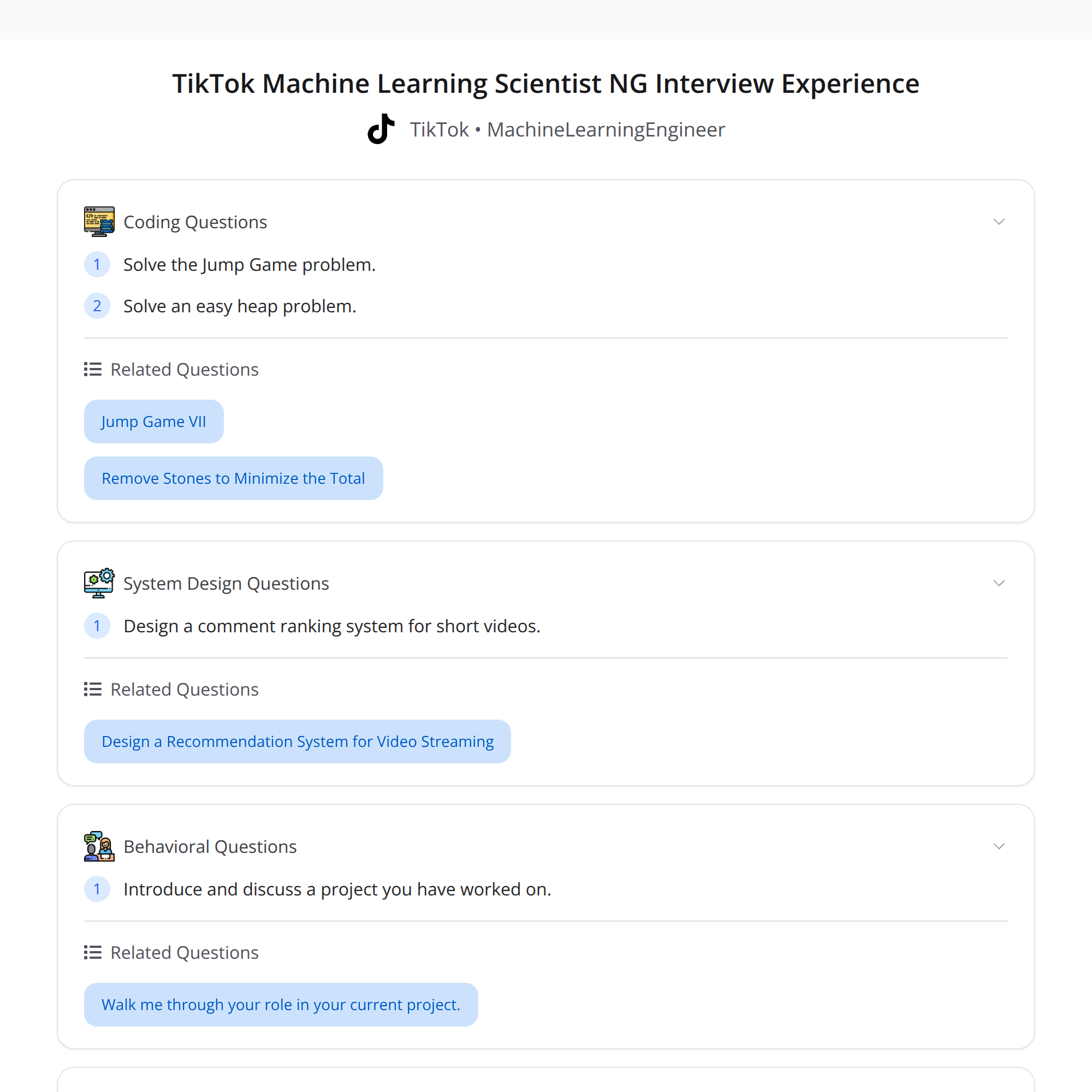
Short summary of a high-score interview shared by Bugfree users for the TikTok ML Scientist (NG) role. The official loop can be 4 rounds (two peer interviews + hiring manager + HR), but this account covers three technical rounds before rejection. Use this as a focused checklist to prepare.
Interview structure (as experienced)
- Planned: 4 rounds (2 peer interviews, 1 hiring manager, 1 HR).
- Actual: 3 technical rounds completed — R1, R2, R3 — then rejection after R3.
Below is an expanded breakdown of each round, typical topics, and concrete prep actions.
Round 1 — Coding + ML fundamentals + Recommender chat
What happened:
- A coding question (Jump Game style) focused on algorithmic thinking and edge cases.
- Short ML fundamentals questions — basics you should be able to answer quickly.
- A conversational segment about recommender systems (high-level design and concepts).
What to prepare:
- Algorithms: arrays/greedy/DP basics. Practice Jump Game, variants, and explain time/space complexity.
- ML fundamentals: bias/variance, train/validation/test splits, common loss functions, evaluation metrics for classification/regression.
- Recommender systems: candidate retrieval vs. ranking, common models (matrix factorization, collaborative filtering, simple heuristics), online metrics (CTR, watch time) and offline proxies.
Example prompt to practice:
- Implement Jump Game (can you reach the last index?). Then discuss complexity and edge cases.
- Describe candidate retrieval pipeline vs. ranking model and when to use implicit feedback.
Round 2 — Easy heap coding + Deep dive into one project
What happened:
- A heap-related coding question (easy level) — think priority queues, top-k problems.
- A thorough walkthrough of a resume project: challenges, design decisions, metrics, and trade-offs.
What to prepare:
- Data structures: heaps, priority queues, top-k algorithms, basic complexity reasoning.
- Project deep dive: pick 1–2 projects and prepare a structured story: problem, data, models/architecture, evaluation, productionization, monitoring, failure modes, and what you would change.
Tips for the project walkthrough:
- Quantify impact (improvements, metrics) wherever possible.
- Be ready to explain model training pipeline, feature engineering, data quality issues, and ablation studies.
- Discuss deployment, latency constraints, and offline vs. online evaluation.
Round 3 — Advanced ML discussion (no coding) — Word2Vec, Transformers, and System Design
What happened:
- No coding. Deep technical discussion on embedding methods and transformers.
- Detailed resume project walkthrough questions.
- System design focused on comment ranking for short videos.
Core technical topics to study:
- Word2Vec implementations and trade-offs on small datasets: skip-gram vs. CBOW, negative sampling, subsampling frequent words, embedding dimensionality, and regularization.
- Transformer positional encoding: sinusoidal vs. learned embeddings, pros/cons, and how positional info is represented and used.
- Scaling/production trade-offs for small data contexts: transfer learning, pretraining, data augmentation, and retrieval-augmented approaches.
System design (comment ranking) — scope to cover:
- End-to-end flow: data sources (comments, signals), candidate generation, ranking model, and re-ranking.
- Features: text embeddings, user history, video metadata, temporal/contextual signals.
- Metrics: relevance, engagement, moderation signals, latency and throughput requirements.
- Practical concerns: freshness, personalization, handling spam/toxicity, A/B testing strategy, fallback heuristics.
How to prepare for a non-coding deep technical interview:
- Revisit fundamentals and be ready to derive/justify design choices verbally.
- Practice explaining trade-offs and alternative designs.
- Prepare succinct technical stories from your resume focusing on decisions, experiments, and lessons learned.
Prep checklist (quick)
- Algorithms: Jump Game, top-k/heap problems (LeetCode medium/easy).
- ML basics: bias/variance, loss functions, evaluation metrics, overfitting remedies.
- Embeddings: Word2Vec mechanics, small-data strategies, and practical tuning knobs.
- Transformers: positional encoding, attention intuition, and efficiency considerations.
- Recommender systems: retrieval vs. ranking, evaluation metrics, online/ offline setup.
- Project stories: metrics, data pipeline, ablations, deployment & monitoring, and failure cases.
- System design: end-to-end flow, feature design, metrics, scalability, safety/moderation.
Sample questions to practice
- Coding: "Given an array of non-negative integers, determine if you can reach the last index." (Explain and implement.)
- Heap: "Find the top-k most frequent items with streaming constraints."
- ML fundamentals: "Explain bias vs. variance and how you would detect and mitigate each."
- Word2Vec: "Why use negative sampling? How would you train embeddings on a small corpus?"
- Transformer: "Explain sinusoidal positional encodings and an alternative learned approach. When might each be preferable?"
- System design: "Design a comment-ranking system for short videos. What are the candidate sources, features, and evaluation metrics?"
Final takeaways
- This loop mixes algorithmic coding, ML fundamentals, deep-dive project discussion, and system design focused on recommendation/comment ranking.
- The R3 (non-coding) round can be the hardest: expect in-depth technical trade-off conversations and rigorous resume questioning.
- Even if the interview ends in rejection, the scope provides a practical checklist to prepare for similar ML scientist roles at major tech companies.
Good luck — study the checklist, rehearse your project stories, and practice both coding and systems/ML design explanations.
#MachineLearning #InterviewPrep #RecommenderSystems
About the author
bugfree.ai is an advanced AI-powered platform designed to help software engineers master system design and behavioral interviews. Whether you’re preparing for your first interview or aiming to elevate your skills, bugfree.ai provides a robust toolkit tailored to your needs. Key Features:
150+ system design questions: Master challenges across all difficulty levels and problem types, including 30+ object-oriented design and 20+ machine learning design problems. Targeted practice: Sharpen your skills with focused exercises tailored to real-world interview scenarios. In-depth feedback: Get instant, detailed evaluations to refine your approach and level up your solutions. Expert guidance: Dive deep into walkthroughs of all system design solutions like design Twitter, TinyURL, and task schedulers. Learning materials: Access comprehensive guides, cheat sheets, and tutorials to deepen your understanding of system design concepts, from beginner to advanced. AI-powered mock interview: Practice in a realistic interview setting with AI-driven feedback to identify your strengths and areas for improvement.
bugfree.ai goes beyond traditional interview prep tools by combining a vast question library, detailed feedback, and interactive AI simulations. It’s the perfect platform to build confidence, hone your skills, and stand out in today’s competitive job market. Suitable for:
New graduates looking to crack their first system design interview. Experienced engineers seeking advanced practice and fine-tuning of skills. Career changers transitioning into technical roles with a need for structured learning and preparation.
Comments
Join the discussionNo comments yet. Be the first to comment.