Stop Guessing: Why “0 Impressions” Is a Binomial Problem
Quick answer
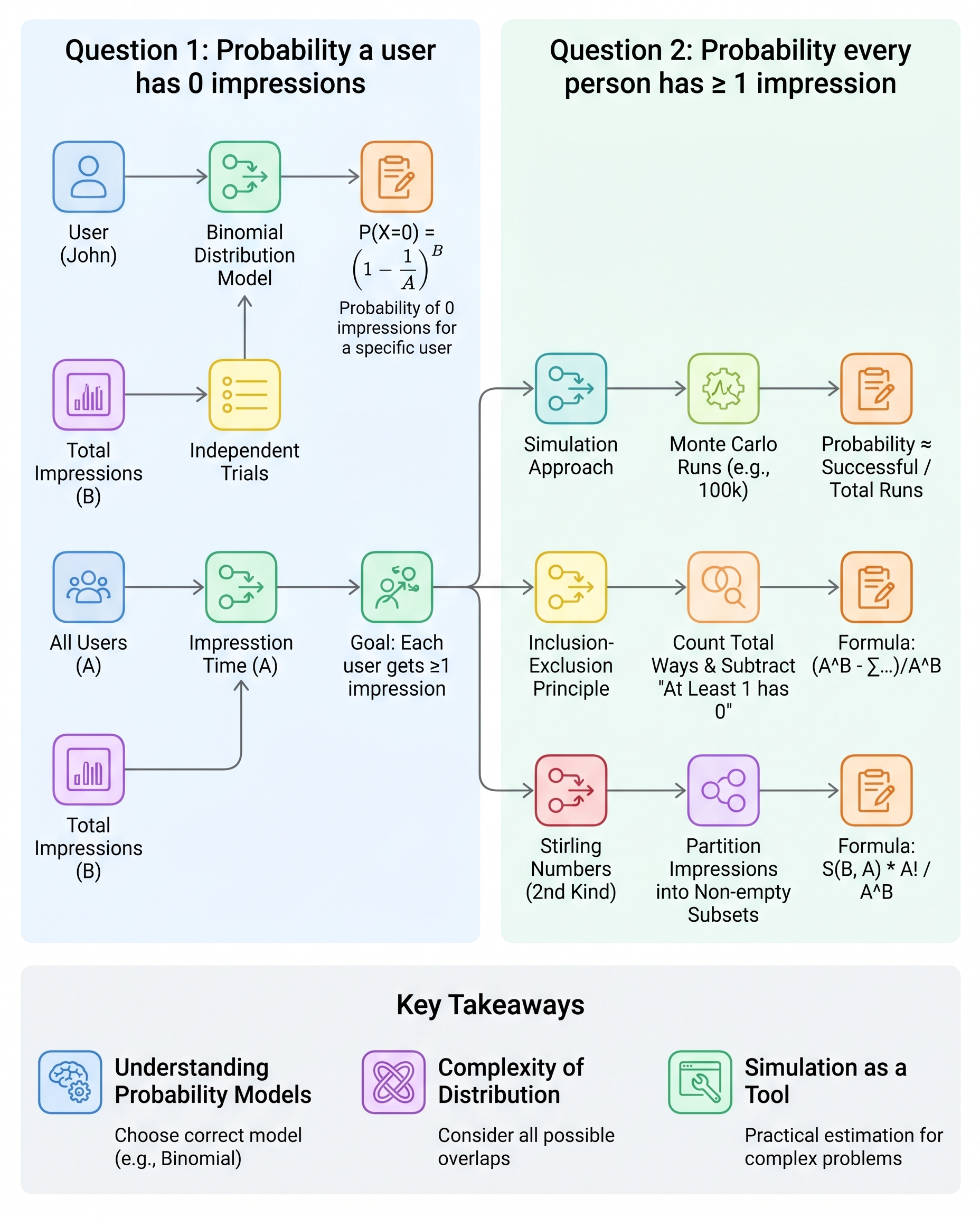
If there are A users and B impressions, and each impression independently lands on John with probability p = 1/A, then the number of impressions John gets is Binomial(B, p). The probability John gets zero impressions is simply:
P(X = 0) = (1 - 1/A)^B.
Why this is Binomial (short):
- Each impression is a trial. There are B trials.
- Each trial has the same chance p = 1/A of "success" (hitting John).
- Trials are independent under the usual random-allocation assumption.
So the event "John gets 0 impressions" means all B trials are misses — i.e., B independent misses — which yields (1 - p)^B.
Derivation
Treat each impression as a Bernoulli trial with success probability p = 1/A. Let X be the number of impressions John receives. Then X ~ Binomial(B, p) and
P(X = 0) = C(B,0) p^0 (1 - p)^B = (1 - p)^B = (1 - 1/A)^B.
Numerical intuition
- Example: A = 1,000 users, B = 50 impressions. Then
P(X = 0) = (1 - 1/1000)^50 ≈ e^{-50/1000} = e^{-0.05} ≈ 0.951. So John has a ~95% chance of seeing zero impressions — unsurprising when impressions are scarce relative to the audience.
Useful approximation (Poisson)
When A is large and p is small (so Bp = B/A is moderate), you can use the Poisson approximation:
P(X = 0) ≈ e^{-B/A}
This often simplifies quick mental math in interviews.
When the assumption fails (say it’s without replacement or nonuniform)
- Without replacement (each impression is shown to a distinct user, B ≤ A): the correct model is hypergeometric. Then
P(X = 0) = C(A-1, B) / C(A, B)(choose all B impressions from the other A−1 users). - Nonuniform selection (some users have higher weight): replace
pwith John's actual selection probability; the count for John is still binomial if trials are independent and identical for John. - If impressions are correlated (not independent), you must model that dependence explicitly.
Interview tips
- State your assumptions up front: independence, identical probability p, and whether selection is with or without replacement.
- Write the Binomial argument clearly: B trials, p = 1/A, P(0) = (1 - p)^B.
- Offer the hypergeometric alternative if the interviewer suggests "no user sees more than one impression."
- Mention the Poisson approximation for large-A, small-p regimes to show practical instinct.
Bottom line
“John gets 0 impressions” is neither mysterious nor hand-wavy: it’s the probability of B independent misses. State the setup, pick the right distribution, and compute P(X = 0) = (1 - 1/A)^B.
#Statistics #DataScience #InterviewPrep
About the author
bugfree.ai is an advanced AI-powered platform designed to help software engineers master system design and behavioral interviews. Whether you’re preparing for your first interview or aiming to elevate your skills, bugfree.ai provides a robust toolkit tailored to your needs. Key Features:
150+ system design questions: Master challenges across all difficulty levels and problem types, including 30+ object-oriented design and 20+ machine learning design problems. Targeted practice: Sharpen your skills with focused exercises tailored to real-world interview scenarios. In-depth feedback: Get instant, detailed evaluations to refine your approach and level up your solutions. Expert guidance: Dive deep into walkthroughs of all system design solutions like design Twitter, TinyURL, and task schedulers. Learning materials: Access comprehensive guides, cheat sheets, and tutorials to deepen your understanding of system design concepts, from beginner to advanced. AI-powered mock interview: Practice in a realistic interview setting with AI-driven feedback to identify your strengths and areas for improvement.
bugfree.ai goes beyond traditional interview prep tools by combining a vast question library, detailed feedback, and interactive AI simulations. It’s the perfect platform to build confidence, hone your skills, and stand out in today’s competitive job market. Suitable for:
New graduates looking to crack their first system design interview. Experienced engineers seeking advanced practice and fine-tuning of skills. Career changers transitioning into technical roles with a need for structured learning and preparation.
Comments
Join the discussionNo comments yet. Be the first to comment.