Fintech systems are unforgiving: sloppy designs can cause outages, lost funds, and regulatory headaches. Interviewers expect candidates to not only name patterns but also explain when to use them, the trade-offs, and how you'd mitigate risks. Below are five essential patterns to study, with focused talking points you can use in interviews.
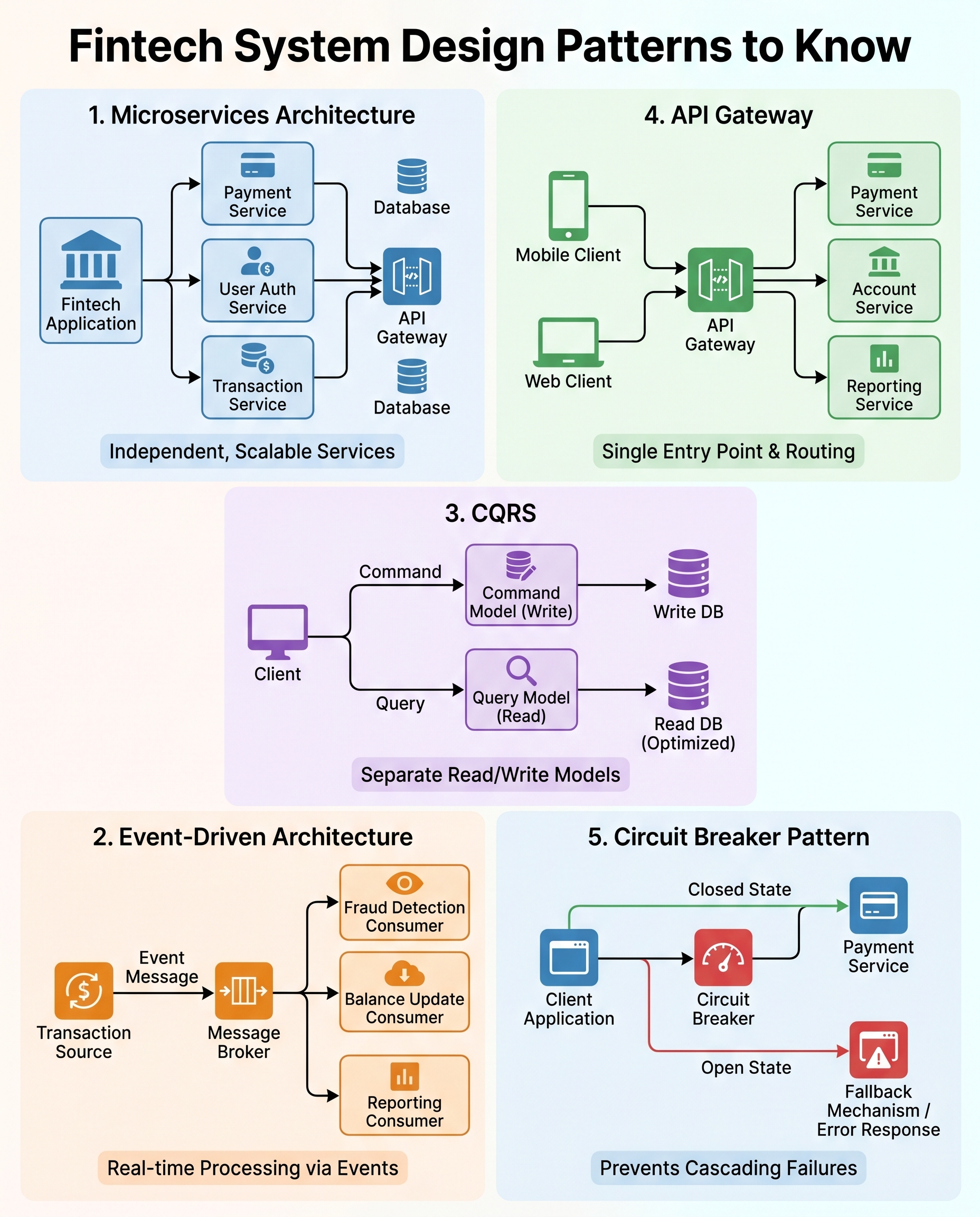
1) Microservices
What it is
- Decompose the platform into domain-specific services (e.g., payments, authentication, ledger, notification).
Why use it in fintech
- Independent scaling for hot paths (payments vs user profile)
- Safer, smaller releases and team autonomy
- Fault isolation: one service failing doesn't take the whole system down
Key trade-offs
- Increased operational complexity (deployments, monitoring, service discovery)
- Data consistency across services—no global DB transactions
- Network latency and error handling between services
Interview talking points
- How you define service boundaries (bounded contexts)
- Approaches for consistency: SAGA, compensating transactions, idempotent operations
- Observability: structured logs, distributed tracing, health checks
When to use
- High throughput, rapidly evolving domains, multiple teams
2) Event-Driven Architecture
What it is
- Services communicate through events published to brokers (Kafka, Pulsar, RabbitMQ).
Why use it in fintech
- Real-time processing for fraud detection, balance updates, and notifications
- Loose coupling and replayability (reprocess events for new consumers)
Key trade-offs
- Eventual consistency (reads may be slightly stale)
- Complexity around ordering, duplication, and exactly-once semantics
- Need for robust schema/versioning and retention policies
Interview talking points
- Choosing a broker and topic partition strategy for ordering and throughput
- Handling duplicates and idempotency in consumers
- Versioning events and evolving schemas (Protobuf/Avro + schema registry)
When to use
- Multiple consumers of transactional data, asynchronous workflows, analytics pipelines
3) CQRS (Command Query Responsibility Segregation)
What it is
- Separate the write model (commands) from the read model (queries). Reads can be denormalized for performance.
Why use it in fintech
- Heavy-read surfaces like statements, dashboards, and balances need low-latency queries
- Allows use of different storage technologies optimized for read vs write
Key trade-offs
- Added complexity: multiple models and synchronization between them
- Eventual consistency between writes and read projections
Interview talking points
- How to keep read models up-to-date (events, change-data-capture)
- When not to use CQRS: simple CRUD systems or when strong consistency is mandatory
- Combining CQRS with event sourcing for auditability and replay
When to use
- When read performance and scalability are primary concerns and slight staleness is acceptable
4) API Gateway
What it is
- A single, secure entry point for clients that handles routing, auth, rate limiting, and protocol translation.
Why use it in fintech
- Centralized enforcement of security (mTLS, OAuth), request throttling, request/response shaping, and API versioning
- Can implement cross-cutting concerns like request aggregation for mobile apps
Key trade-offs
- Gateway can become a bottleneck or single point of failure (use HA and regional gateways)
- Additional latency and operational complexity
Interview talking points
- Rate limiting per API key, IP, or user to protect downstream services
- Edge caching strategies and when to bypass the gateway
- Authentication patterns: JWTs vs opaque tokens, refresh strategies, token revocation
When to use
- Public-facing APIs, multiple client types, need centralized security and governance
5) Circuit Breaker
What it is
- Prevents cascading failures by stopping calls to a failing dependency and providing fallbacks
Why use it in fintech
- Protects critical flows (e.g., payment gateway) and allows graceful degradation (read-only mode, cached responses)
Key trade-offs
- Tuning thresholds is hard: too sensitive = premature break; too lenient = late action
- In distributed systems, circuit state coordination and consistent behavior can be complex
Interview talking points
- Fallback strategies (queue requests, return cached data, degrade non-critical features)
- Integrating circuit breakers with bulkheads and retries (backoff policies)
- Monitoring and alerting: error rate, latency, open/close events
When to use
- When you depend on unstable external services or want to protect system stability under load
Quick comparison & when to combine
- Microservices + API Gateway: common pairing for team autonomy and a secure edge.
- Event-Driven + CQRS: use events to update read models asynchronously.
- Circuit Breakers + Bulkheads + Retries: combine for robust fault handling.
How to explain trade-offs in an interview (short framework)
- State constraints (consistency, latency, throughput, regulatory needs).
- Propose a pattern and why it fits the constraints.
- Explain key trade-offs and consequences.
- Describe mitigations (monitoring, fallbacks, eventual consistency strategies).
- Mention specific technologies and metrics you’d track.
Example snippet: “I’d split the payments service out (microservice) so we can scale and deploy independently. To keep cross-service consistency I’d use an event-driven SAGA for settlement. Trade-offs are higher operational overhead and eventual consistency; we mitigate with strict auditing, idempotency, and replayable events in Kafka.”
Study these patterns, practice explaining the trade-offs concisely, and be ready to justify your choices with constraints and mitigation strategies. That’s what interviewers are listening for.
About the author
bugfree.ai is an advanced AI-powered platform designed to help software engineers master system design and behavioral interviews. Whether you’re preparing for your first interview or aiming to elevate your skills, bugfree.ai provides a robust toolkit tailored to your needs. Key Features:
150+ system design questions: Master challenges across all difficulty levels and problem types, including 30+ object-oriented design and 20+ machine learning design problems. Targeted practice: Sharpen your skills with focused exercises tailored to real-world interview scenarios. In-depth feedback: Get instant, detailed evaluations to refine your approach and level up your solutions. Expert guidance: Dive deep into walkthroughs of all system design solutions like design Twitter, TinyURL, and task schedulers. Learning materials: Access comprehensive guides, cheat sheets, and tutorials to deepen your understanding of system design concepts, from beginner to advanced. AI-powered mock interview: Practice in a realistic interview setting with AI-driven feedback to identify your strengths and areas for improvement.
bugfree.ai goes beyond traditional interview prep tools by combining a vast question library, detailed feedback, and interactive AI simulations. It’s the perfect platform to build confidence, hone your skills, and stand out in today’s competitive job market. Suitable for:
New graduates looking to crack their first system design interview. Experienced engineers seeking advanced practice and fine-tuning of skills. Career changers transitioning into technical roles with a need for structured learning and preparation.
Comments
Join the discussionNo comments yet. Be the first to comment.