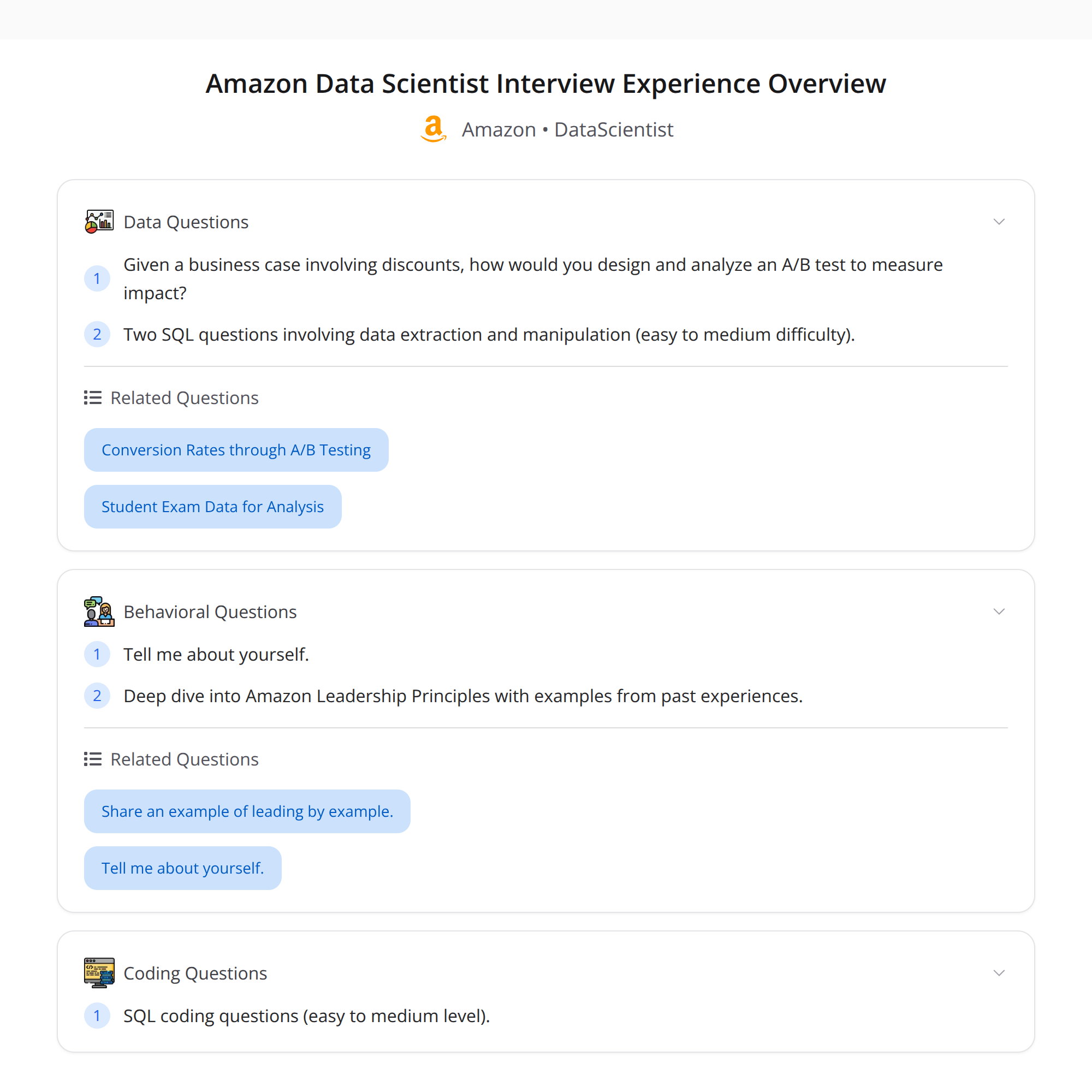

High-Score Interview Experience: Amazon CA L5 ML Engineer Onsite Loop (6 Rounds)
This post summarizes a high-scoring, bug-free interview experience shared by a candidate who received an offer for Amazon Canada (L5) ML Engineer. The onsite loop had six rounds and focused on a mix of research presentation, coding, system design, ML breadth and depth, plus the Bar Raiser. Key themes: clear delivery, systems thinking, experimental rigor, and leadership principles like Earn Trust and Ownership.
Below is a concise breakdown of each round, what was asked, how the candidate prepared and performed, and practical tips you can apply.
Round 1 — Job Talk (PhD Thesis Presentation + Q&A)
What happened
- 20–30 minute presentation of the candidate’s PhD thesis, followed by deep technical Q&A.
Why it matters
- Shows your ability to communicate complex ideas, defend results, and discuss limitations and next steps.
How to prepare
- Treat it like a conference talk: clear motivation, crisp problem statement, baseline comparisons, ablation studies, and reproducibility details.
- Anticipate questions on experimental setup, hyperparameters, failure cases, and why you chose particular baselines or metrics.
- Practice concise answers and a 1–2 minute “elevator pitch” summary for quick framing.
Tips during the talk
- Use a clear slide flow: problem → approach → experiments → takeaways → future work.
- Admit limitations and provide realistic mitigations (shows Earn Trust).
Round 2 — Coding (Algorithmic Problem, Optimize & Deliver)
What happened
- Standard coding interview with an emphasis on delivering a correct, efficient solution and communicating tradeoffs.
Candidate approach highlighted
- Started with a straightforward hashmap/count-based solution to get a correct baseline quickly.
- Optimized to a two-pointer approach (when constraints allowed sorting/two-pointer) to reduce memory/time.
- Presented a delivery plan: test cases, complexity analysis, and edge-case handling.
How to prepare
- Practice writing a correct brute force solution first, then iteratively optimize while narrating your decisions.
- Know common patterns (hashmaps, two pointers, sliding window, sorting, binary search, DFS/BFS) and when to prefer one over another.
- Always discuss complexity, memory tradeoffs, and a plan to test and deploy the solution.
Interview tips
- If you optimize, explain why the optimized approach is better in this context (input size, memory limits, stability of sort, etc.).
- Write 3–5 test cases (including edge cases) out loud and show how your code handles them.
Round 3 — Hiring Manager (ML System Design for NLP/Video + Leadership)
What happened
- System-level discussion focused on designing ML pipelines for NLP/video applications, plus behavioral questions aligned to leadership principles (e.g., Earn Trust).
Topics covered
- End-to-end pipeline components: data collection, annotation strategy, model training, evaluation, deployment, monitoring.
- Tradeoffs for latency vs. accuracy, labeling strategies, data governance, and team collaboration.
- Behavioral: ownership, cross-team communication, handling tight deadlines and incomplete data.
How to prepare
- Prepare a few real-world design examples (search, recommendation, video understanding, classification) and walk through metrics, bottlenecks, and mitigations.
- Be ready to show how you’d earn trust: clarity in communication, transparent timelines, risk mitigation, and owning failure recovery.
Behavioral tip
- Use STAR (Situation, Task, Action, Result) and quantify impact (reduced latency by X%, improved metric by Y%).
Round 4 — ML Breadth (Model Knowledge & Curiosity)
What happened
- Rapid-fire or conversational questions across modern architectures and methods.
Key topics cited
- Transformers and attention mechanisms
- Vision architectures: ViT, Swin
- Language models: BERT, GPT-2
- Multimodal approaches: CLIP
How to prepare
- Understand core ideas (self-attention, positional encoding, pretraining objectives) and practical tradeoffs (compute, data needs, fine-tuning vs. prompt tuning).
- Show intellectual curiosity: mention recent papers, practical failure modes, and when to choose one architecture over another.
Example prompts to practice
- Explain attention vs. convolution tradeoffs.
- When would you use CLIP vs. a specialized classifier?
- How does ViT differ from CNNs for small-data regimes?
Round 5 — Bar Raiser (Leadership, Ownership, Thinking Big)
What happened
- Focus on culture fit, long-term thinking, and examples of taking ownership under ambiguity.
What they look for
- Evidence of thinking big, bias for action, handling ambiguity, and influencing cross-functional stakeholders.
How to prepare
- Have 3–5 concise ownership stories showing impact, tradeoffs, and measurable outcomes.
- Highlight decisions under tight deadlines or with incomplete data, and show how you balanced risk and speed.
Answering style
- Be explicit about tradeoffs, decision rationale, and how you rallied teams or stakeholders to deliver results.
Round 6 — ML Depth (End-to-End LLM/VLM Pipeline)
What happened
- Deep technical discussion around building and deploying an LLM or VLM pipeline from tokenization to edge deployment.
Typical elements to cover
- Data ingestion and cleaning, tokenization/patching strategies, pretraining vs. fine-tuning setups.
- Optimization steps: mixed precision, distributed training, model parallelism, checkpointing.
- Production concerns: quantization, pruning, distillation, latency/throughput tradeoffs, on-device constraints.
- Monitoring, drift detection, and A/B testing strategies in production.
How to prepare
- Be fluent in the full lifecycle: data, architecture, training, infra, and post-deployment monitoring.
- Be ready to show concrete examples (e.g., converting a research model to a production-ready, quantized variant for edge inference).
Final Result & Takeaways
Outcome: Received an offer.
Top takeaways
- Start with a correct baseline quickly, then optimize with clear rationale and delivery plan.
- Communicate experiments and limitations transparently during research presentations—this demonstrates Earn Trust.
- Be prepared to discuss both breadth (modern architectures and when to use them) and depth (practical end-to-end engineering and deployment).
- Behavioral stories matter: show ownership, quantify impact, and explain tradeoffs.
Quick checklist for similar interviews
- Prepare a 10–15 min job talk and 1–2 minute elevator pitch.
- Practice coding: brute force → optimize → tests → complexity analysis.
- Draft 3 system-design examples with metrics, bottlenecks, and mitigations.
- Prepare 4–5 leadership stories aligned with Amazon principles.
- Review detailed pipeline considerations for LLMs and VLMs (data → training → optimization → deployment → monitoring).
If you found this useful, save it for your interview prep and adapt the checklist to your strengths and target role.
#MachineLearning #InterviewPrep #NLP
About the author
bugfree.ai is an advanced AI-powered platform designed to help software engineers master system design and behavioral interviews. Whether you’re preparing for your first interview or aiming to elevate your skills, bugfree.ai provides a robust toolkit tailored to your needs. Key Features:
150+ system design questions: Master challenges across all difficulty levels and problem types, including 30+ object-oriented design and 20+ machine learning design problems. Targeted practice: Sharpen your skills with focused exercises tailored to real-world interview scenarios. In-depth feedback: Get instant, detailed evaluations to refine your approach and level up your solutions. Expert guidance: Dive deep into walkthroughs of all system design solutions like design Twitter, TinyURL, and task schedulers. Learning materials: Access comprehensive guides, cheat sheets, and tutorials to deepen your understanding of system design concepts, from beginner to advanced. AI-powered mock interview: Practice in a realistic interview setting with AI-driven feedback to identify your strengths and areas for improvement.
bugfree.ai goes beyond traditional interview prep tools by combining a vast question library, detailed feedback, and interactive AI simulations. It’s the perfect platform to build confidence, hone your skills, and stand out in today’s competitive job market. Suitable for:
New graduates looking to crack their first system design interview. Experienced engineers seeking advanced practice and fine-tuning of skills. Career changers transitioning into technical roles with a need for structured learning and preparation.
Comments
Join the discussionNo comments yet. Be the first to comment.