Stop Guessing in System Design Interviews: Use These 8 Resources
System design interviews aren’t a buzzword contest. They test whether you can reason about scalability, reliability, and trade-offs under uncertainty. Instead of memorizing patterns, learn core principles, practice deliberately, and apply a consistent interview workflow.
Below are eight high-impact resources—four to build your foundation and four to practice—plus a concise study plan and a practical checklist you can use in interviews.
Build your foundation
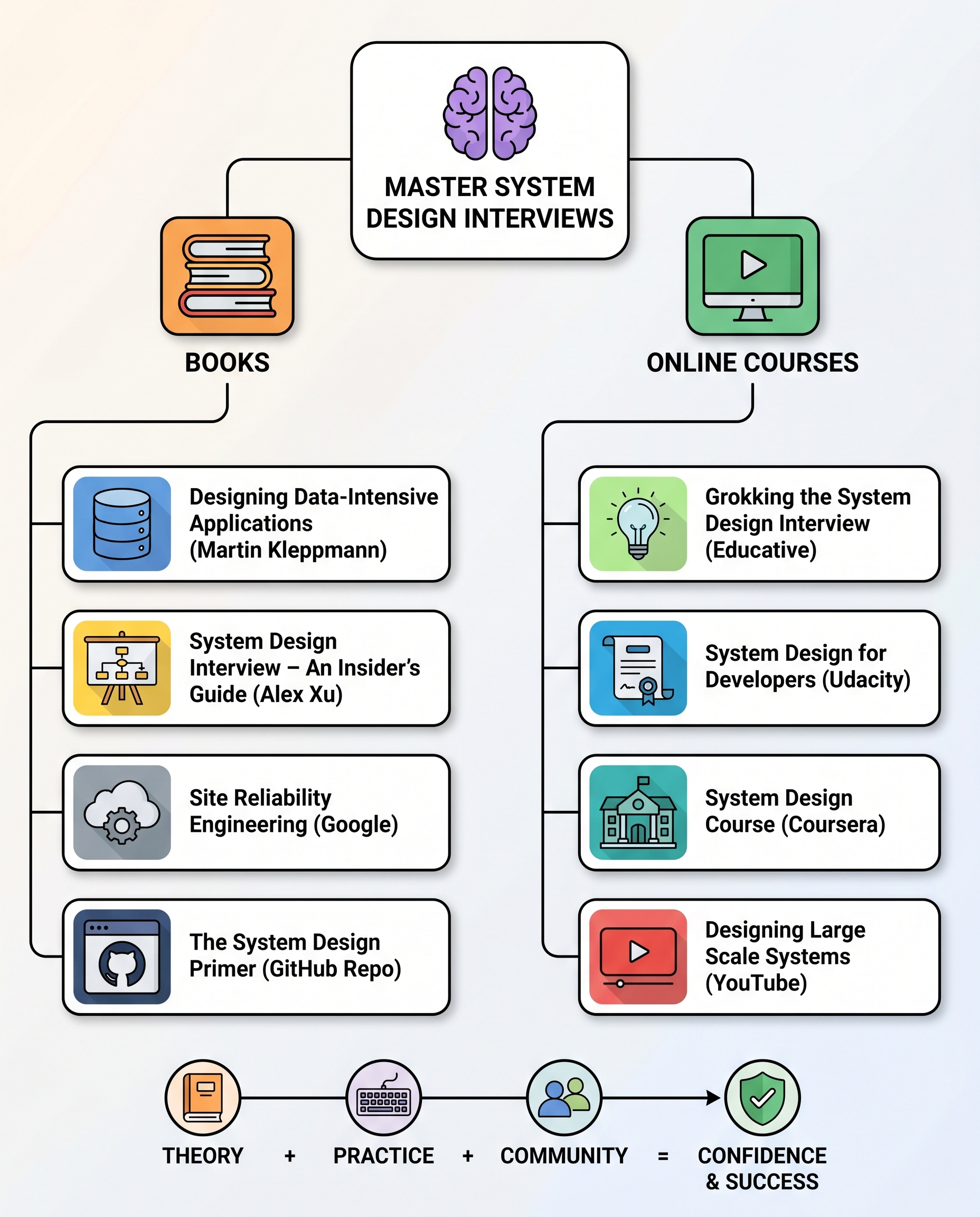
Designing Data-Intensive Applications (Martin Kleppmann)
- Deep, principled coverage of storage engines, replication, partitioning, consistency models, stream processing, and trade-offs. Read for conceptual clarity and mental models.
System Design Interview – An Insider's Guide (Alex Xu)
- Practical, interview-focused patterns and step-by-step walkthroughs. Great for learning how to structure answers and what interviewers expect.
Site Reliability Engineering (Google)
- Real-world ops knowledge: SRE principles, SLIs/SLOs/SLAs, monitoring, incident response, and operational trade-offs. Helps you design systems that are not just functional but operable.
System Design Primer (GitHub)
- Community-driven, concise checklists, diagrams, and common interview prompts. Use this as a quick reference and to find sample questions.
Then practice with
Grokking the System Design Interview (Educative)
- Guided walkthroughs of frequently asked designs with emphasis on trade-offs and incremental improvements. Good for timed practice.
Udacity (System Design courses)
- Project-based lessons and practical exercises to build end-to-end systems and reinforce hands-on thinking.
Coursera (System architecture / cloud courses)
- University-level and cloud-provider courses that explain large-scale design and real-world case studies.
YouTube: Designing Large-Scale Systems (channels like Gaurav Sen, Tech Dummies, System Design Primer videos)
- Short, focused video explanations and whiteboard-style walkthroughs. Use videos to reinforce concepts and watch multiple takes on the same problem.
How to use these resources effectively
- Read to build mental models
- Start with Kleppmann and SRE to form a conceptual foundation. These explain why things behave the way they do.
- Learn interview structure and patterns
- Use Alex Xu and the System Design Primer to learn a repeatable interview flow and common component choices.
- Practice deliberately
- Work through Grokking and project-based courses. Time yourself and verbalize every decision.
- Watch and imitate
- Watch multiple designers solve the same problem on YouTube to see different approaches and phrasing.
- Iterate with mock interviews
- Practice with peers or coaches. Record sessions and review weaknesses.
A simple 4-week study plan (example)
- Week 1 — Core concepts
- Read chapters on storage, replication, and consistency. Make flash summaries of patterns and guarantees.
- Week 2 — Patterns & architecture
- Study caches, queues, load balancing, databases, and CAP/consistency trade-offs. Sketch 3 common systems: URL shortener, chat, and feed.
- Week 3 — Guided practice
- Do 4–6 guided walkthroughs (Grokking/Educative). Time yourself and refine your verbal flow.
- Week 4 — Mock interviews & polish
- Do 6–8 mock interviews, review failure modes, and prepare crisp trade-off explanations and metrics (latency, throughput, error budget).
Adjust pace depending on time until your interview.
Interview checklist: a repeatable workflow
- Clarify requirements
- Ask about scale, latency, data volume, consistency, feature constraints, and non-functional requirements.
- Define metrics & SLAs
- Choose key metrics (QPS, latency P99, durability) and acceptable SLOs.
- Estimate scale
- Pick reasonable numbers (users, requests per second, payload size) and use them to size components.
- High-level design
- Draw components: clients, API layer, load balancers, caches, services, databases, queues, and CDNs.
- Data modeling & storage choices
- Choose SQL vs NoSQL, explain partitioning, replication, indexing, and consistency trade-offs.
- Detailed subsystems
- Caching, replication strategy, queues for async work, backpressure, and rate limiting.
- Reliability & operations
- Failure modes, retries, circuit breakers, monitoring, alerts, backup/restore, and capacity planning.
- Trade-offs & alternatives
- Discuss simpler options, bottlenecks, and how changes shift latency/availability/cost.
- Summarize
- Recap your design, trade-offs, and next steps for production rollout.
Topics to master (quick list)
- Consistency models, replication, and partition tolerance (CAP)
- Caching strategies and invalidation
- Load balancing and autoscaling
- Databases: vertical vs horizontal scaling, sharding, indexing
- Queues, event-driven design, and stream processing
- CDNs, latency optimization, and caching layers
- Monitoring, SLIs/SLOs, error budgets, and incident response
- Security, authentication, and privacy basics
Final rule
Read to learn; design to win. With the right resources and deliberate practice you stop guessing and start reasoning confidently about trade-offs.
#SystemDesign #SoftwareEngineering #TechInterviews
About the author
bugfree.ai is an advanced AI-powered platform designed to help software engineers master system design and behavioral interviews. Whether you’re preparing for your first interview or aiming to elevate your skills, bugfree.ai provides a robust toolkit tailored to your needs. Key Features:
150+ system design questions: Master challenges across all difficulty levels and problem types, including 30+ object-oriented design and 20+ machine learning design problems. Targeted practice: Sharpen your skills with focused exercises tailored to real-world interview scenarios. In-depth feedback: Get instant, detailed evaluations to refine your approach and level up your solutions. Expert guidance: Dive deep into walkthroughs of all system design solutions like design Twitter, TinyURL, and task schedulers. Learning materials: Access comprehensive guides, cheat sheets, and tutorials to deepen your understanding of system design concepts, from beginner to advanced. AI-powered mock interview: Practice in a realistic interview setting with AI-driven feedback to identify your strengths and areas for improvement.
bugfree.ai goes beyond traditional interview prep tools by combining a vast question library, detailed feedback, and interactive AI simulations. It’s the perfect platform to build confidence, hone your skills, and stand out in today’s competitive job market. Suitable for:
New graduates looking to crack their first system design interview. Experienced engineers seeking advanced practice and fine-tuning of skills. Career changers transitioning into technical roles with a need for structured learning and preparation.
Comments
Join the discussionNo comments yet. Be the first to comment.