Posted by Bugfree users — a high-score Amazon Data Scientist interview experience that covers both depth and breadth.
Overview
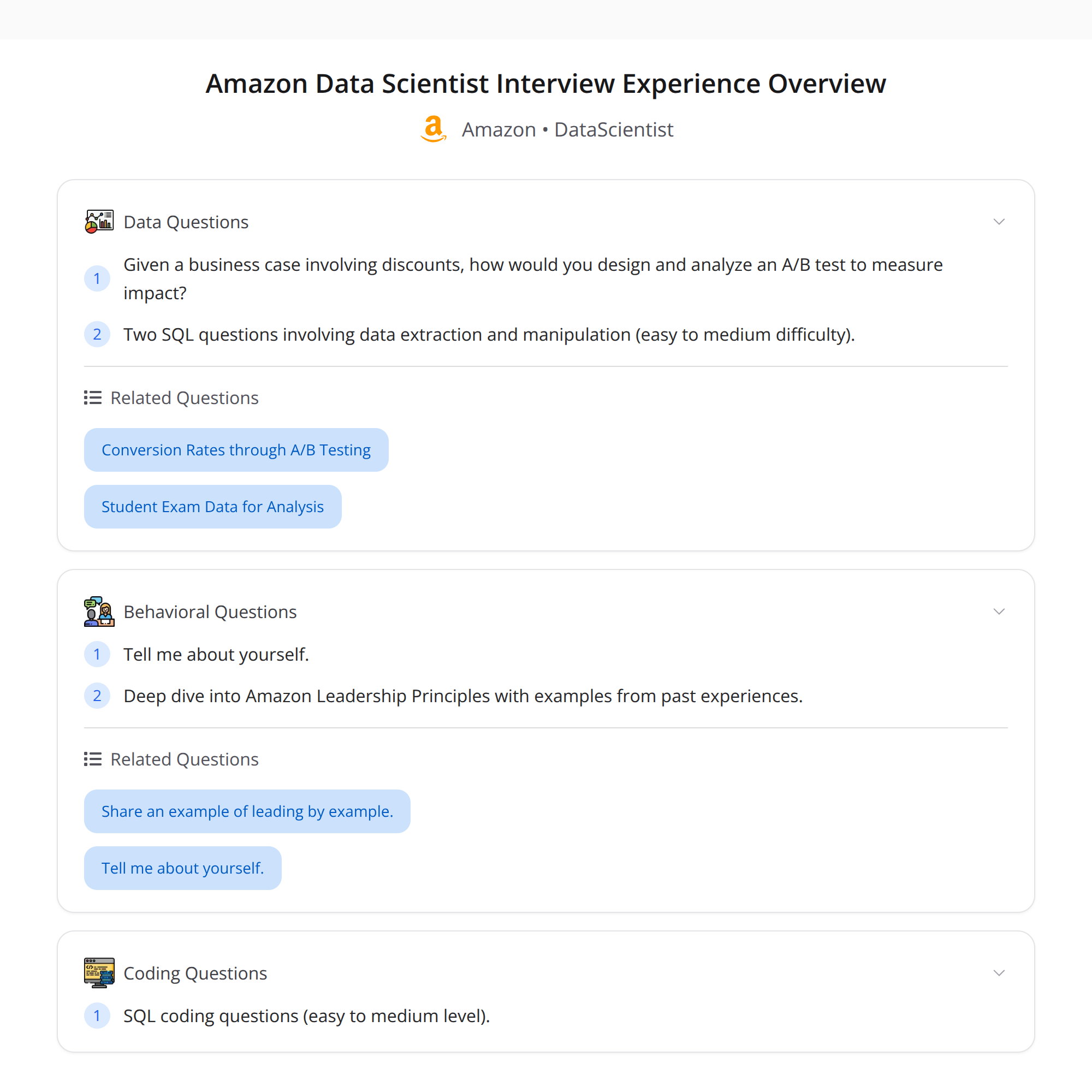
This write-up summarizes a successful Amazon Data Scientist interview experience shared by Bugfree users. The loop included a classic opener, a deep project walkthrough, a business case focused on A/B testing, technical SQL rounds, and a thorough behavioral assessment against Amazon Leadership Principles.
Key sections you can expect:
- "Tell me about yourself" and how to structure it
- Project walkthrough (goals, methods, impact) using the STAR framework
- Business case: A/B test around a discount scenario — design, analysis, decision-making
- Technical SQL: 2 questions (easy–medium), focused on extracting insights efficiently
- Behavioral interview: strong emphasis on Amazon Leadership Principles with real examples
How the interview flowed (what to expect)
Opening: "Tell me about yourself"
- Keep it concise (2–3 minutes). Highlight your background, most relevant technical strengths, and one or two high-impact projects.
- End with a transition: a sentence connecting your experience to the role you’re interviewing for.
Project deep-dive
- Interviewers will ask you to walk through a past project in detail: goals, your role, methods, trade-offs, results, and business impact.
- Use the STAR structure (Situation, Task, Action, Result) and quantify impact where possible (e.g., revenue uplift, conversion increase, latency improvement).
Business case: A/B testing (discount scenario)
- Expect a real-world business case focused on testing a pricing or discount change. You may be asked to:
- Formulate hypotheses (e.g., discount increases conversion but reduces margin)
- Choose primary and guardrail metrics (conversion rate, revenue per user, average order value)
- Design the experiment (sample size, randomization, duration, segmentation)
- Describe analysis and decision rules (statistical significance, confidence intervals, p-values, Bayesian alternatives)
- Consider operational concerns (sampling bias, seasons, overlapping experiments)
- Be ready to defend trade-offs and propose an action plan depending on outcomes.
- Expect a real-world business case focused on testing a pricing or discount change. You may be asked to:
Technical rounds: SQL (2 questions, easy–medium)
- Typical themes: data cleaning, joins, aggregations, window functions, deduplication, and performance considerations.
- Expect to explain thought process and optimize for readability and efficiency.
Behavioral: Amazon Leadership Principles
- Interviewers heavily probe alignment with Leadership Principles using real examples. Prepare 4–6 concise STAR stories mapped to principles like Customer Obsession, Ownership, Dive Deep, Bias for Action, and Deliver Results.
Preparation checklist and practical tips
Tell-me-about-yourself
- 2–3 minute pitch focused on role-relevant skills and results.
- End by connecting your background to the role.
Project Walkthrough
- Prepare 2–3 projects. For each, have clear answers for: problem statement, your contributions, technical approach, key trade-offs, and quantifiable results.
A/B Testing Case
- Practice structuring experiments: define hypothesis, metrics, sample-size calculation (mention power, alpha), stopping rules, and guardrails.
- Know common pitfalls: peeking, multiple testing, seasonality, and interference.
SQL Practice
- Brush up on joins, GROUP BY, window functions (ROW_NUMBER(), RANK(), PARTITION BY), CTEs, and writing readable, performant queries.
- Practice timed SQL exercises on platforms like LeetCode, Mode Analytics SQL, or HackerRank.
Leadership Principles
- Prepare STAR stories mapped to principles. Keep them specific, recent, and measurable.
Communication
- Talk through assumptions, ask clarifying questions, and summarize trade-offs and next steps.
Sample prompts & sample framing (brief)
"Tell me about yourself"
- "I’m a data scientist with X years of experience in [domain]. I focus on causal inference and experimentation. In my last role I led an A/B test that improved conversion by Y% while preserving margin, and I’m excited about applying that to Amazon’s large-scale experimentation platform."
A/B test design (discount)
- Hypothesis: "Offering a 10% discount increases conversion rate by at least 3%, while revenue per user does not decline by more than 2%."
- Metrics: primary = conversion rate; secondary/guardrail = average order value, revenue per user, refund rate.
- Decision rule: predefine significance (alpha = 0.05), power (80%), and minimum detectable effect; use sequential testing safeguards if running continuous monitoring.
SQL question example (conceptual)
- "Give me the top 3 products with the most month-over-month growth in unique buyers."
- Tips: outline steps first (filter date range, aggregate buyers per product per month, compute growth, rank), then write the query using CTEs and window functions.
Final advice
- Be specific and data-driven. Quantify impact wherever possible.
- Show clear thinking: structure your answers, call out assumptions, and explain trade-offs.
- Prepare Leadership Principle stories—these matter as much as technical ability at Amazon.
Good luck — use this structure to practice mock interviews and refine concise, measurable examples.
#DataScience #SQL #InterviewPrep
About the author
bugfree.ai is an advanced AI-powered platform designed to help software engineers master system design and behavioral interviews. Whether you’re preparing for your first interview or aiming to elevate your skills, bugfree.ai provides a robust toolkit tailored to your needs. Key Features:
150+ system design questions: Master challenges across all difficulty levels and problem types, including 30+ object-oriented design and 20+ machine learning design problems. Targeted practice: Sharpen your skills with focused exercises tailored to real-world interview scenarios. In-depth feedback: Get instant, detailed evaluations to refine your approach and level up your solutions. Expert guidance: Dive deep into walkthroughs of all system design solutions like design Twitter, TinyURL, and task schedulers. Learning materials: Access comprehensive guides, cheat sheets, and tutorials to deepen your understanding of system design concepts, from beginner to advanced. AI-powered mock interview: Practice in a realistic interview setting with AI-driven feedback to identify your strengths and areas for improvement.
bugfree.ai goes beyond traditional interview prep tools by combining a vast question library, detailed feedback, and interactive AI simulations. It’s the perfect platform to build confidence, hone your skills, and stand out in today’s competitive job market. Suitable for:
New graduates looking to crack their first system design interview. Experienced engineers seeking advanced practice and fine-tuning of skills. Career changers transitioning into technical roles with a need for structured learning and preparation.
Comments
Join the discussionNo comments yet. Be the first to comment.