Caching isn’t just about speed — it’s a contract about consistency and durability. When an interviewer asks you to choose between write-through and write-back (write-behind) cache strategies, they’re testing your ability to weigh consistency guarantees against write performance and system complexity.
Quick definitions
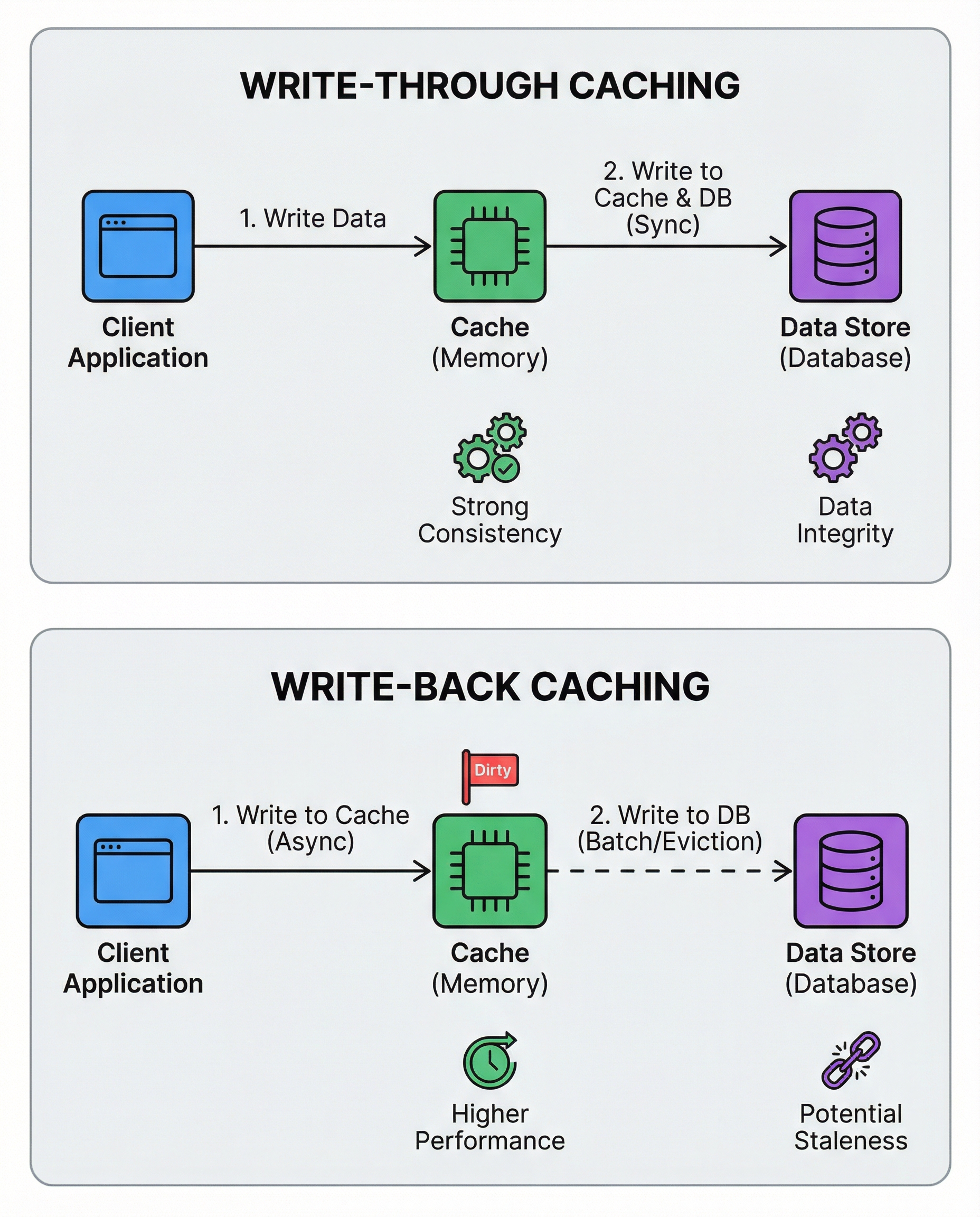
- Write-through: Every write goes to the cache and the backing store (database) synchronously. Simple and predictable; strong consistency.
- Write-back (write-behind): Writes go to the cache first and are flushed to the backing store later (often on eviction or in batched intervals). Fast for writes but riskier for durability and consistency.
Pros and cons
Write-through
- Pros:
- Stronger consistency: cache and DB stay in sync after the write returns.
- Simpler to reason about and debug.
- Safer for critical workloads (financial data, order state).
- Cons:
- Higher write latency: every write pays the cost of both cache and DB writes.
- Fewer gains for write-heavy workloads.
Write-back
- Pros:
- Lower write latency: clients return quickly after updating cache.
- Efficient for heavy write loads via batching and reduced DB IOPS.
- Cons:
- Risk of lost or stale data if the cache fails before flushing.
- More complex: eviction policies, flush scheduling, and failure handling.
- Harder to ensure strong consistency and durability.
When to pick which
Choose write-through when:
- You need strong consistency and durability immediately (payments, account balances, inventory control).
- Simplicity and predictability matter more than raw write throughput.
Choose write-back when:
- You have very high write volume and can tolerate eventual consistency.
- Latency for the write operation is critical and you can accept complexity to gain throughput.
Failure modes and mitigations
- Risk: data loss if cache crashes before flushing.
- Mitigations: write-ahead logs (WAL), persistent cache (AOF/RDB for Redis), replicate cache, use reliable message queues for flush tasks.
- Risk: stale reads / read-after-write inconsistency.
- Mitigations: read-through for hot keys, strong read-your-writes guarantees at application level, versioning or sequence numbers.
- Risk: complexity in eviction and batching logic.
- Mitigations: bounded batch intervals, backpressure, and observability (metrics/alerts for flush lag).
Hybrid and alternatives
- Write-around: Write directly to DB and populate cache on reads — good when writes rarely hit the same keys.
- Primary-backup or consensus-based approaches: Use a durable, replicated store as the primary and cache for reads (sacrifices some cache performance for stronger durability).
How to answer this in an interview (short script)
"Caching is more than speed—it's a consistency decision. I’d pick write-through when I need immediate durability and strong consistency (e.g., financial data). I’d pick write-back for high-ingest workloads where eventual consistency is acceptable, but I’d add durability safeguards (WAL/replication) and careful flush/error handling. Ultimately, the choice depends on the consistency requirements versus acceptable write latency and system complexity."
Quick takeaways
- Write-through = simple, predictable, consistent, slower writes.
- Write-back = fast writes, higher throughput, more risk and complexity.
- In interviews, explicitly state the consistency vs latency trade-off and give a short justification tied to the business use case.
#SystemDesign #SoftwareEngineering #TechInterviews
About the author
bugfree.ai is an advanced AI-powered platform designed to help software engineers master system design and behavioral interviews. Whether you’re preparing for your first interview or aiming to elevate your skills, bugfree.ai provides a robust toolkit tailored to your needs. Key Features:
150+ system design questions: Master challenges across all difficulty levels and problem types, including 30+ object-oriented design and 20+ machine learning design problems. Targeted practice: Sharpen your skills with focused exercises tailored to real-world interview scenarios. In-depth feedback: Get instant, detailed evaluations to refine your approach and level up your solutions. Expert guidance: Dive deep into walkthroughs of all system design solutions like design Twitter, TinyURL, and task schedulers. Learning materials: Access comprehensive guides, cheat sheets, and tutorials to deepen your understanding of system design concepts, from beginner to advanced. AI-powered mock interview: Practice in a realistic interview setting with AI-driven feedback to identify your strengths and areas for improvement.
bugfree.ai goes beyond traditional interview prep tools by combining a vast question library, detailed feedback, and interactive AI simulations. It’s the perfect platform to build confidence, hone your skills, and stand out in today’s competitive job market. Suitable for:
New graduates looking to crack their first system design interview. Experienced engineers seeking advanced practice and fine-tuning of skills. Career changers transitioning into technical roles with a need for structured learning and preparation.
Comments
Join the discussionNo comments yet. Be the first to comment.