A/B Testing Fails in Interviews? Use These 5 Alternatives (and Know When)
A/B tests are a go-to for product and growth teams, but they're not always valid or practical. Low traffic, long experiment cycles, cross-experiment interference, or ethical constraints can make A/B testing infeasible. In interviews, hiring managers want to hear that you can diagnose those limitations and propose credible alternative approaches.
Below are five alternatives to A/B testing, when to pick each, their trade-offs, and quick talking points you can use in an interview.
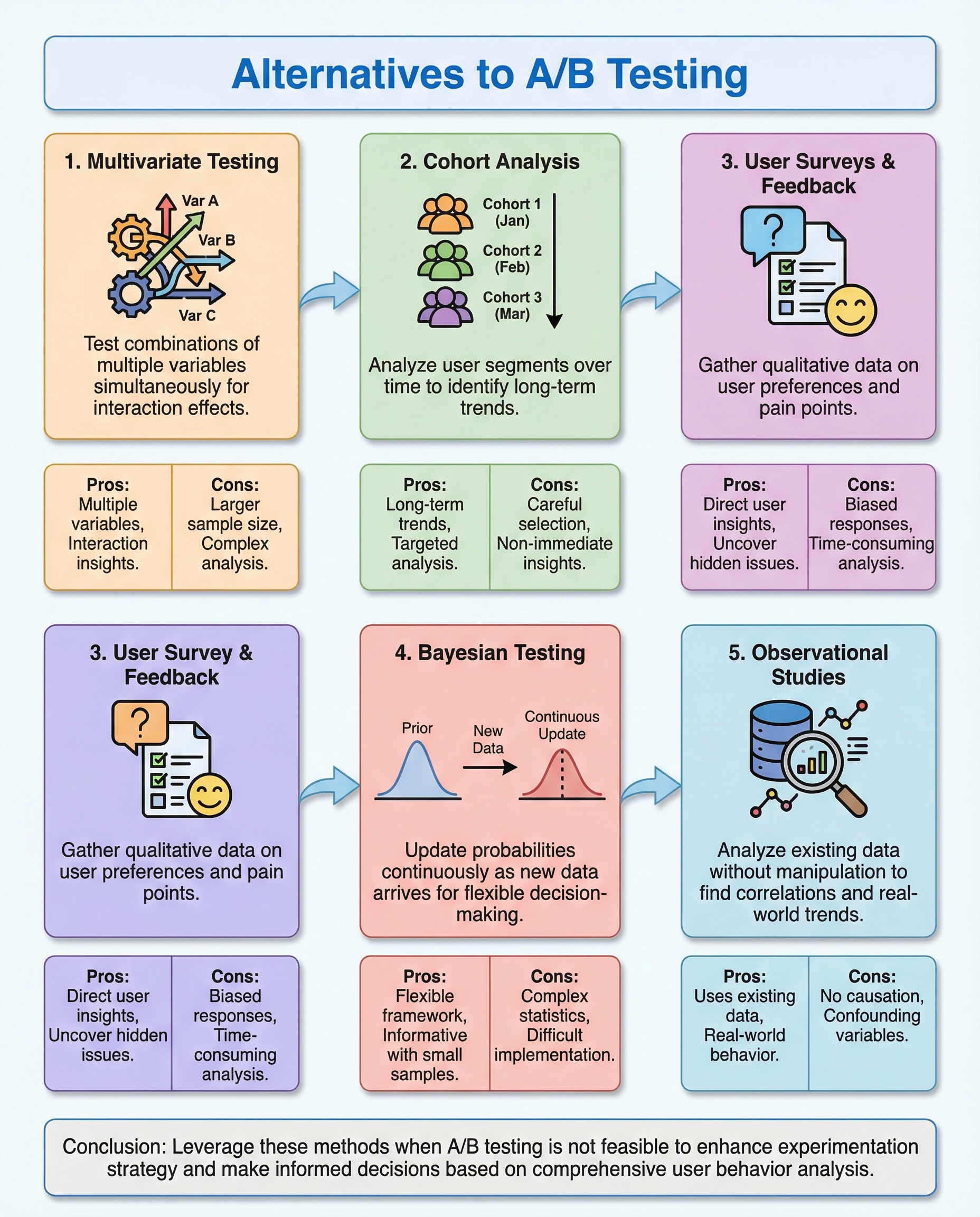
1) Multivariate testing
What it is
- Test combinations of multiple variables (e.g., headline + CTA + image) simultaneously.
When to use
- You have high traffic and want to understand interactions between elements rather than a single factor.
Pros
- Reveals interaction effects between features.
- Can find the best combination instead of isolated improvements.
Cons
- Requires a much larger sample size (combinatorial explosion).
- Complexity in analysis and interpretation.
Interview tip
- Mention power calculations and how you’d limit the number of variants (e.g., fractional factorial designs) to keep sample size realistic.
2) Cohort analysis
What it is
- Segment users by exposure time, signup week, or behavior and compare metrics over time.
When to use
- When you can’t randomize or need to measure long-term effects (retention, LTV).
Pros
- Captures longitudinal behavior and lifecycle effects.
- Good for product changes with delayed impact.
Cons
- Slower to get results.
- Susceptible to confounders if cohorts differ in composition.
Interview tip
- Explain how you’d control for seasonality and cohort composition (e.g., matching or covariate adjustment).
3) Surveys and user feedback
What it is
- Ask users why they behave a certain way through in-product surveys, interviews, or NPS prompts.
When to use
- When you need behavioral drivers, qualitative insight, or hypothesis generation.
Pros
- Quickly uncovers motivations and friction points.
- Low cost and fast to implement for early validation.
Cons
- Response and self-report biases.
- Doesn’t reliably quantify behavior change by itself.
Interview tip
- Combine surveys with behavioral data (triangulation). Describe how you'd design unbiased questions and sample users to avoid survivorship bias.
4) Bayesian approaches
What it is
- Use Bayesian statistics to continuously update beliefs about variants as data arrives.
When to use
- When you want flexible stopping rules, sequential monitoring, or intuitive probability statements (e.g., "there’s a 92% chance variant B is better").
Pros
- Natural for sequential testing and small-sample updating.
- More interpretable probability statements than p-values.
Cons
- Requires statistical expertise and careful choice of priors.
- Can be harder to explain if stakeholders expect classic frequentist outputs.
Interview tip
- Explain how you’d set priors (informative vs. weakly informative) and control for optional stopping to avoid biased conclusions.
5) Observational (causal inference from existing data)
What it is
- Use historical or real-world data with methods like matching, difference-in-differences, regression discontinuity, or instrumental variables to estimate causal effects.
When to use
- When randomization isn’t possible but rich data and natural experiments are available.
Pros
- Leverages existing data without running new experiments.
- Can be powerful when a credible identification strategy exists.
Cons
- Correlation vs. causation risk if assumptions are violated.
- Requires domain knowledge and careful robustness checks.
Interview tip
- Walk through an identification strategy (e.g., pre/post with a control group, or propensity-score matching) and the checks you’d run to validate assumptions.
How to pick the right method (short checklist)
- Constraints: traffic, time, ethics/regulations, and measurement quality.
- Risk tolerance: how costly is a wrong decision? (low-stakes -> faster, qualitative methods OK; high-stakes -> stronger causal methods needed).
- Urgency: need fast insight vs. long-term evidence.
- Data richness: do you have covariates and historical data to support observational causal inference?
In interviews, present a decision tree: state the constraints, list candidate methods, justify your pick, and describe validation and monitoring steps.
Quick sample interview answer
"If traffic is low and the feature impacts retention over months, I’d avoid a classic A/B. I’d either run cohort analyses to track user groups over time or set up a Bayesian sequential test with conservative priors and pre-specified business-risk thresholds. I’d also run short qualitative surveys to surface friction points and combine those signals before making a rollout decision."
Pick the method that matches constraints and decision risk, and be ready to explain trade-offs and validation steps. Interviewers care less about the single "right" method and more about your reasoning.
#DataScience #ProductAnalytics #Experimentation
About the author
bugfree.ai is an advanced AI-powered platform designed to help software engineers master system design and behavioral interviews. Whether you’re preparing for your first interview or aiming to elevate your skills, bugfree.ai provides a robust toolkit tailored to your needs. Key Features:
150+ system design questions: Master challenges across all difficulty levels and problem types, including 30+ object-oriented design and 20+ machine learning design problems. Targeted practice: Sharpen your skills with focused exercises tailored to real-world interview scenarios. In-depth feedback: Get instant, detailed evaluations to refine your approach and level up your solutions. Expert guidance: Dive deep into walkthroughs of all system design solutions like design Twitter, TinyURL, and task schedulers. Learning materials: Access comprehensive guides, cheat sheets, and tutorials to deepen your understanding of system design concepts, from beginner to advanced. AI-powered mock interview: Practice in a realistic interview setting with AI-driven feedback to identify your strengths and areas for improvement.
bugfree.ai goes beyond traditional interview prep tools by combining a vast question library, detailed feedback, and interactive AI simulations. It’s the perfect platform to build confidence, hone your skills, and stand out in today’s competitive job market. Suitable for:
New graduates looking to crack their first system design interview. Experienced engineers seeking advanced practice and fine-tuning of skills. Career changers transitioning into technical roles with a need for structured learning and preparation.
Comments
Join the discussionNo comments yet. Be the first to comment.