Win Analytics Interviews: Validate Footfall Ideas with A/B Tests (Not Opinions)
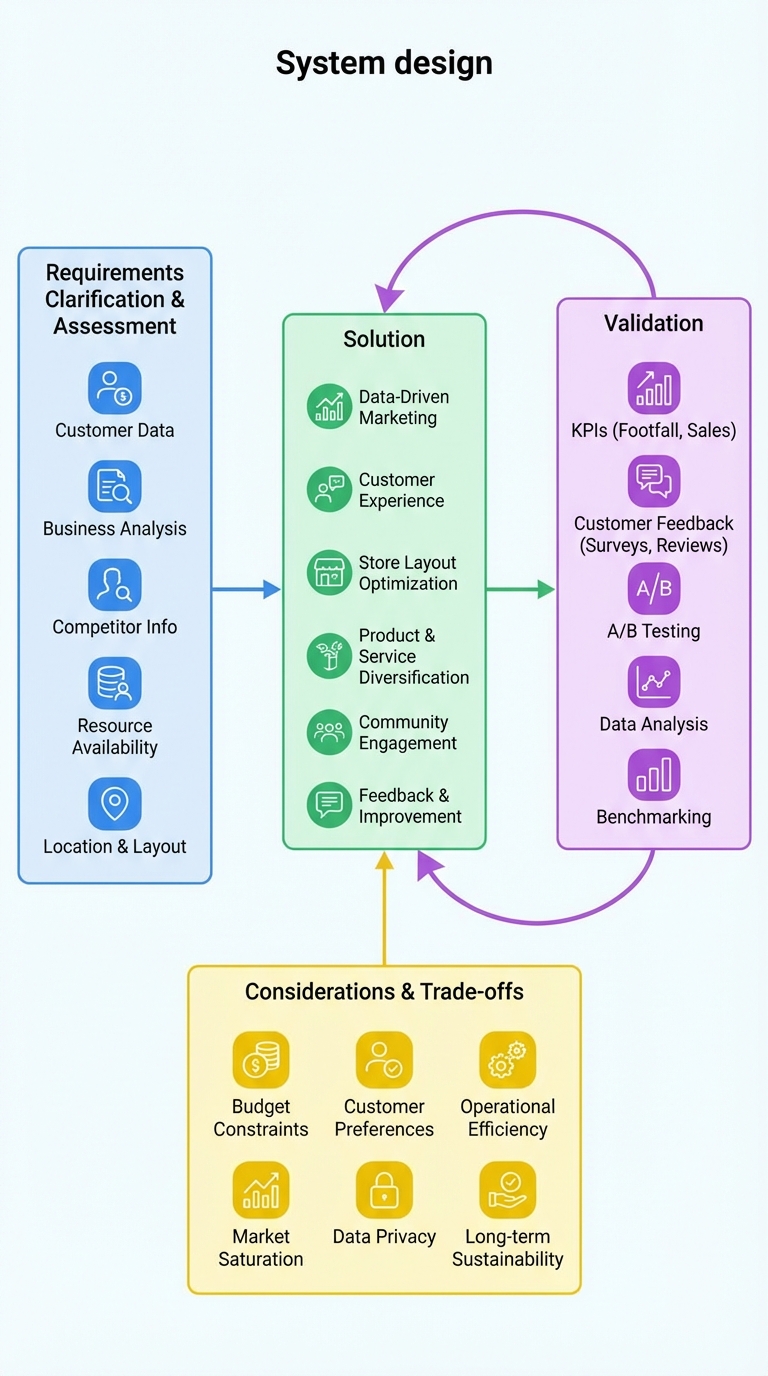
TL;DR: Don’t assert that a loyalty program or promotion “works” — prove it. Define a clear KPI (daily footfall, retention, or average ticket), choose a test unit (store/day/customer), run randomized control vs treatment with identical timing, guard against confounders, report lift and statistical confidence, then decide to scale, iterate, or kill.
Why A/B tests matter for footfall
Business stakeholders often make decisions based on intuition or anecdotes. For analytics interviews (and real product work) the highest-signal evidence is a well-designed A/B test. It replaces opinions with measurable, actionable results you can defend.
Step-by-step: validate a footfall idea
Define the KPI
- Pick the metric that matches the business goal: daily footfall, retention rate, conversion-to-purchase, or average ticket value. Be explicit (e.g., "daily unique customer visits per store").
Choose the test unit and randomization level
- Common units: store, store-day, or customer. Unit choice depends on interference risk and operational constraints. Randomize at the unit level to avoid spillovers.
Design control vs treatment
- Ensure identical timing and context for both groups (same weekdays, marketing calendar, opening hours).
- Use equal exposure windows and balance pre-period metrics if possible.
Precompute sample size and duration
- Run a power calculation for the minimum detectable effect (MDE). Don’t stop early unless pre-registered sequential rules are in place.
Guard against confounders
- Watch for holidays, staffing changes, store refurbishments, local events, and weather.
- Strategies: stratified randomization, blocking (match similar stores), run parallel experiments, or exclude anomalous dates.
Run the test and collect data
- Monitor data quality, missing telemetry, and any operational deviations (e.g., cashier errors).
Analyze and report
- Report absolute and relative lift, with confidence intervals and p-values. Prefer CI + effect size over p-value-only reporting.
- Segment results (by store type, weekday, customer cohort) and run pre-specified heterogeneity checks.
Decide: scale, iterate, or kill
- Scale if lift is business-relevant and robust. Iterate (tweak treatment) if signal exists but not enough ROI. Kill if no lift or negative impact.
Common pitfalls and how to avoid them
- Stopping early: inflates false positives. Predefine stopping rules or use sequential testing methods.
- Operational confounders: coordinate with ops to avoid staffing or promo changes during the test.
- Spillover effects: randomize at a higher level (store instead of customer) if customers cross stores.
- Multiple comparisons: correct for multiplicity when testing many outcomes or segments.
How to present results in an interview
- Lead with the business question and KPI.
- Describe unit choice and why you randomized that way.
- Summarize power calculation and test duration.
- Show lift, confidence intervals, and a decision threshold (e.g., MDE and required ROI).
- Mention confounders you controlled for and any sensitivity checks.
Quick checklist for validating footfall ideas
- [ ] KPI defined and measurable
- [ ] Test unit and randomization plan
- [ ] Power calculation and pre-registered duration
- [ ] Confounder mitigation (blocking/stratification)
- [ ] Data quality monitoring plan
- [ ] Effect size + CI reported, not just p-value
- [ ] Clear decision rule: scale / iterate / kill
A/B tests are the difference between convincing and conjecture. When you can say "we tested, we measured X% lift with Y% confidence," you move from debate to decision — exactly the kind of thinking that wins analytics interviews and drives better product outcomes.
About the author
bugfree.ai is an advanced AI-powered platform designed to help software engineers master system design and behavioral interviews. Whether you’re preparing for your first interview or aiming to elevate your skills, bugfree.ai provides a robust toolkit tailored to your needs. Key Features:
150+ system design questions: Master challenges across all difficulty levels and problem types, including 30+ object-oriented design and 20+ machine learning design problems. Targeted practice: Sharpen your skills with focused exercises tailored to real-world interview scenarios. In-depth feedback: Get instant, detailed evaluations to refine your approach and level up your solutions. Expert guidance: Dive deep into walkthroughs of all system design solutions like design Twitter, TinyURL, and task schedulers. Learning materials: Access comprehensive guides, cheat sheets, and tutorials to deepen your understanding of system design concepts, from beginner to advanced. AI-powered mock interview: Practice in a realistic interview setting with AI-driven feedback to identify your strengths and areas for improvement.
bugfree.ai goes beyond traditional interview prep tools by combining a vast question library, detailed feedback, and interactive AI simulations. It’s the perfect platform to build confidence, hone your skills, and stand out in today’s competitive job market. Suitable for:
New graduates looking to crack their first system design interview. Experienced engineers seeking advanced practice and fine-tuning of skills. Career changers transitioning into technical roles with a need for structured learning and preparation.
Comments
Join the discussionNo comments yet. Be the first to comment.