Stop Rehearsing in a Bubble: Use Feedback to Sharpen Your Behavioral Stories
Behavioral stories don’t get better just because you repeat them. They improve because you test them against other people's perception and sharpen them with targeted feedback.
Why repetition alone fails
- Rehearsal conceals blind spots. You can’t hear what’s missing if you only listen to yourself.
- Answers become scripted rather than authentic—canned responses are easy to spot in interviews.
- You might be focusing on the wrong signals (length, anecdotes) instead of the evidence interviewers care about (impact, problem-solving, trade-offs).
Who to ask
- Peers who know the role or the domain. They’ll flag technical gaps and jargon.
- Mentors who’ve hired or led people in similar roles. They’ll assess whether you’re demonstrating leadership, ownership, or influence.
- Ex-interviewers or recruiters who’ve run interviews for the role. They’ll tell you what convinces them.
How to ask (be specific)
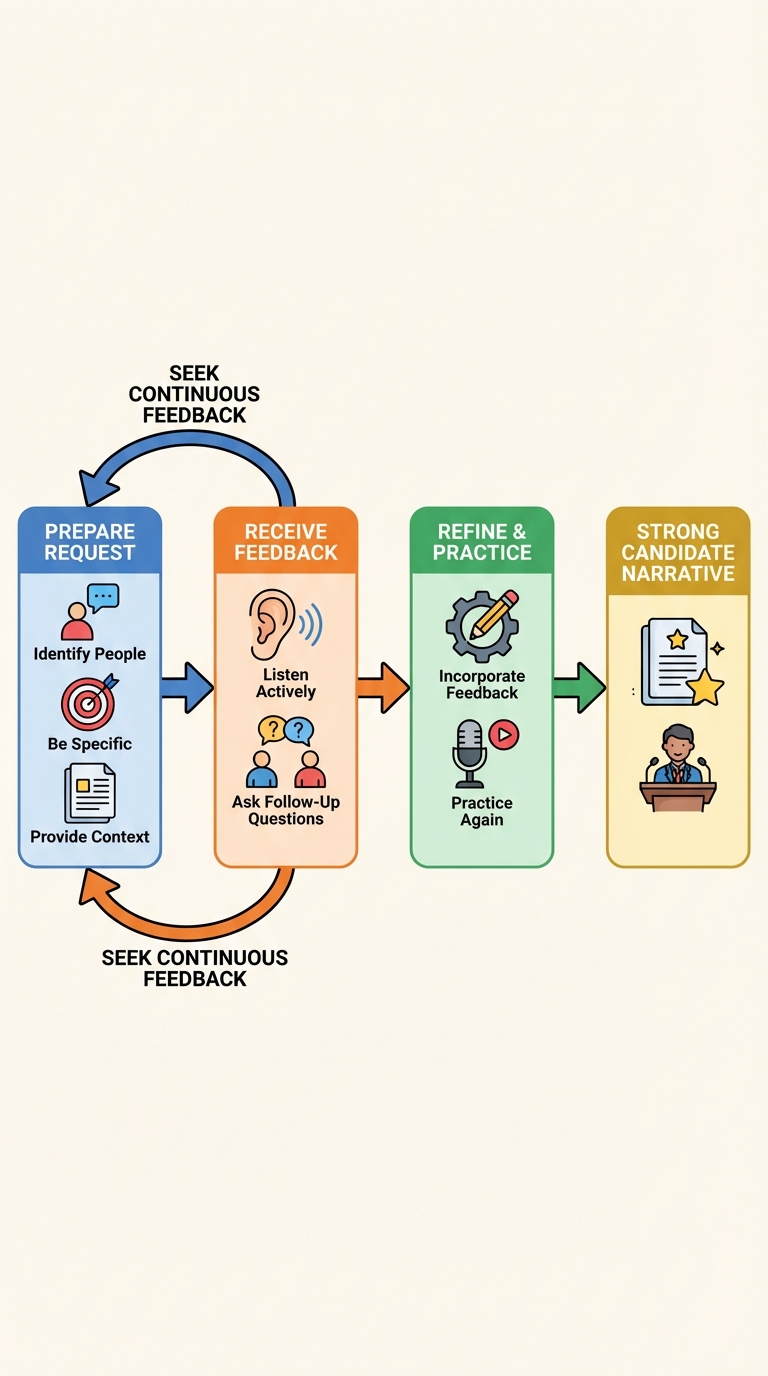
- Give context: role you’re targeting, skills you want to show, and the time limit you expect in an answer.
- Ask focused questions, for example:
- "Where is this unclear?"
- "Does this prove problem-solving or just effort?"
- "What detail would make this answer more convincing?"
- "Can you show me a concrete fix or a better opening line?"
How to receive feedback
- Listen without defending. Defensive responses shut down useful critique.
- Take concise notes and repeat the suggested change back to confirm you understood.
- Ask for an example: "If I add one sentence to prove impact, what would you say?"
How to apply feedback
- Apply feedback selectively—preserve your authentic voice and the facts of the story.
- Prioritize changes that increase clarity, show impact, or remove ambiguity.
- Practice the revised story briefly to internalize the flow, then test it again with another reviewer.
Iteration is the skill
Treat rehearsal as a loop, not a one-time polish: ask, listen, revise, practice, repeat. Over time, you’ll build stories that are clear, evidence-based, and still unmistakably you.
#InterviewPrep #BehavioralInterview #CareerGrowth
About the author
bugfree.ai is an advanced AI-powered platform designed to help software engineers master system design and behavioral interviews. Whether you’re preparing for your first interview or aiming to elevate your skills, bugfree.ai provides a robust toolkit tailored to your needs. Key Features:
150+ system design questions: Master challenges across all difficulty levels and problem types, including 30+ object-oriented design and 20+ machine learning design problems. Targeted practice: Sharpen your skills with focused exercises tailored to real-world interview scenarios. In-depth feedback: Get instant, detailed evaluations to refine your approach and level up your solutions. Expert guidance: Dive deep into walkthroughs of all system design solutions like design Twitter, TinyURL, and task schedulers. Learning materials: Access comprehensive guides, cheat sheets, and tutorials to deepen your understanding of system design concepts, from beginner to advanced. AI-powered mock interview: Practice in a realistic interview setting with AI-driven feedback to identify your strengths and areas for improvement.
bugfree.ai goes beyond traditional interview prep tools by combining a vast question library, detailed feedback, and interactive AI simulations. It’s the perfect platform to build confidence, hone your skills, and stand out in today’s competitive job market. Suitable for:
New graduates looking to crack their first system design interview. Experienced engineers seeking advanced practice and fine-tuning of skills. Career changers transitioning into technical roles with a need for structured learning and preparation.
Comments
Join the discussionNo comments yet. Be the first to comment.