Unsupervised Feature Extraction: What Interviewers Expect You to Know
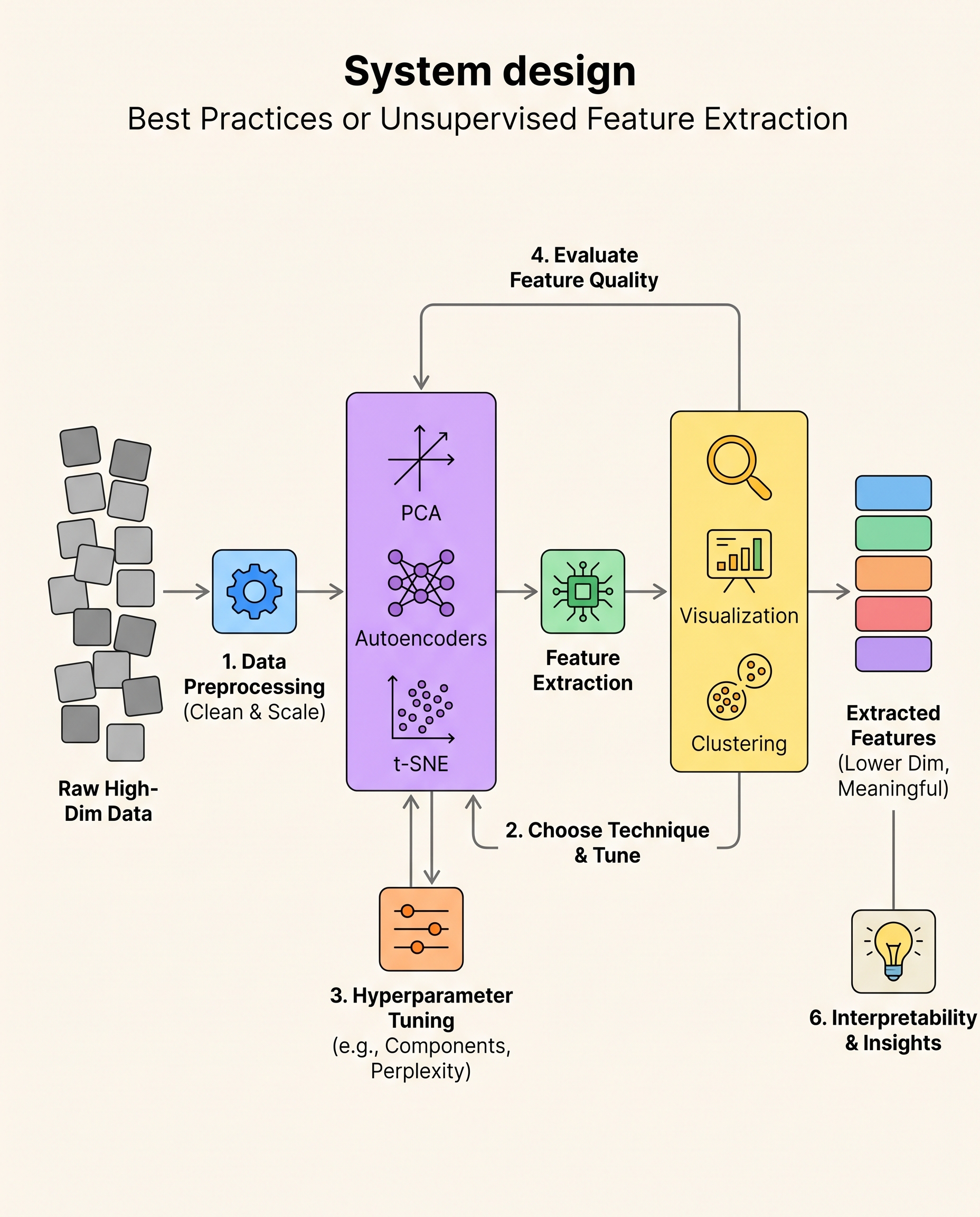
Unsupervised feature extraction turns high-dimensional data into compact, useful representations without labels. Interviewers expect you to know not just the names of methods, but when to use them, how to tune them, and how to validate results. Below is a practical, interview-friendly guide with concrete steps, trade-offs, and a quick checklist.
1) Preprocess first
Good features start with good data. Cover these basics before applying any dimensionality reduction:
- Handle missing values (imputation: mean/median, KNN, model-based) and be explicit about why you chose one method.
- Deal with outliers (capping, winsorization, robust scalers) when they distort the representation.
- Scale or normalize (StandardScaler, MinMax) — many methods assume zero mean/unit variance.
- Encode categoricals appropriately (one-hot, ordinal) or use embeddings for high-cardinality features.
- Reduce noise or sparsity when needed (variance thresholding, TF-IDF for text, hashing for very high-cardinality features).
Pro tip: run a quick PCA or variance-explained check to see if meaningful structure exists before complex modeling.
2) Pick the right tool (and why)
Match the method to the goal (compression vs visualization vs interpretability):
PCA (Principal Component Analysis)
- Use for linear compression, speed, and interpretability (loadings).
- Choose n_components based on explained variance (e.g., keep 90–95%).
- Useful as a preprocessing step for other methods.
t-SNE
- Non-linear visualization tool that preserves local neighborhoods — great for 2D/3D plots but not for general-purpose embeddings.
- Sensitive to perplexity, learning rate, and initialization; not deterministic unless seed fixed.
- Avoid over-interpreting global distances.
UMAP
- Faster than t-SNE, often preserves more global structure, good for visualization and downstream tasks.
- Key hyperparameters: n_neighbors, min_dist.
Autoencoders
- Learn non-linear embeddings via neural networks; flexible (denoising, variational, sparse).
- Good when you expect complex structure and have enough data; latent dimension is the bottleneck to tune.
Other methods
- NMF: parts-based, interpretable for non-negative data.
- ICA: independent components for signal separation.
- Sparse PCA, Factor Analysis for specific interpretability or noise models.
3) Tune key hyperparameters (know the important ones)
Interviewers often ask which parameters you’d tune and why. Examples:
- PCA: n_components (explained variance), svd_solver for performance.
- t-SNE: perplexity (effective neighborhood size), learning_rate, n_iter, early_exaggeration, init.
- UMAP: n_neighbors (local vs global structure), min_dist (tightness of clusters), metric.
- Autoencoders: latent_dim, architecture depth/width, activation, regularization (L1/L2, dropout), optimizer/learning rate, batch_size, epochs.
Also tune preprocessing choices (scaler, imputation) and remember to fix random seeds for reproducibility when demonstrating results.
4) Validate feature quality
Unsupervised methods don’t have labels, so use multiple validation strategies:
- Visual checks: 2D/3D plots (PCA, t-SNE, UMAP) to inspect cluster separation and outliers.
- Clustering + metrics: run K-means/DBSCAN and compute silhouette score, Calinski-Harabasz, or Davies-Bouldin.
- Downstream task: train a simple supervised model (logistic regression, random forest) on the extracted features and compare performance.
- Reconstruction/error measures: for autoencoders, monitor reconstruction loss; for PCA, look at reconstruction error or explained variance.
- Stability: test sensitivity to random seeds, subsampling, and hyperparameter changes.
- Interpretability checks: examine PCA loadings, NMF components, or perturbation-based feature importance for model-based embeddings.
5) Combine methods (practical patterns)
Combining techniques often yields better results in practice:
- PCA → t-SNE/UMAP: reduce to a moderate dimension (e.g., 30–50) with PCA to denoise and speed up t-SNE/UMAP.
- Ensemble/concatenate features: combine linear and non-linear embeddings to feed into downstream models.
- Use autoencoders for nonlinear compression, then cluster in latent space.
6) Balance performance with interpretability
This is a common interview topic. Consider these trade-offs:
- Use PCA, NMF, or sparse methods when interpretability matters (you can inspect loadings/components).
- Use autoencoders or manifold methods (t-SNE/UMAP) when you need expressive non-linear representations and have sufficient data, but be ready to justify lack of direct interpretability.
- If both are needed, combine: train a constrained/sparse autoencoder or apply methods that enforce structure.
Interview tips and a short example answer
- Explain your objective (visualization vs feature compression vs noise reduction).
- State your preprocessing choices and why.
- Choose method(s) with rationale (speed, interpretability, nonlinearity).
- Describe how you'd validate (clustering metrics, downstream model performance, stability tests).
Example short answer: "I'd start with imputation and scaling, run PCA to check explained variance, and if the structure looks linear use PCA components. For nonlinear structure or visualization I'd apply UMAP (or t‑SNE) after reducing dimensions with PCA; for production embeddings I'd consider an autoencoder and validate via downstream model performance and clustering stability."
Quick checklist to recite in an interview
- Preprocess: impute, handle outliers, scale.
- Pick tool: PCA (linear), UMAP/t‑SNE (visualization), autoencoder (nonlinear).
- Tune: n_components, perplexity/n_neighbors, latent_dim, learning rate.
- Validate: plots, clustering metrics, downstream task, stability.
- Trade-offs: interpretability vs performance; combine methods when useful.
Unsupervised feature extraction is as much art as science: be explicit about choices, validate multiple ways, and communicate trade-offs clearly.
#MachineLearning #DataScience #MLOps
About the author
bugfree.ai is an advanced AI-powered platform designed to help software engineers master system design and behavioral interviews. Whether you’re preparing for your first interview or aiming to elevate your skills, bugfree.ai provides a robust toolkit tailored to your needs. Key Features:
150+ system design questions: Master challenges across all difficulty levels and problem types, including 30+ object-oriented design and 20+ machine learning design problems. Targeted practice: Sharpen your skills with focused exercises tailored to real-world interview scenarios. In-depth feedback: Get instant, detailed evaluations to refine your approach and level up your solutions. Expert guidance: Dive deep into walkthroughs of all system design solutions like design Twitter, TinyURL, and task schedulers. Learning materials: Access comprehensive guides, cheat sheets, and tutorials to deepen your understanding of system design concepts, from beginner to advanced. AI-powered mock interview: Practice in a realistic interview setting with AI-driven feedback to identify your strengths and areas for improvement.
bugfree.ai goes beyond traditional interview prep tools by combining a vast question library, detailed feedback, and interactive AI simulations. It’s the perfect platform to build confidence, hone your skills, and stand out in today’s competitive job market. Suitable for:
New graduates looking to crack their first system design interview. Experienced engineers seeking advanced practice and fine-tuning of skills. Career changers transitioning into technical roles with a need for structured learning and preparation.
Comments
Join the discussionNo comments yet. Be the first to comment.