High-Score (Bugfree Users) Uber Senior Data Scientist Interview: Projects + Product Experiment Design
This post summarizes a high-scoring interview experience for Uber’s Senior Data Scientist role (shared by Bugfree users). Two one-hour technical rounds tested both product/experimentation thinking and project depth — plus a short coding task. Below is a clear breakdown, concrete tips, and sample approaches you can reuse in prep.
Interview structure (high level)
- Two 1-hour technical rounds:
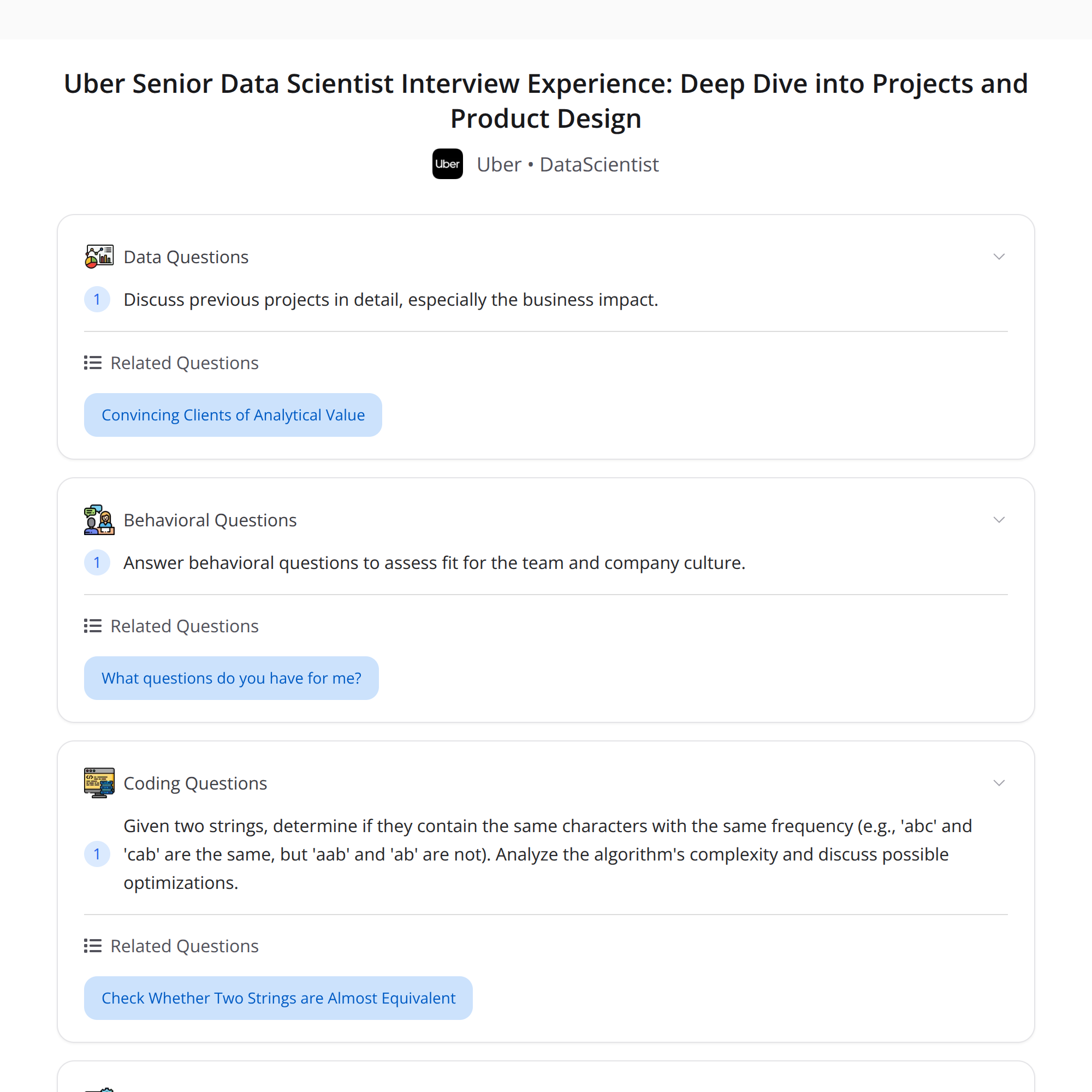
- Round 1 (DS Director): past projects deep-dive, a product launch case focused on experiment design, handling network effects, discussion of instrumental variables (IVs) and their assumptions, and a quick coding problem (anagram check + complexity/optimizations).
- Round 2 (DS Manager): deep follow-up on project details, business impact, and behavioral/fit questions.
Key theme: communicate technical rigor and business outcomes clearly — both matter.
Round 1 — what they asked and how to approach it
1) Past projects
- Expect questions about objectives, signals and metrics, methods, deployment, A/B test validation, and business impact (quantified when possible).
- Structure answers with: context → objective → approach/model → evaluation/metrics → business impact → trade-offs.
2) Product launch case: design an experiment
- Standard experiment design checklist:
- Clarify the goal and primary metric (e.g., DAU, conversion rate, revenue per user).
- Define the population and unit of randomization (user, session, region, cluster).
- Choose treatment and control definitions and ensure randomization is feasible.
- Pre-specify primary and guardrail metrics and success criteria (including minimum detectable effect and power).
- Compute sample size and estimate duration.
- Define monitoring rules, stopping rules, and analysis plan (intent-to-treat vs. per-protocol).
- Plan for rollout and rollback.
3) Handling network effects
- Why they matter: randomization assumptions break when one unit’s treatment affects another unit’s outcome (interference).
- Solutions/approaches:
- Cluster-level randomization (randomize groups rather than individuals).
- Graph cluster / community detection to form clusters with minimal cross-cluster edges.
- Exposure modeling: define and estimate treatment exposure levels rather than binary treatment.
- Encourage designs (peer encouragement) when you can’t force treatment but can randomize encouragement.
- Use observational/causal inference methods with careful assumptions if experimentation isn’t possible.
- “Unlimited supply” nuance: even if supply (e.g., driver availability) is large, network effects can remain via user-to-user externalities (matching quality, social signals). If truly unlimited and independent, some congestion-based network effects vanish; but indirect benefits (word-of-mouth, platform value) may still create interference.
4) Instrumental variables (IVs): when/why & assumptions
- When to use: use IVs when treatment is endogenous (e.g., take-up is correlated with unobserved confounders) but you have a valid instrument that affects treatment assignment and only affects outcome through treatment.
- Main assumptions:
- Relevance: instrument strongly predicts treatment.
- Exclusion restriction: instrument affects the outcome only via the treatment (no direct path).
- Independence: instrument is as good as randomly assigned (unconfounded with outcome).
- (Sometimes) Monotonicity: no units for which the instrument has a negative effect on treatment if it increases treatment for others.
- Practical examples: random assignment to encouragement, geographic variation in policy exposure, or time-based rollouts.
5) Quick coding: check if two strings are anagrams
- Clarify assumptions: character set (ASCII, lowercase letters, unicode), case sensitivity, whitespace.
- Approaches:
- Sorting method: sort both strings and compare. Time: O(n log n) (n = length), Space: O(n).
- Counting method (hashmap or fixed-size array for known alphabet): iterate once and count frequency differences. Time: O(n), Space: O(k) where k is alphabet size.
Sample Python-ish approach (assuming lowercase a–z):
# O(n) time, O(1) extra space if alphabet fixed
def is_anagram(a, b):
    if len(a) != len(b):
        return False
    counts = [0] * 26
    for ch1, ch2 in zip(a, b):
        counts[ord(ch1) - 97] += 1
        counts[ord(ch2) - 97] -= 1
    return all(c == 0 for c in counts)
Notes: use collections.Counter for general unicode and clarity (still O(n) time, O(k) space). Discuss edge cases with the interviewer and optimize based on constraints.
Round 2 — what to expect
- Deep dive into a few projects: interviewers will probe technical details (model choices, feature engineering, validation), edge cases, and deployment/monitoring.
- Business impact & trade-offs: quantify business outcomes, describe alternative approaches you considered, and explain why you chose a particular solution.
- Behavioral fit: use STAR (Situation, Task, Action, Result), focus on leadership, cross-functional influence, and product intuition.
Key takeaways & preparation checklist
- Communicate both technical rigor and business outcomes: always tie your methods back to business metrics and impact.
- For experiment design problems: follow a checklist (goal → unit → metrics → randomization → power → analysis plan) and explicitly call out interference risks.
- For network effects: propose cluster designs, exposure models, and encourage designs; explain why each reduces interference.
- For IVs: state assumptions (relevance, exclusion, independence), give real examples, and explain plausibility checks.
- For coding: clarify constraints, pick an approach, explain complexity, and mention edge cases.
- Behavioral stories: quantify impact, give clear role delineation, and highlight collaboration.
Quick prep plan (1–2 weeks)
- Rehearse 4–6 project summaries focusing on impact and trade-offs.
- Practice 3–5 experiment designs with network interference scenarios.
- Review IV theory and a few applied examples.
- Brush up on small coding problems (string & array manipulations) and practice explaining complexity.
Good luck — remember: clarity, structure, and measurable impact are as important as technical correctness.
#DataScience #ProductAnalytics #Experimentation
About the author
bugfree.ai is an advanced AI-powered platform designed to help software engineers master system design and behavioral interviews. Whether you’re preparing for your first interview or aiming to elevate your skills, bugfree.ai provides a robust toolkit tailored to your needs. Key Features:
150+ system design questions: Master challenges across all difficulty levels and problem types, including 30+ object-oriented design and 20+ machine learning design problems. Targeted practice: Sharpen your skills with focused exercises tailored to real-world interview scenarios. In-depth feedback: Get instant, detailed evaluations to refine your approach and level up your solutions. Expert guidance: Dive deep into walkthroughs of all system design solutions like design Twitter, TinyURL, and task schedulers. Learning materials: Access comprehensive guides, cheat sheets, and tutorials to deepen your understanding of system design concepts, from beginner to advanced. AI-powered mock interview: Practice in a realistic interview setting with AI-driven feedback to identify your strengths and areas for improvement.
bugfree.ai goes beyond traditional interview prep tools by combining a vast question library, detailed feedback, and interactive AI simulations. It’s the perfect platform to build confidence, hone your skills, and stand out in today’s competitive job market. Suitable for:
New graduates looking to crack their first system design interview. Experienced engineers seeking advanced practice and fine-tuning of skills. Career changers transitioning into technical roles with a need for structured learning and preparation.
Comments
Join the discussionNo comments yet. Be the first to comment.