Uber L4 (SDE-2) Interview Experience — OA → DSA Hard → LLD → HLD → Leadership → Offer
This is a concise, high-score interview walkthrough from a candidate in the "Bugfree Users" group who completed the Uber L4 (SDE-2) loop in about eight weeks. It highlights the structure, expectations, and practical tips for each stage: the online assessment (OA), DSA screening and onsite, low-level design (LLD) machine-coding, high-level design (HLD), leadership questions, and the final outcome.
Quick summary
- Timeline: ~8 weeks from OA to offer
- Outcome: Hire, team match, and offer
- OA: 4 questions (target score ~3.5 / 4)
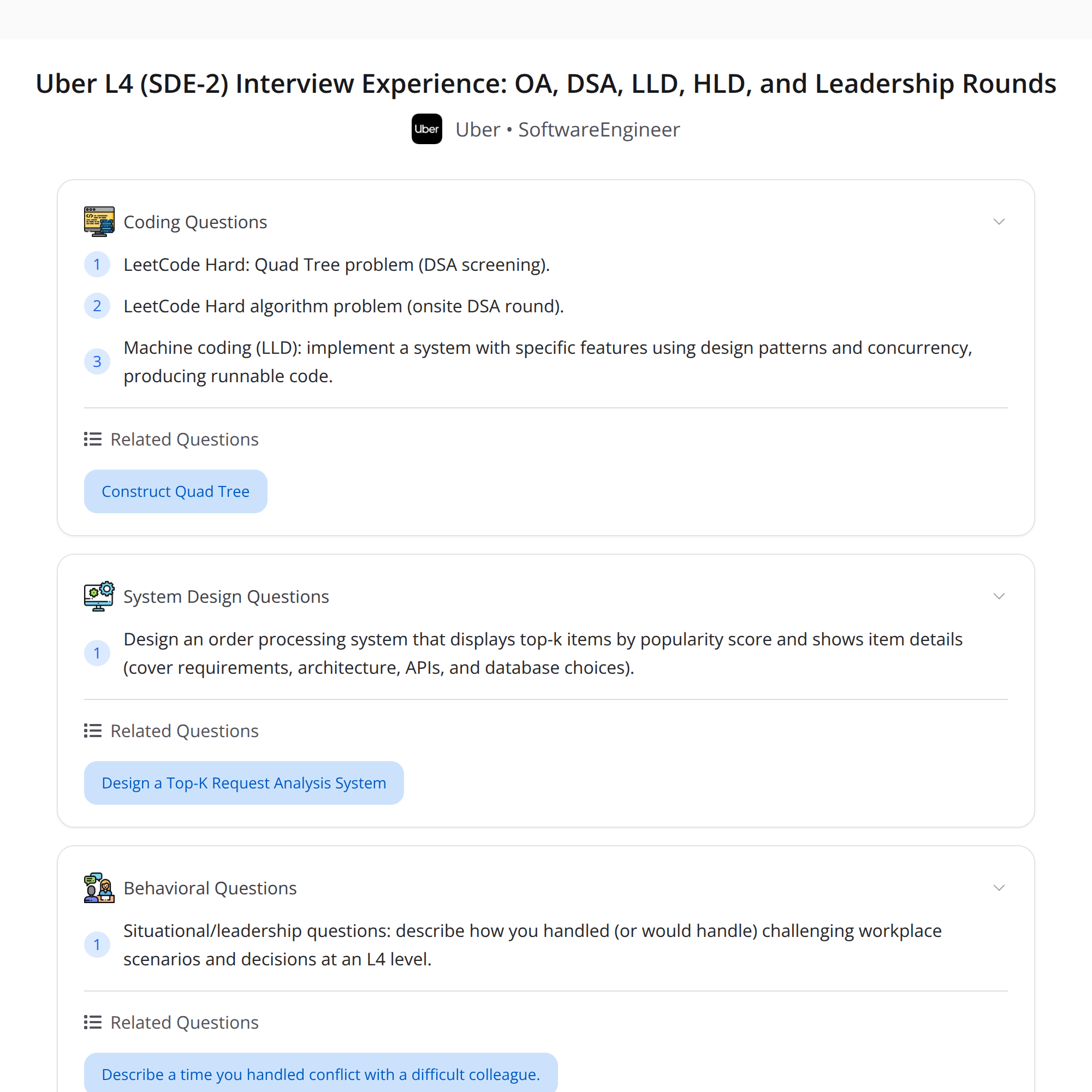
- DSA: LeetCode Hard problems (screen + onsite) — Quad Tree problem included
- Emphasis: correct, test-passing code and clear time/space analysis
- LLD: machine-coding with runnable, well-structured code, design patterns, and concurrency
- HLD: order processing, top‑k popularity, item details — requirements, APIs, architecture, DB trade-offs
- Leadership: situational; focus on operating at L4
Timeline & structure
- Online assessment (OA) — 4 questions
- DSA screening (hard problems) — LeetCode Hard
- Onsite DSA — additional LeetCode Hard-level problems (one involved Quad Trees)
- LLD machine-coding — runnable code, design patterns, concurrency considerations
- HLD — system-level design: order processing, top-k popularity, item details
- Leadership round — situational questions to validate L4 behavior
- Team match and offer
Online assessment (OA)
- Format: 4 coding problems; aim was roughly 3.5 / 4
- Expectation: solve a mix of medium/hard problems with correct, well-tested submissions
- Tip: prioritize correctness and passing edge-case tests over super-optimized micro-optimizations. Clear code and comments help automated graders and reviewers.
DSA screening & onsite DSA
- Difficulty: LeetCode Hard level (screening and onsite)
- Example topic encountered: Quad Trees (spatial/recursion + careful base-case handling)
- Interviewer focus:
- Correctness and robustness (edge cases and tests)
- Clear time and space complexity analysis
- Clean, compilable code (where applicable)
- Tips:
- Practice Hard problems end-to-end—write runnable solutions and test them locally.
- Verbalize your approach, complexity trade-offs, and where bugs might occur.
- For tree/graph/recursion problems, carefully define base cases and invariants.
Low-Level Design (LLD) — machine-coding
- Goal: deliver runnable, well-structured code that demonstrates good design and coding practices
- Requirements encountered:
- Use appropriate design patterns (factory, strategy, etc.) where they simplify extensibility
- Demonstrate thread-safety and concurrency control when required
- Provide unit-testable components and, if requested, sample tests
- Interviewer focus: clarity of interfaces, modular design, readable code, and ability to run through examples
- Tips:
- Keep functions small and single-responsibility; show how components interact.
- If concurrency is involved, discuss locking, immutability, or thread-safe collections rather than only sketching solutions.
- Provide a simple harness or driver that shows how your code can be executed.
High-Level Design (HLD)
Typical HLD topics in this loop:
- Order processing system (ingestion → validation → fulfillment)
- Top-k popularity (ranking and caching strategies)
- Item details (serving read-heavy data, caching, and denormalization)
Interview structure:
- Requirement gathering and clarifying questions
- API design (endpoints, request/response shapes, SLAs)
- High-level architecture (services, queues, caches)
- Database choices and trade-offs (SQL vs NoSQL, consistency, transaction needs)
- Scaling and reliability concerns (sharding, replication, retry semantics)
Tips:
- Start by clarifying functional and non-functional requirements.
- Sketch components and data flow, then dive into one or two parts (DB schema, caching, or queueing) in depth.
- Discuss bottlenecks and trade-offs explicitly—e.g., denormalization for read performance vs. data freshness.
- Consider monitoring, metrics, and failure scenarios.
Leadership round
- Format: situational and behavioral questions focused on operating at L4
- Focus areas:
- Ownership and impact: examples where you drove a project end-to-end
- Mentorship and collaboration: cross-team coordination and influence without authority
- Trade-offs and decision-making under uncertainty
- Tips:
- Use structured examples (STAR: Situation, Task, Action, Result).
- Emphasize measurable outcomes, ambiguity-handling, and how you raised others’ bar.
- Show you can operate at the scope expected of L4 — technical depth plus broader system and team thinking.
Final outcome & notes
- Result: passed interviews, completed team match, and received an offer
- Key success factors called out by this candidate:
- Practice Hard-level DSA problems until solutions are robust and testable
- Write runnable, modular code for LLD problems and explain concurrency choices
- In HLD, prioritize requirement clarification, API design, and justified trade-offs
- Demonstrate L4 leadership through specific, outcome-driven examples
Practical preparation checklist
- DSA
- Solve a steady mix of Hard LeetCode problems; practice explaining complexity.
- Run and test your solutions; cultivate habits for edge-case handling.
- LLD
- Build small, runnable modules that show good patterns and clear interfaces.
- Review basic concurrency primitives and common pitfalls.
- HLD
- Practice structured system designs: clarify requirements, sketch architecture, discuss DB and scaling trade-offs.
- Leadership
- Prepare 4–6 STAR stories showing ownership, trade-offs, and measurable impact.
TL;DR
Uber L4 (SDE-2) loop tested both deep algorithmic skills (LeetCode Hard-level) and practical software engineering (runnable LLD, thoughtful HLD, and L4 leadership). Focus on correctness, testable code, clear complexity analysis, and structured system design. With focused prep and clear communication, the candidate completed the loop in about eight weeks and received an offer.
#SoftwareEngineering #SystemDesign #InterviewPrep
About the author
bugfree.ai is an advanced AI-powered platform designed to help software engineers master system design and behavioral interviews. Whether you’re preparing for your first interview or aiming to elevate your skills, bugfree.ai provides a robust toolkit tailored to your needs. Key Features:
150+ system design questions: Master challenges across all difficulty levels and problem types, including 30+ object-oriented design and 20+ machine learning design problems. Targeted practice: Sharpen your skills with focused exercises tailored to real-world interview scenarios. In-depth feedback: Get instant, detailed evaluations to refine your approach and level up your solutions. Expert guidance: Dive deep into walkthroughs of all system design solutions like design Twitter, TinyURL, and task schedulers. Learning materials: Access comprehensive guides, cheat sheets, and tutorials to deepen your understanding of system design concepts, from beginner to advanced. AI-powered mock interview: Practice in a realistic interview setting with AI-driven feedback to identify your strengths and areas for improvement.
bugfree.ai goes beyond traditional interview prep tools by combining a vast question library, detailed feedback, and interactive AI simulations. It’s the perfect platform to build confidence, hone your skills, and stand out in today’s competitive job market. Suitable for:
New graduates looking to crack their first system design interview. Experienced engineers seeking advanced practice and fine-tuning of skills. Career changers transitioning into technical roles with a need for structured learning and preparation.
Comments
Join the discussionNo comments yet. Be the first to comment.