High-Score (Bugfree Users) Uber L4 / SDE-2 Interview Experience: OA → DSA Hard → LLD → HLD → Leadership → Offer
Posted by Bugfree Users — a high-score Uber L4 (SDE-2) interview experience completed in ~8 weeks. This write-up summarizes each stage, what was asked, how I approached it, and concrete tips you can use when prepping for a similar process.
At-a-glance
- Timeline: ~8 weeks from OA to offer
- Outcome: Hire, team match, and offer
- Key focuses: Correct, test-passing code; clear time/space analysis; runnable LLD code with concurrency and design patterns; system-level trade-offs in HLD; leadership/situational competence at L4
Timeline & Structure
- Online Assessment (OA)
- DSA screening (take-home / online) — LeetCode Hard level
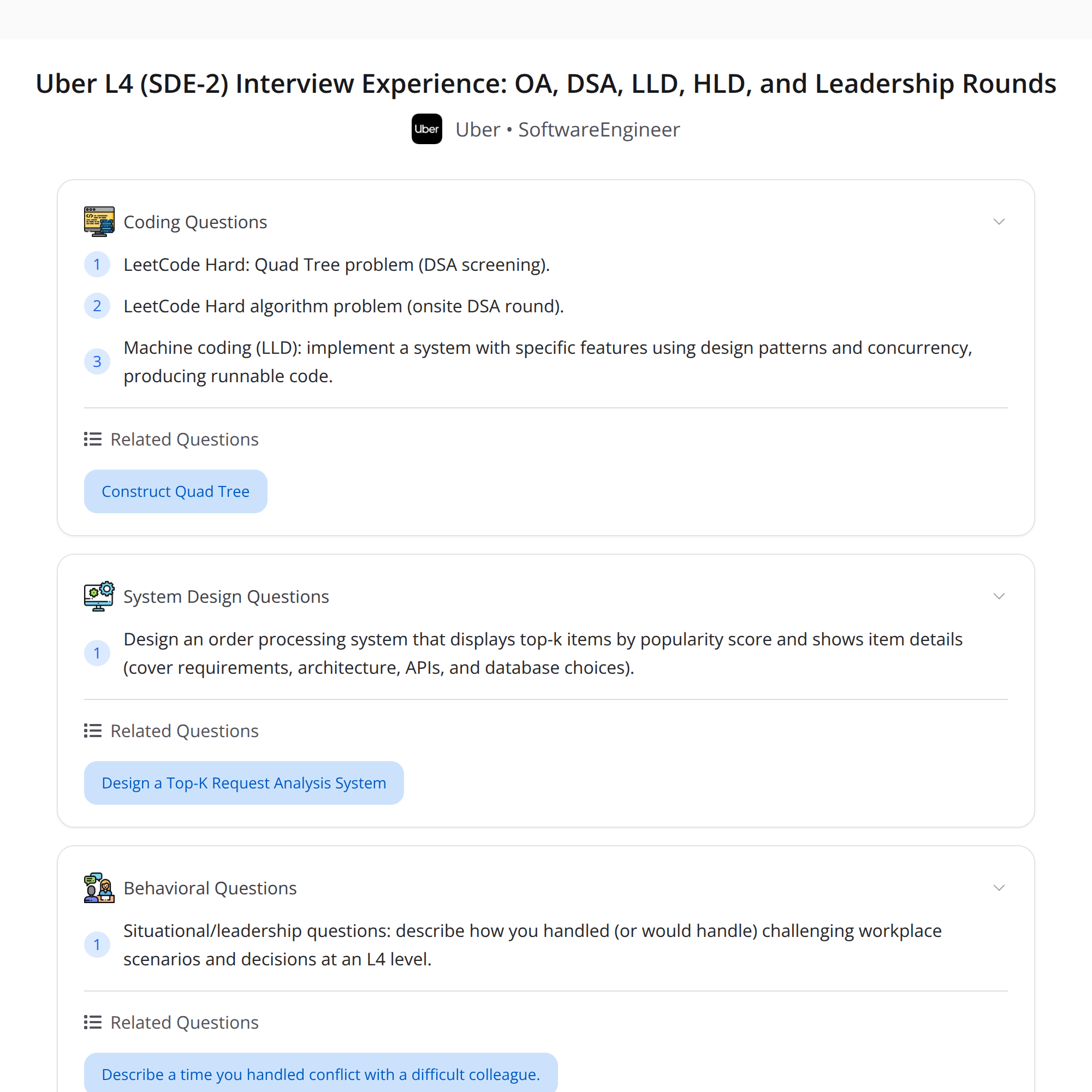
- Onsite DSA interviews — LeetCode Hard topics (incl. Quad Trees)
- Low-Level Design (machine coding) — runnable code, patterns, concurrency
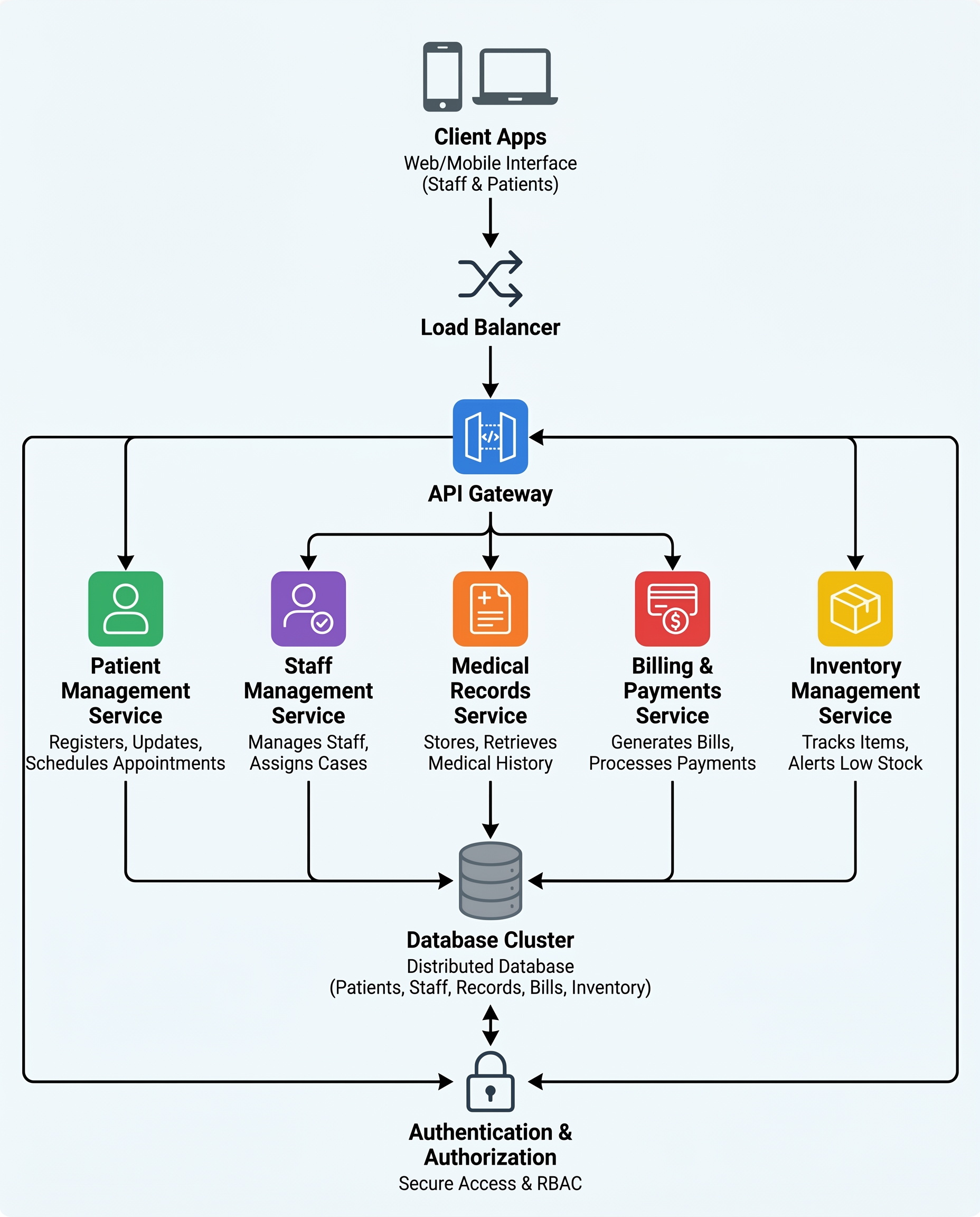
- High-Level Design — order processing, top‑k popularity, item details, DB trade-offs
- Leadership round — situational, L4 expectations
- Team match & offer
Online Assessment (OA)
- Format: 4 questions
- Target: aim to solve ~3.5/4 (good completeness + correctness)
Tips:
- Practice mid-to-hard LeetCode questions under time constraints.
- Prioritize correctness and passing tests over fancy optimizations.
- Write clean code and include brief complexity analysis comments.
DSA Screening & Onsite DSA (Hard)
- Question difficulty: LeetCode Hard
- Example topics: Quad Trees, graph/tree algorithms, advanced dynamic programming
- Interviewers emphasized:
- Correctness (pass all tests)
- Edge-case handling
- Clear time & space complexity analysis
Approach:
- Talk through your plan before coding.
- Start with a brute force if it helps clarify, then optimize.
- Write tests or at least verbalize test cases and edge cases.
- Keep code modular so small helper functions can be tested in isolation.
Low-Level Design (Machine Coding)
- Expectation: runnable, well-structured code that demonstrates engineering quality
- Key assessment areas:
- API / class design and modularity
- Use of design patterns where appropriate
- Concurrency awareness (thread-safety, locks, or concurrent data structures)
- Error handling and input validation
Tips:
- Provide a concise README or comments on how to run your code if asked.
- Prefer clarity over clever one-liners; maintainable code wins.
- If concurrency is involved, explain race conditions and your mitigation (locks, atomic ops, thread pools).
High-Level Design (HLD)
Typical HLD topics covered in this interview:
- Order processing flow
- Top‑k popularity (recommendation/analytics pattern)
- Item details retrieval and caching
What to cover:
- Requirements (functional & non-functional)
- APIs and endpoints
- Component architecture (queues, services, caches)
- Data model and DB choices (SQL vs NoSQL), partitioning, consistency
- Trade-offs: latency vs consistency, cost vs complexity
- Scaling strategies and failure modes
Example talking points:
- Use message queues (Kafka/SQS) for order processing to decouple services
- Use a read-optimized store or cache (Redis / CDN) for item details
- For top-k: use streaming aggregation with approximate algorithms (e.g., Count-Min Sketch) vs exact counts depending on SLAs
Leadership Round (L4 expectations)
- Format: situational / behavioral
- Focus: operating at L4 — ownership, cross-team collaboration, incident response, trade-off decisions
Prep tips:
- Have 3–4 STAR-format stories ready (impactful project, trade-offs you led, a production incident, mentoring or conflict resolution).
- Emphasize decisions, metrics, stakeholders, and outcomes.
- Show how you think about long-term maintainability and team processes.
Final Outcome & Takeaways
- End result: hired and matched to a team
- The process rewards engineers who ship correct, maintainable code and can reason about systems and trade-offs
Checklist to prepare:
- Solidify problem-solving on Hard-level LeetCode problems (especially trees, graphs, DP).
- Practice machine-coding tasks: runnable code, tests, and concurrency considerations.
- Review system design patterns for order processing, caching, and analytics.
- Prepare leadership stories that show L4 decision-making and ownership.
Resources
- LeetCode: Hard problems for trees, graphs, DP
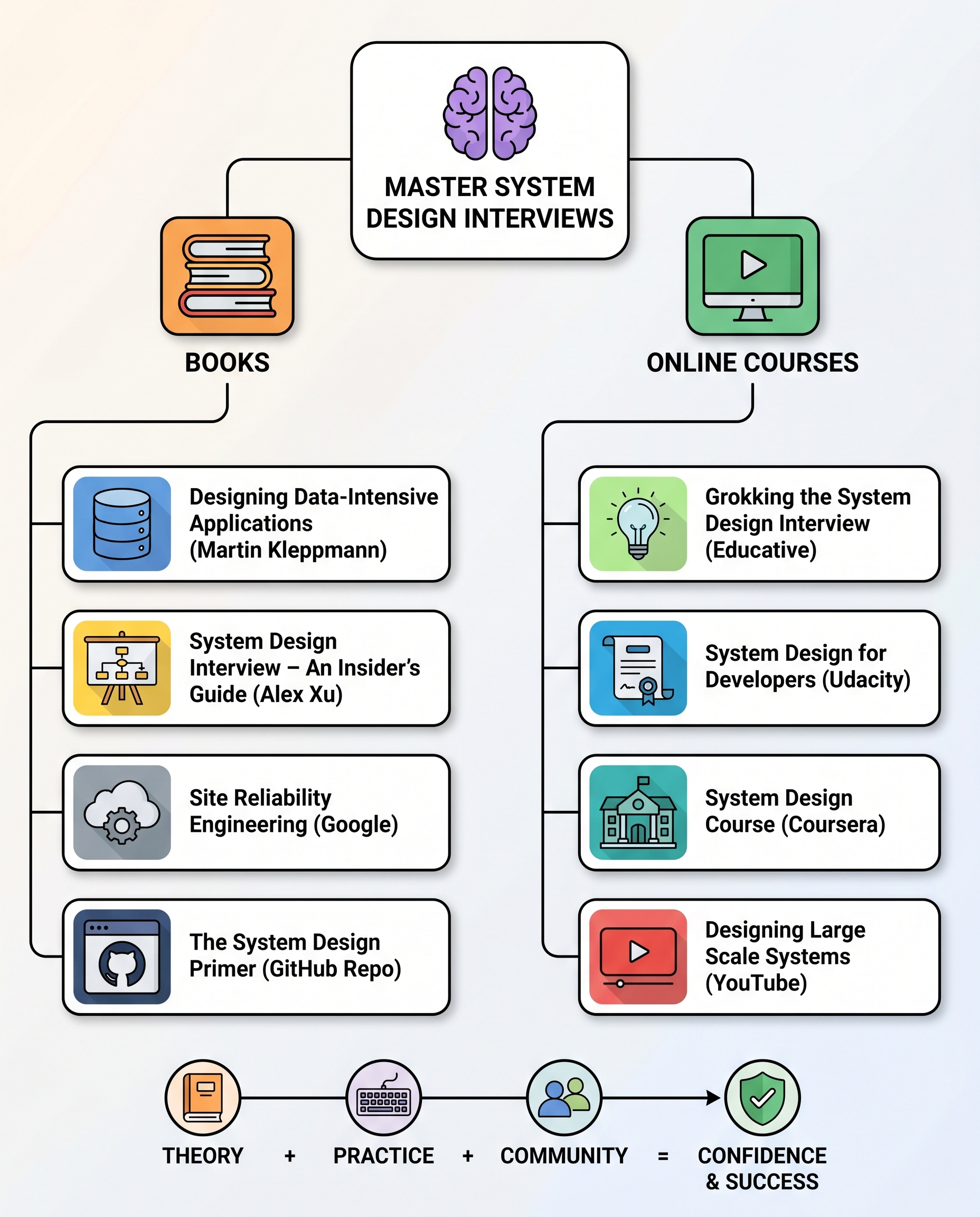
- System Design Primer: HLD patterns (queues, caching, DB trade-offs)
- Concurrency tutorials and language-specific best practices for thread-safety
If you want, I can: provide a sample Quad Tree question with a walkthrough, a checklist for machine-coding interviews, or bulletproof STAR stories tailored to L4. Which would be most helpful?
#SoftwareEngineering #SystemDesign #InterviewPrep
About the author
bugfree.ai is an advanced AI-powered platform designed to help software engineers master system design and behavioral interviews. Whether you’re preparing for your first interview or aiming to elevate your skills, bugfree.ai provides a robust toolkit tailored to your needs. Key Features:
150+ system design questions: Master challenges across all difficulty levels and problem types, including 30+ object-oriented design and 20+ machine learning design problems. Targeted practice: Sharpen your skills with focused exercises tailored to real-world interview scenarios. In-depth feedback: Get instant, detailed evaluations to refine your approach and level up your solutions. Expert guidance: Dive deep into walkthroughs of all system design solutions like design Twitter, TinyURL, and task schedulers. Learning materials: Access comprehensive guides, cheat sheets, and tutorials to deepen your understanding of system design concepts, from beginner to advanced. AI-powered mock interview: Practice in a realistic interview setting with AI-driven feedback to identify your strengths and areas for improvement.
bugfree.ai goes beyond traditional interview prep tools by combining a vast question library, detailed feedback, and interactive AI simulations. It’s the perfect platform to build confidence, hone your skills, and stand out in today’s competitive job market. Suitable for:
New graduates looking to crack their first system design interview. Experienced engineers seeking advanced practice and fine-tuning of skills. Career changers transitioning into technical roles with a need for structured learning and preparation.
Comments
Join the discussionNo comments yet. Be the first to comment.