High-Score (Bugfree Users) Uber India L5 Interview Experience
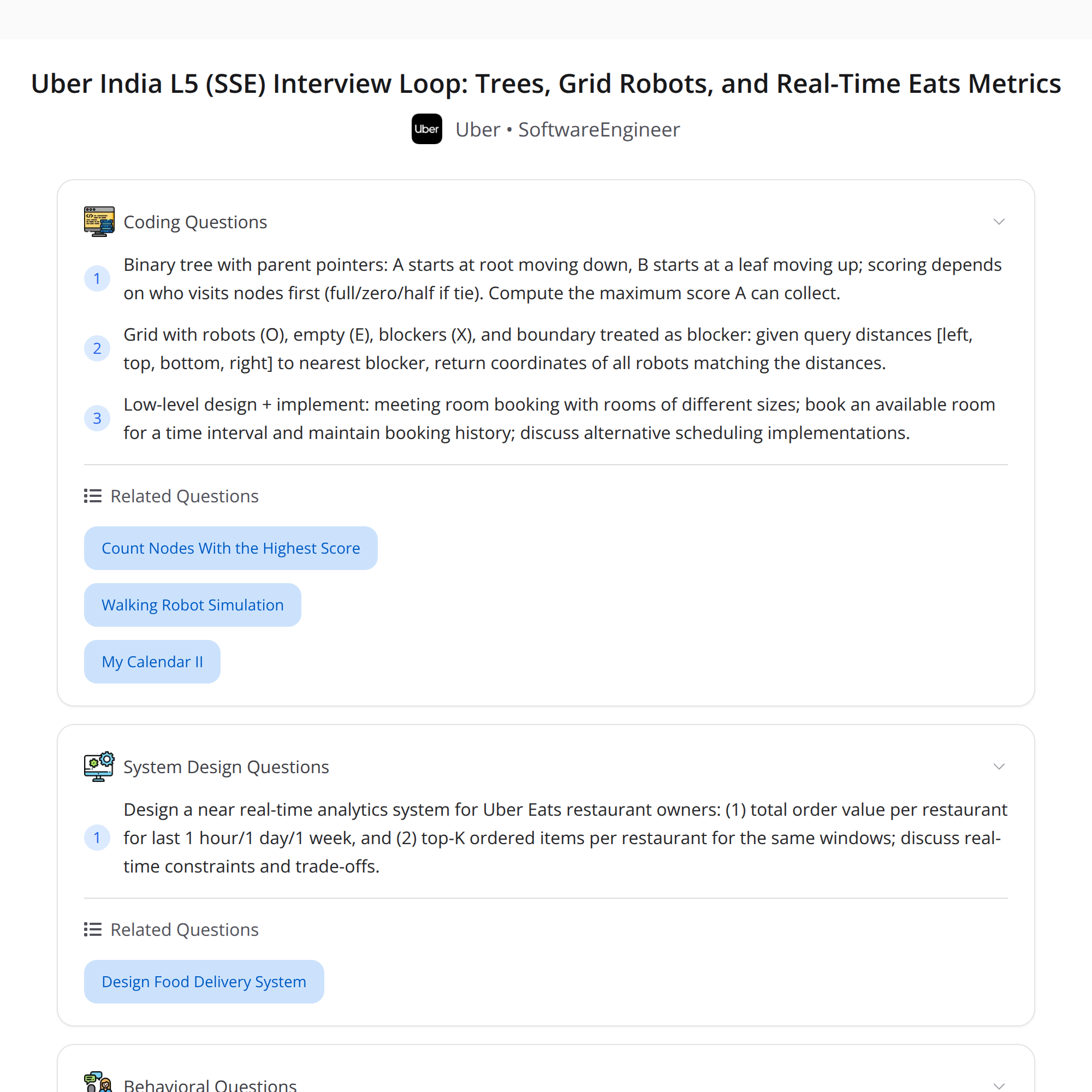
A compact, targeted walkthrough of a high-scoring interview loop for Uber India L5 (SSE). This loop blends core DSA problems with systems and design depth: tree DP and timing, grid-robot preprocessing, near real-time Uber Eats metrics design, low-level design for meeting-room booking, and a heavy-machine (HM) deep dive focused on trade-offs.
Below I rephrase each round, explain likely approaches, highlight interviewer expectations, and give practical tips so you can reproduce a similarly strong performance.
R1 — Tree with parent pointers: "race from root vs leaf" (timing + scoring)
Problem sketch
- You are given a tree (parent pointers available). Two agents move along the tree (one from root, one from some leaf or other node). Each node has points. Based on arrival time at a node, the node's points may be awarded fully, partially (half), or not at all. The task: compute the maximum points achievable (or compute final score distribution) given movement rules and timing.
Reasonable approach
- Clarify the exact movement model and scoring rules before coding (speeds, simultaneous arrival rule, half/full/zero thresholds).
- Convert parent pointers into an adjacency representation if needed and compute distances (depths) from relevant sources (root and the other start node). BFS/DFS works since this is a tree.
- Compute arrival times for both agents for every node. Compare arrival times to decide score allocation (full to earlier, half if equal, etc.).
- If the problem asks to optimize some choice (e.g., choose the leaf to start from or pick a route): reduce to dynamic programming on the tree, computing best outcomes for subtrees, or run a DP along the unique path connecting the two starting points.
Complexity & tips
- Distances on a tree: O(N) with one or two DFS/BFS sweeps.
- If a choice must be optimized over many candidate leaves, precompute depths/parent jumps (binary lifting) to get O(log N) LCA/distance queries.
- Interviewer cues: explain arrival-time logic, consider edge cases (ties, zero-time nodes), and explicitly state time/space bounds.
What interviewers look for
- Clear problem restatement and assumptions.
- Correct distance computation and arrival-time comparison.
- Clean DP or path simulation if optimization is required.
- Attention to corner cases and complexity.
R2 — Grid robots: precompute nearest blockers (L/T/B/R) and answer queries
Problem sketch
- You have a grid with obstacles. Robots or queries ask how far a robot can move or whether two robots' moves conflict. A fast solution requires precomputing nearest blockers in all four directions for every cell.
Preprocessing approaches
- Four directional sweeps (DP):
- Left-to-right sweep to compute nearest blocker to the left for each cell.
- Right-to-left for the right blocker.
- Top-to-bottom and bottom-to-top for top/bottom.
- Each sweep is O(R*C) for an R x C grid.
- Monotonic stack approaches can help for certain constraints but are usually unnecessary for simple nearest-blocker queries.
Query answering
- Use the precomputed bounds per cell to determine reachable ranges in O(1) per query.
- For multi-step movement, combine ranges or simulate jumps using precomputed extents.
Complexity & tips
- Preprocessing: O(RC). Memory: O(RC) for four direction arrays.
- For many queries, this is ideal. If the grid changes often, consider dynamic structures (segment trees per row/column) but that complicates implementation and interview time.
What interviewers look for
- Correctness of preprocessing and reasoning about boundary conditions.
- Ability to translate precomputation into O(1) query logic.
- Considerations about mutability of grid and trade-offs for updates.
R3 — System design: Near real-time Uber Eats metrics (order value + Top-K items over 1h/1d/1w)
Requirements to clarify
- Input: stream of orders (adds/updates/cancels). Expected QPS? Event size? Late/duplicated events?
- Output: near real-time total order value and Top-K items for windows of 1 hour, 1 day, 1 week.
- SLOs: acceptable latency, freshness, accuracy (exact vs approximate), cost constraints.
- API surface and read QPS (dashboard vs internal service).
High-level architecture
- Ingestion: Kafka (or Kinesis) with partitions keyed by item_id or region.
- Stream processing: Apache Flink / Spark Structured Streaming / Kafka Streams
- Maintain windowed aggregations for sum(order_value) and heavy-hitters (Top-K).
- Use event-time processing and watermarks to handle lateness.
- State store: RocksDB (embedded in Flink) or an external store (Redis for low-latency reads; Cassandra for longer retention).
- Top-K approach:
- For exact Top-K within small windows: maintain ordered heaps or balanced BSTs per window. This can be expensive at scale.
- For large-scale cost/latency trade-offs: use stream sketches like Space-Saving (Misra-Gries) or Count-Min Sketch + Heavy Keeper to approximate frequent items with bounded memory and mergeability.
- Windowing strategy:
- Use tumbling windows (1h) and sliding windows (e.g., 1h sliding every minute) depending on freshness needs.
- For 1d/1w, either keep separate window computations or compose windows using aggregated sub-windows (hierarchical rollups) to reduce state.
- Serving layer:
- Materialize results into a read-optimized store (Redis or an HTTP cache). API servers read from this cache.
- For ad-hoc windows, fall back to query historical aggregates in a store like Presto/Cassandra.
Key trade-offs
- Latency vs correctness: Exactly-once semantics (with checkpointing) increase complexity but reduce double-counting. At-least-once with idempotency can be simpler.
- Accuracy vs cost: Sketches drastically reduce memory but give approximate Top-K. If the product needs exact lists, you must provision more resources.
- Window granularity vs storage: many small windows mean more state. Use hierarchical aggregation to amortize cost.
Scaling & reliability
- Partition streams by item_id or geography to scale processing.
- Monitor watermark progression and late events; tune watermarks and retention.
- Provide fallbacks for read APIs when state is rebuilding (stale data indicators).
What interviewers look for
- Clear requirements clarification and clear SLAs.
- Architecture diagram with components and data flow.
- Precise trade-offs: why choose sketches or exact, how to handle late events, how to scale and monitor.
R4 — LLD: Meeting room booking with history and schedules (deliver working code fast)
Essential domain model
- Entities: Room, Booking (start_time, end_time, user_id, room_id), User.
- APIs: createBooking, cancelBooking, listAvailability, getBookingHistory.
Core design choices
- Conflict detection
- For each room, keep bookings sorted by start_time. To check conflict for a new booking, binary search the nearest bookings (O(log n) for search; O(n) worst-case for insert in array but O(log n) with a BST).
- Use interval trees (augmented BST) for efficient overlap queries.
- Concurrency
- Optimistic concurrency: try insert and fail on conflict; return a friendly error to retry.
- Or use per-room locks (coarse but simple) if QPS is modest.
- History
- Store booking events in an append-only log for audit/history queries. Expose paginate-able history API.
- Quick working implementation
- Start with an in-memory per-room sorted list or TreeMap. Implement APIs with clear interfaces and unit tests.
- Then persist bookings to a DB (Postgres/Cassandra) and add transactional/locking semantics.
What interviewers look for
- Good entity modeling and pagination for history queries.
- Efficient conflict detection and a strategy for concurrency.
- A pragmatic path from a working prototype to production-grade design.
R5 — HM deep dive: trade-offs, stack choices, learnings
Content to be ready with
- Be prepared to explain language/runtime choices (e.g., Java vs Go for streaming), libraries (Flink, Kafka, RocksDB), and their trade-offs (latency, ecosystem, operational cost).
- Trade-offs in algorithmic choices: exact Top-K vs approximate, windowing strategies, state size vs retention, read-latency vs update-latency.
- Observability: what metrics you’d report (event lag, watermark delay, state size, error rates) and how you’d debug issues.
- Operational concerns: rolling upgrades, state migration, disaster recovery, and backpressure handling.
Interview emphasis
- Show depth on one or two trade-offs you made. Use past learnings: e.g., how approximate algorithms reduced cost by X% while keeping 99% of important items.
- Demonstrate ability to reason about failure modes and mitigations.
General interview tips (applies across rounds)
- Clarify requirements first. Restate to confirm.
- Discuss complexity and memory before coding. Time-box implementation.
- Use examples and run through small cases out loud to validate logic.
- Keep code readable; prioritize correctness and edge cases.
- For system design, emphasize trade-offs, scaling, and monitoring.
Final notes
This loop tests a balanced mix of algorithmic rigor and pragmatic system design. Candidates who do well typically:
- Ask clarifying questions early.
- Separate correctness from optimization: get a correct approach down first, then optimize.
- Explain trade-offs during design and show awareness of operational constraints.
If you want, I can:
- Flesh out a full solution for any of the DSA problems with code (Python/Java).
- Draw a diagram or provide a sample Flink pipeline and schema for the Eats metrics design.
Good luck — and focus on clarity, correctness, and thoughtful trade-offs.
#SoftwareEngineering #SystemDesign #InterviewPrep
About the author
bugfree.ai is an advanced AI-powered platform designed to help software engineers master system design and behavioral interviews. Whether you’re preparing for your first interview or aiming to elevate your skills, bugfree.ai provides a robust toolkit tailored to your needs. Key Features:
150+ system design questions: Master challenges across all difficulty levels and problem types, including 30+ object-oriented design and 20+ machine learning design problems. Targeted practice: Sharpen your skills with focused exercises tailored to real-world interview scenarios. In-depth feedback: Get instant, detailed evaluations to refine your approach and level up your solutions. Expert guidance: Dive deep into walkthroughs of all system design solutions like design Twitter, TinyURL, and task schedulers. Learning materials: Access comprehensive guides, cheat sheets, and tutorials to deepen your understanding of system design concepts, from beginner to advanced. AI-powered mock interview: Practice in a realistic interview setting with AI-driven feedback to identify your strengths and areas for improvement.
bugfree.ai goes beyond traditional interview prep tools by combining a vast question library, detailed feedback, and interactive AI simulations. It’s the perfect platform to build confidence, hone your skills, and stand out in today’s competitive job market. Suitable for:
New graduates looking to crack their first system design interview. Experienced engineers seeking advanced practice and fine-tuning of skills. Career changers transitioning into technical roles with a need for structured learning and preparation.
Comments
Join the discussionNo comments yet. Be the first to comment.