High-Score (Bugfree Users) Interview Experience: TikTok Ads Data Scientist — What Actually Got Tested
This post summarizes a high-scoring interview report from Bugfree users for the TikTok Ads Data Scientist role. It highlights what was tested, how rounds were structured, and how to prepare efficiently.
Overview
Interview format (as reported):
- Recruiter reach-out
- Technical round (deep-dive + problem solving)
- Case + behavioral round
The technical and case rounds emphasized a mix of core data science skills (SQL, experiment/causal thinking, metrics design) and business-minded product/ads thinking.
Technical Round — What Happened
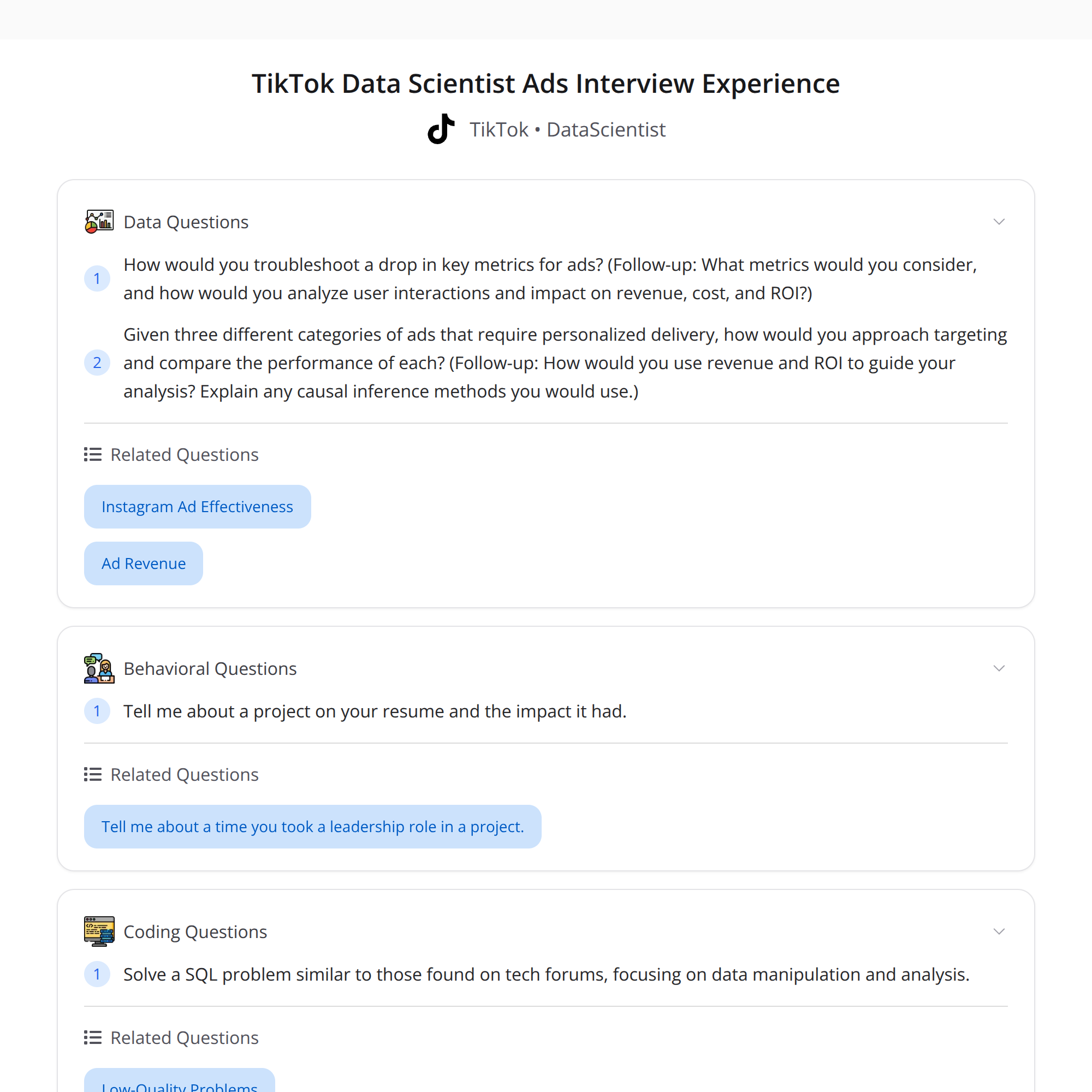
The technical round opened with a quick introduction and then a deep dive into the resume and projects. Interviewers focused heavily on impact: how you measured success, trade-offs you considered, and what decisions your analyses informed.
Expect:
- A resume/project deep dive oriented around impact and results
- SQL questions similar to well-known forum examples (joins, window functions, group by, edge cases)
- A metric-drop troubleshooting case (see details below)
Typical SQL expectations
- Write clear, efficient queries using joins, aggregations, and window functions
- Handle nulls, deduplication, and edge cases
- Explain time-window logic and cohort definitions
Example simple troubleshooting query (identify daily revenue):
SELECT event_date,
       SUM(revenue) AS daily_revenue
FROM ads_events
WHERE event_date BETWEEN '2024-04-01' AND '2024-04-30'
GROUP BY event_date
ORDER BY event_date;
Be prepared to adapt queries on the fly (e.g., change granularity, add user-level deduplication, or exclude test accounts).
Metric-Drop Troubleshooting Case
This is a classic: a key metric (e.g., revenue, impressions, CTR) has dropped. Interviewers evaluate how you structure the investigation.
A recommended approach:
- Clarify the problem: confirm metric definition, timeframe, and baselines.
- Define metrics and sub-metrics to investigate (e.g., impressions, clicks, CTR, CVR, spend, eCPM, ARPU).
- Quantify the drop: how big is it (absolute and relative), and when did it start?
- Segment analysis: by region, device, ad type, publisher, campaign, and user cohort.
- Funnel and user-flow analysis: which stage(s) of the funnel show the biggest change?
- Check for confounders: deployments, configuration changes, data pipeline issues, billing/attribution changes.
- Prioritize root causes and propose A/B tests or fixes.
Practical tips:
- Start with a high-level dashboard (daily/weekly time series) then drill down into segments.
- Always rule out instrumentation and data issues first (missing logs, schema changes).
- Quantify impact (revenue loss, ROI change) and recommend short-term mitigations.
Ad Personalization & Comparison Case
A later case asked how to personalize and compare three ad types. Interviewers looked for both targeting strategies and ways to compare effectiveness.
Key elements to cover:
- Proposed targeting strategies for each ad type (audience segments, contextual signals, recency/frequency caps).
- Metrics for comparison: revenue, ROAS, CPA, CTR, conversion rate, long-term retention/LTV.
- Experiment design: randomized trials or multi-armed bandit approaches to test personalization.
- Causal inference angles: how to attribute differences to the ad types rather than confounders.
Causal approaches to mention:
- Randomized controlled trials (gold standard)
- Regression adjustment / propensity score matching (when randomization limited)
- Difference-in-differences (for pre/post comparisons with control groups)
- Instrumental variables (if you have a valid instrument)
Also discuss trade-offs between short-term revenue and long-term user experience (ad fatigue, engagement decay).
What Interviewers Were Testing
- Data fundamentals: SQL, data modeling, and analytical rigor
- Metrics literacy: defining, segmenting, and diagnosing business metrics
- Product/ads thinking: how analysis informs monetization and user experience
- Causal reasoning and experiment design
- Communication: explaining findings and prioritizing actions
Quick Prep Checklist
- Refresh SQL with window functions, complex joins, and dedup logic
- Practice metric-drop case frameworks and drill-down workflows
- Review A/B testing concepts and common causal inference techniques
- Prepare 2–3 projects: focus on impact, measurement choices, and business implications
- Rehearse clear, structured communication (clarify assumptions, summarize conclusions)
Final Notes
This process favors candidates who can combine technical depth with practical, business-oriented thinking. Focus on being methodical, quantifying impact, and explaining how your analysis drives decisions.
Good luck — and practice structuring your thought process out loud.
#DataScience #SQL #InterviewPrep #TikTokAds
About the author
bugfree.ai is an advanced AI-powered platform designed to help software engineers master system design and behavioral interviews. Whether you’re preparing for your first interview or aiming to elevate your skills, bugfree.ai provides a robust toolkit tailored to your needs. Key Features:
150+ system design questions: Master challenges across all difficulty levels and problem types, including 30+ object-oriented design and 20+ machine learning design problems. Targeted practice: Sharpen your skills with focused exercises tailored to real-world interview scenarios. In-depth feedback: Get instant, detailed evaluations to refine your approach and level up your solutions. Expert guidance: Dive deep into walkthroughs of all system design solutions like design Twitter, TinyURL, and task schedulers. Learning materials: Access comprehensive guides, cheat sheets, and tutorials to deepen your understanding of system design concepts, from beginner to advanced. AI-powered mock interview: Practice in a realistic interview setting with AI-driven feedback to identify your strengths and areas for improvement.
bugfree.ai goes beyond traditional interview prep tools by combining a vast question library, detailed feedback, and interactive AI simulations. It’s the perfect platform to build confidence, hone your skills, and stand out in today’s competitive job market. Suitable for:
New graduates looking to crack their first system design interview. Experienced engineers seeking advanced practice and fine-tuning of skills. Career changers transitioning into technical roles with a need for structured learning and preparation.
Comments
Join the discussionNo comments yet. Be the first to comment.