High-Score Interview Experience: TikTok Ads Data Scientist — What Was Tested
A concise, practical write-up from Bugfree users who landed a high score in the TikTok Ads Data Scientist interview. If you're interviewing for an ads-focused DS role, this summary highlights the process, the question types, and how to structure answers so you demonstrate both technical chops and business thinking.
Interview process (what to expect)
- Recruiter reach-out
- Technical round (main focus)
- Case + behavioral round
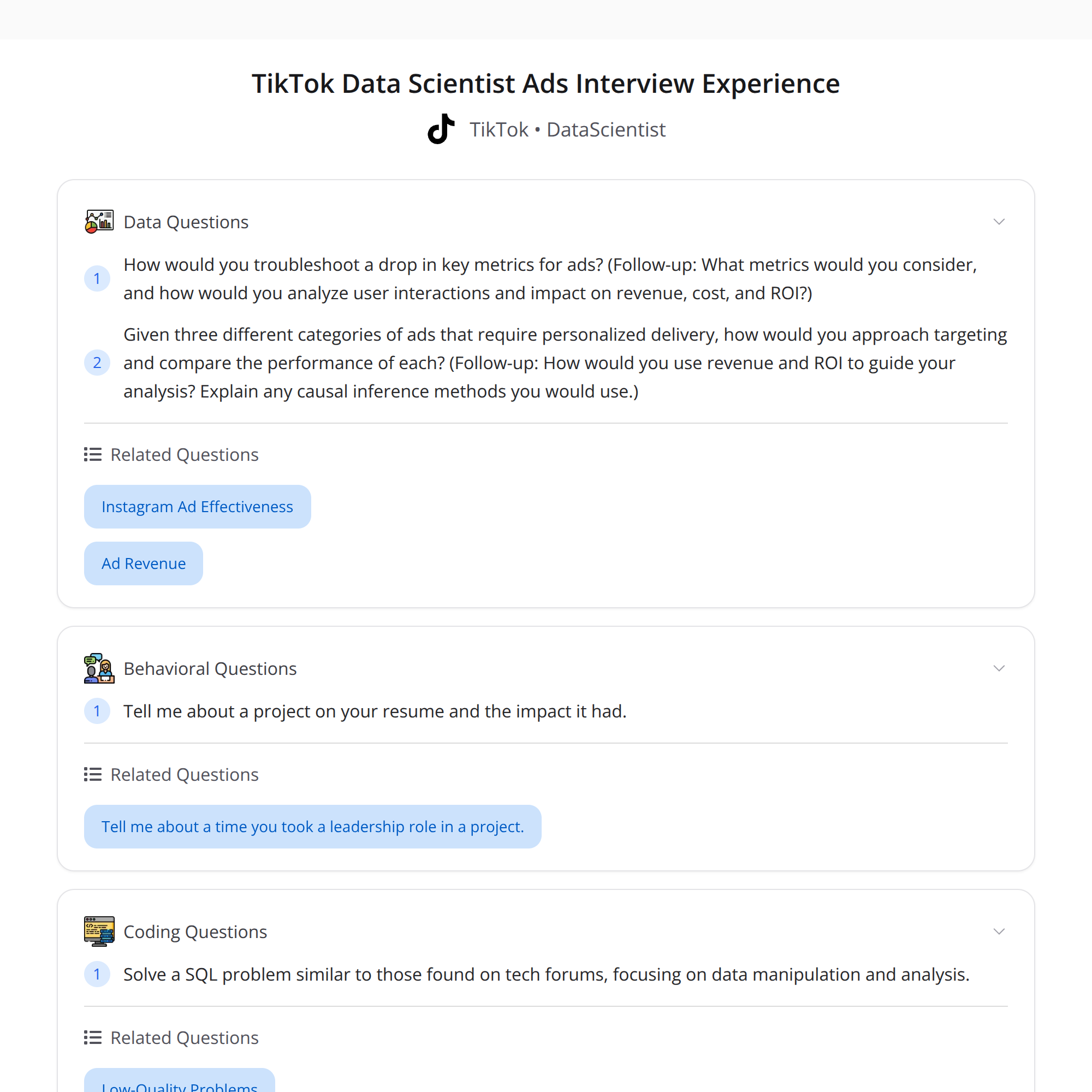
The technical round opened with a short introduction, then a deep dive into the resume and projects. After that came SQL and two case-style problems focused on metrics and product/business thinking.
What they focused on in the technical round
Resume/project deep dive
- Expect questions that probe impact, metrics you moved, and how you measured success.
- Be ready to explain trade-offs, data sources, and how you translated insights into action.
SQL
- Typical problems are similar to popular forum/LeetCode-style SQL tasks: joins, window functions, aggregation, deduplication, and event/session-based queries.
- Practice writing clear, efficient SQL and narrating your approach: first explain logic, then write the query.
Metric-drop troubleshooting case
This is a common ads-focused question. The expected structure for answers:
- Clarify the problem and timeline (when did the drop start? sudden vs. gradual?)
- Define the primary metric (e.g., revenue, clicks, impressions, ROAS) and relevant guardrail metrics (CTR, CPC, CVR, sessions)
- Quantify the drop (absolute and relative change, segment by geography/platform/ad-type)
- Analyze user flows and funnel conversion points (impression → click → install → purchase)
- Segment by cohorts (new vs. returning users, campaign, device, creative)
- Form hypotheses for causes (budget changes, tracking issues, bid algorithm shifts, creative fatigue, supply-side changes)
- Suggest concrete data checks and diagnostics (traffic logs, auction win rates, SDK/tracking debug, campaign config audit)
- Recommend short-term mitigations and long-term root-cause fixes; propose experiments if needed
Interviewers appreciate a crisp structure and prioritization (start with high-impact checks).
Personalization / comparing 3 ad types case
- You may be asked to design a system or analysis to compare three ad formats/strategies and recommend a personalization approach.
Good answer frames:
- Define the business objective (maximize revenue? ROI? engagement?)
- Outline the targeting strategy: which user features matter (LTV, recency, demographics, interest signals)
- Create an evaluation plan: define metrics per ad type (ARPU, CTR, CVR, CPA, ROAS) and how to compare them
- Consider experimental design and causal inference: A/B tests, multi-armed bandits for exploration, uplift models, or propensity score matching if randomization is constrained
- Discuss practicalities: data pipeline, latency, feature freshness, fairness and safety constraints
Be ready to discuss trade-offs: revenue vs. user experience, short-term ROI vs. long-term retention.
Concrete examples of metrics and checks to mention
- Primary metrics: revenue, ROAS, CPA, ARPU
- Intermediate metrics: impressions, clicks, CTR, CPC, installs, CVR
- Diagnostic checks: sample size and power for experiments, per-campaign budget changes, ad approval status, SDK/tracking errors, publisher-side supply shifts
How to present answers (tips)
- Ask clarifying questions early to scope the problem.
- Structure your response (e.g., Clarify → Measure → Diagnose → Hypothesize → Action).
- Be quantitative: show how you'd compute metrics and report change (percent drop, absolute loss, daily impact).
- Prioritize: start with the most likely/highest-impact causes.
- Tie technical details to business impact: say why a fix matters to revenue or ROI.
- When doing SQL, narrate before typing; when doing causal inference, explicitly state assumptions.
Preparation checklist
- Practice LeetCode/Forum SQL problems (joins, windows, dedupe, funnel queries).
- Rehearse project stories emphasizing impact and measurement.
- Practice metric-debug cases and structure answers aloud.
- Review A/B testing basics, power/sample size, and common causal inference tools (randomization, matching, uplift).
- Prepare a short portfolio of examples where you moved metrics and explain your experiment and analysis.
Final takeaway
The TikTok Ads DS interview mixes solid data-science fundamentals (SQL, metrics, experimentation) with product and business sense. Interviewers want to see that you can not only crunch numbers but also interpret them in ways that drive measurable business outcomes.
Good luck — focus on structure, quantify everything, and connect your analysis to business impact.
#Resources
- LeetCode (SQL), SQLZoo, Mode Analytics SQL tutorials
- A/B testing primers and docs on causal inference
About the author
bugfree.ai is an advanced AI-powered platform designed to help software engineers master system design and behavioral interviews. Whether you’re preparing for your first interview or aiming to elevate your skills, bugfree.ai provides a robust toolkit tailored to your needs. Key Features:
150+ system design questions: Master challenges across all difficulty levels and problem types, including 30+ object-oriented design and 20+ machine learning design problems. Targeted practice: Sharpen your skills with focused exercises tailored to real-world interview scenarios. In-depth feedback: Get instant, detailed evaluations to refine your approach and level up your solutions. Expert guidance: Dive deep into walkthroughs of all system design solutions like design Twitter, TinyURL, and task schedulers. Learning materials: Access comprehensive guides, cheat sheets, and tutorials to deepen your understanding of system design concepts, from beginner to advanced. AI-powered mock interview: Practice in a realistic interview setting with AI-driven feedback to identify your strengths and areas for improvement.
bugfree.ai goes beyond traditional interview prep tools by combining a vast question library, detailed feedback, and interactive AI simulations. It’s the perfect platform to build confidence, hone your skills, and stand out in today’s competitive job market. Suitable for:
New graduates looking to crack their first system design interview. Experienced engineers seeking advanced practice and fine-tuning of skills. Career changers transitioning into technical roles with a need for structured learning and preparation.
Comments
Join the discussionNo comments yet. Be the first to comment.