
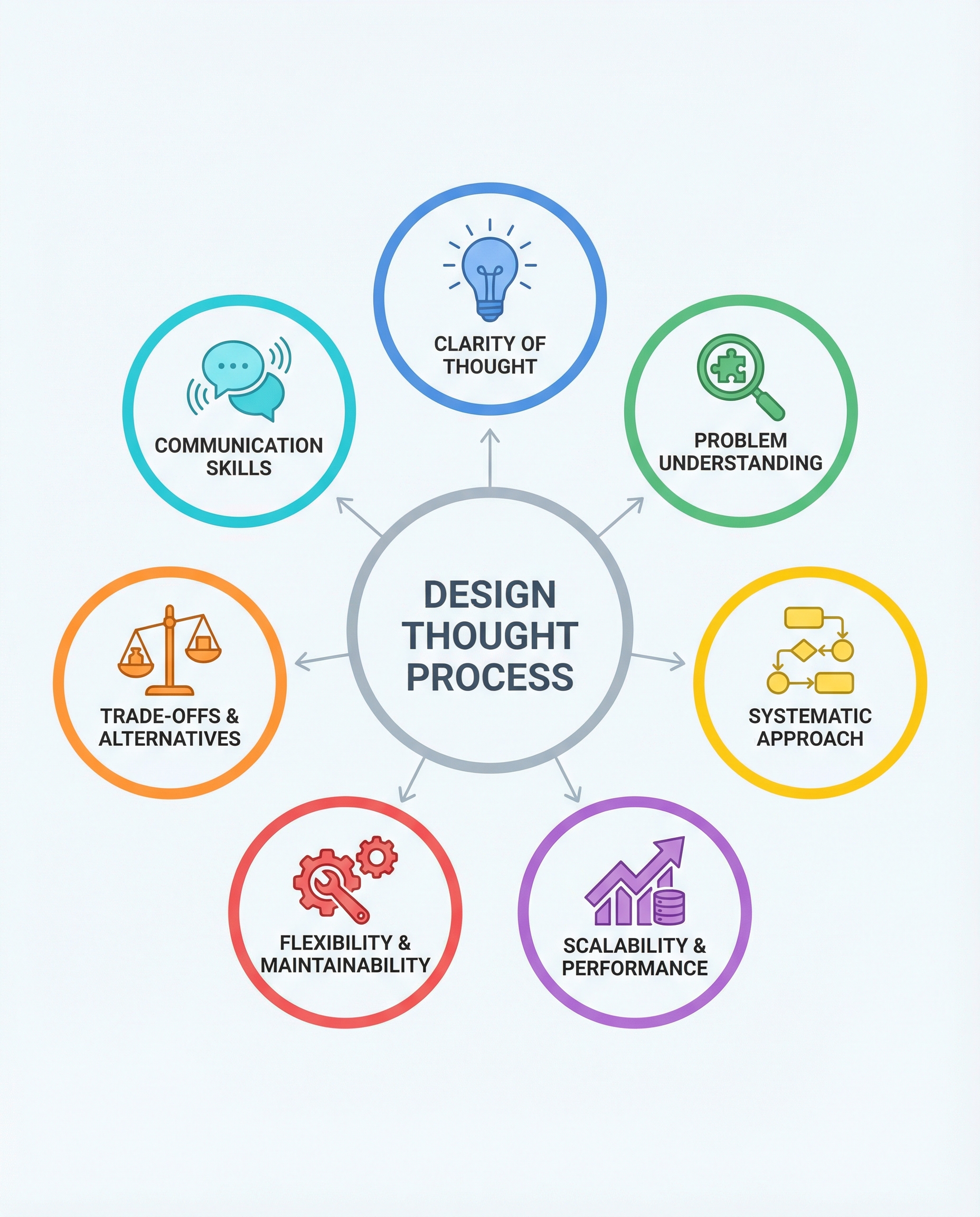
System design interviews aren’t just a test of whether you can sketch a working architecture. Interviewers are grading your thought process: how you clarify scope, structure your approach, reason about trade-offs, and communicate clearly under pressure.
Below is a practical breakdown of what interviewers look for and exactly how to demonstrate each quality during an interview.
1) Clarity: Start high-level, then drill down
What they want: a clear top-level design first, so they can follow your reasoning.
How to show it:
- Begin with a one- or two-sentence system description and the main components (clients, API gateway, services, datastore, cache, async pipelines).
- Draw a simple diagram before diving into internals.
Say something like: “At a high level I’ll have a load balancer → API layer → service layer → datastore. I’ll sketch endpoints and then choose DB + caching strategy.”
Pitfall: jumping into low-level details (data models, indexes) before the big picture.
2) Understanding: Ask sharp questions; lock requirements & constraints
What they want: that you don’t assume requirements—clarify them.
Key clarifying questions to ask:
- Expected traffic (requests/sec, daily active users)?
- Latency SLOs? Data retention and consistency needs? Read vs write ratio?
- Is strong consistency required (financial systems) or is eventual consistency acceptable?
- Budget / infra constraints? Compliance or geo restrictions?
How to show it: list assumptions explicitly and verify them with the interviewer.
Pitfall: designing for unrealistic scale or making hidden assumptions that break the solution.
3) Method: Break the system into components; justify decisions
What they want: a reproducible approach and rationale for each choice.
Suggested method:
- Identify major components (ingest, processing, storage, caching, orchestration).
- For each, explain responsibilities and alternatives you considered.
- Tie decisions to requirements (e.g., pick Cassandra for high write throughput if writes are heavy).
Sample line: “I’ll separate the ingestion layer from processing so we can independently scale spikes without touching the DB.”
Pitfall: presenting components without explaining why they exist or how they interact.
4) Scale: Address load, latency, caching, DB choices
What they want: how your design handles growth and performance.
Concrete points to cover:
- Expected bottlenecks and how to mitigate them (load balancers, sharding, partition keys).
- Caching strategy: cache what, eviction policy, cache invalidation approach.
- Database choice: relational vs. NoSQL and why; indexing and partitioning strategy.
- Asynchronous patterns (message queues, background workers) for heavy or variable workloads.
Tip: show rough math for capacity (e.g., QPS × payload → bandwidth; DB writes/sec → shards needed).
Pitfall: vague statements like “we’ll scale the DB” without specifics.
5) Maintainability: Modular design, clean boundaries
What they want: a design that teams can own and iterate on.
How to show it:
- Emphasize service boundaries and clear API contracts.
- Discuss monitoring, observability (metrics, traces, logs), and deploy strategy (CI/CD, canary releases).
- Talk about schema migration plans and backward compatibility.
Say: “Each microservice exposes a versioned API and publishes metrics to Prometheus; we’ll use feature flags for rollout.”
Pitfall: building a tangled monolith with many implicit dependencies.
6) Trade-offs: Present options and why you chose one
What they want: evidence you can weigh pros and cons and make practical choices.
How to show it:
- For each major decision, present at least one alternative and the trade-offs (complexity, cost, latency, consistency).
- Be explicit about what you’re sacrificing and why it’s acceptable given the requirements.
Example: “We could use strong consistency with a single primary DB, but that increases latency and reduces availability; eventual consistency suits our use case because stale reads are tolerable.”
Pitfall: being dogmatic—treat options as if there’s only one right answer.
7) Communication: Explain simply, not vaguely
What they want: clear, confident explanations that an interviewer (or future teammate) can follow.
How to show it:
- Narrate your diagram and thought process. Use short statements and confirm that the interviewer is following.
- Repeat or summarize important decisions at the end.
Good lines:
- “To recap: we’ll use a stateless API layer, Redis for hot reads, and partitioned NoSQL for writes. This meets our latency and scale targets while keeping cost moderate.”
Pitfall: long monologues filled with jargon—pause for questions.
Quick interview checklist (5–10 minute rhythm)
- 0–2 min: Restate the problem and ask clarifying questions.
- 2–4 min: Present a high-level diagram and main components.
- 4–10 min: Drill into key areas (scaling, DB, caching, async) and show reasoning.
- 10–15 min: Discuss trade-offs, failure modes, monitoring, and maintenance.
- Final 1–2 min: Summarize decisions and assumptions.
Common mistakes to avoid
- Designing without asking key constraints (traffic, SLOs, consistency).
- Overengineering for extreme scale when requirements are small.
- Not quantifying capacity or cost implications.
- Failing to explain trade-offs.
System design interviews are less about arriving at a single “correct” diagram and more about demonstrating a clear, structured way of thinking. Use the checklist above, narrate decisions, and always tie your choices back to explicit requirements.
Good luck — and design with intent.
About the author
bugfree.ai is an advanced AI-powered platform designed to help software engineers master system design and behavioral interviews. Whether you’re preparing for your first interview or aiming to elevate your skills, bugfree.ai provides a robust toolkit tailored to your needs. Key Features:
150+ system design questions: Master challenges across all difficulty levels and problem types, including 30+ object-oriented design and 20+ machine learning design problems. Targeted practice: Sharpen your skills with focused exercises tailored to real-world interview scenarios. In-depth feedback: Get instant, detailed evaluations to refine your approach and level up your solutions. Expert guidance: Dive deep into walkthroughs of all system design solutions like design Twitter, TinyURL, and task schedulers. Learning materials: Access comprehensive guides, cheat sheets, and tutorials to deepen your understanding of system design concepts, from beginner to advanced. AI-powered mock interview: Practice in a realistic interview setting with AI-driven feedback to identify your strengths and areas for improvement.
bugfree.ai goes beyond traditional interview prep tools by combining a vast question library, detailed feedback, and interactive AI simulations. It’s the perfect platform to build confidence, hone your skills, and stand out in today’s competitive job market. Suitable for:
New graduates looking to crack their first system design interview. Experienced engineers seeking advanced practice and fine-tuning of skills. Career changers transitioning into technical roles with a need for structured learning and preparation.
Comments
Join the discussionNo comments yet. Be the first to comment.


