Don’t just draw boxes — prove you can run a real system
In system design interviews you’re often judged not on how many components you can name but on whether you can operate a real system in production. That means thinking beyond diagrams to concrete decisions for security, observability, and performance. Below are concise checklists and talking points you can use in interviews to show you understand trade-offs and operational realities.
1) Security — Make it secure by default
Why it matters: Security failures are showstoppers in production. Interviewers expect you to identify sensitive surfaces and propose practical protections.
Checklist
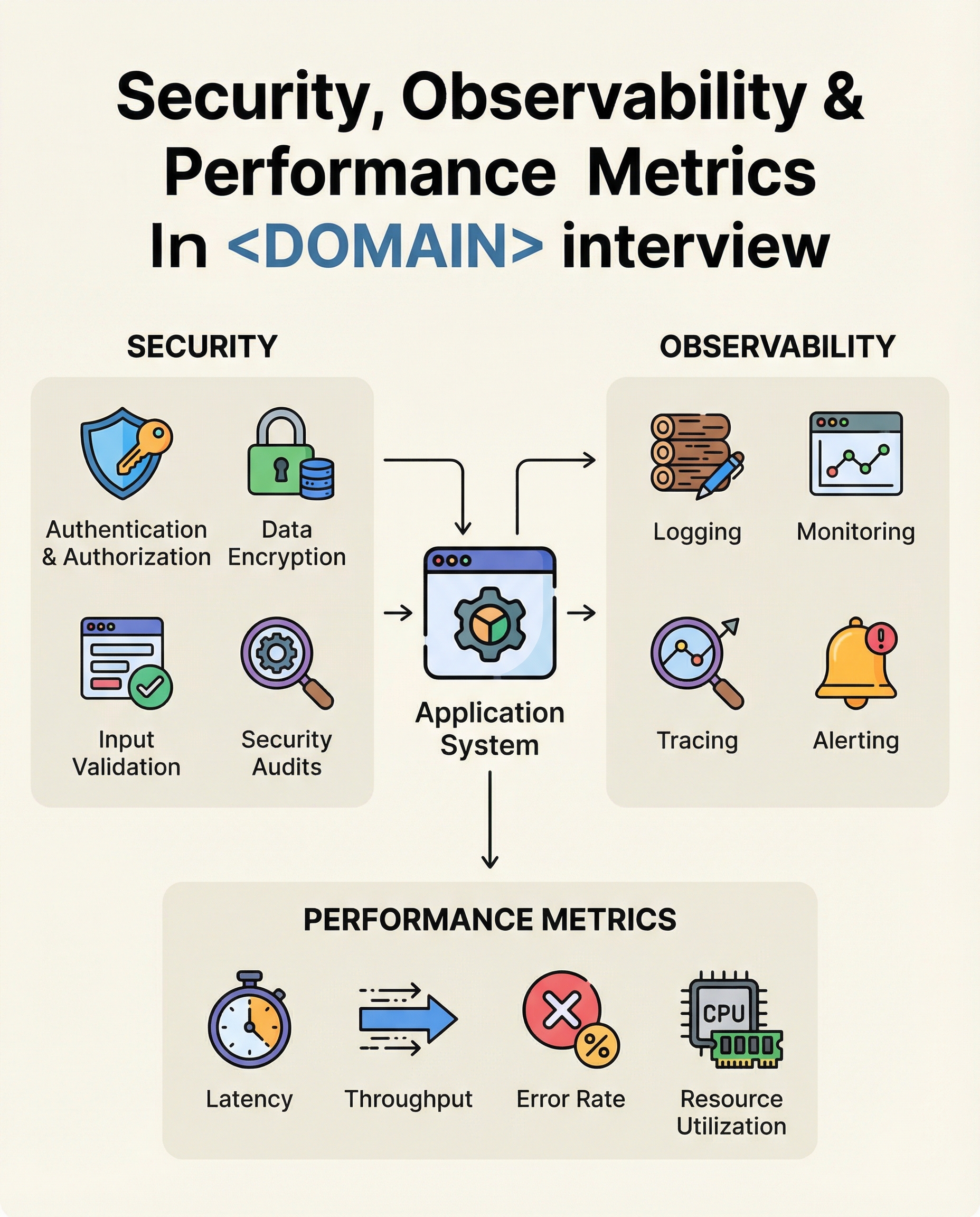
- Enforce authentication (authN) and authorization (authZ): OAuth2, JWTs, or mutual TLS as appropriate.
- Encrypt data in transit (TLS) and at rest (KMS-backed encryption keys).
- Validate and sanitize inputs at service boundaries; use whitelists where possible.
- Secrets and key management: centralized vaults (HashiCorp Vault, cloud KMS).
- Audit and access logging for forensics and compliance.
- Threat modeling for critical paths (attack surface, privilege escalation).
Trade-offs to call out
- Stronger auth (mTLS, short-lived certs) vs increased operational complexity and latency.
- Client-side encryption vs server-side (usability vs security).
- Logging verbosity vs leakage of sensitive data — mask PII.
Interview lines to use
- “We’ll use OAuth2 for user flows and RBAC for service-side authorization. Sensitive fields will be masked in logs, persisted only encrypted with KMS.”
2) Observability — Make it debuggable and measurable
Why it matters: Without observability you can’t find, explain, or fix problems in production.
Checklist
- Structured logs (JSON) with correlation IDs.
- Metrics for key signals: request rate, error rate, latency (p50/p95/p99), resource utilization.
- Distributed tracing (OpenTelemetry) for cross-service latency attribution.
- Alerting: actionable alerts with runbooks (not just paging on high CPU).
- Dashboards for SLOs and service health; retention and sampling policies.
Trade-offs to call out
- Full tracing vs sampling: lower cost but less fidelity.
- High-cardinality logs/metrics vs storage and query costs.
- Short retention for cost savings vs longer retention for audits and debugging.
Interview lines to use
- “We’ll add correlation IDs, instrument p95/p99 latency metrics, and set alerts on error budget burn rate with an automated runbook.”
3) Performance — Measure and make it fast under load
Why it matters: Latency, throughput, and efficiency directly affect user experience and cost.
Checklist
- Track latency (p50/p95/p99), throughput (RPS), error rates, and CPU/memory usage.
- Identify bottlenecks: DB queries, network, serialization.
- Improvements: caching (CDN, edge, in-memory), connection pooling, async processing, bulk/batched operations.
- Flow control: backpressure, rate limiting, circuit breakers, and graceful degradation.
- Capacity planning and autoscaling policies.
Trade-offs to call out
- Cache freshness vs reduced load: TTL and invalidation complexity.
- Consistency vs latency: eventual consistency for read-heavy paths.
- Horizontal scaling vs vertical scaling (cost, complexity).
Interview lines to use
- “We’ll cache read-heavy endpoints with a short TTL, add connection pooling to reduce DB overhead, and autoscale the stateless frontends with CPU + latency-based policies.”
How to present these in an interview
- Prioritize: pick 2–3 items from each pillar you’d implement first and explain why.
- Quantify: give numbers where you can (expected RPS, target p99, error budget, retention windows).
- Explain trade-offs: always say what you’re sacrificing to gain something else.
- Fallbacks & runbooks: describe how you’ll detect and recover from failures.
Example mini-script
- “I’d enforce OAuth2 for user access, use KMS for at-rest encryption, and redact PII from logs. For observability, we’ll instrument p95/p99 latency, add distributed tracing with sampling, and alert on error budget burn. Performance-wise, introduce a CDN and short-TTL cache for hot reads, and add autoscaling for the frontend. These choices balance latency, cost, and operational overhead.”
Conclusion
Interviewers aren’t impressed by buzzwords — they want concrete decisions, measurable targets, and clear trade-offs. Address security, observability, and performance explicitly, and you’ll demonstrate you can design systems that actually run in the real world.
About the author
bugfree.ai is an advanced AI-powered platform designed to help software engineers master system design and behavioral interviews. Whether you’re preparing for your first interview or aiming to elevate your skills, bugfree.ai provides a robust toolkit tailored to your needs. Key Features:
150+ system design questions: Master challenges across all difficulty levels and problem types, including 30+ object-oriented design and 20+ machine learning design problems. Targeted practice: Sharpen your skills with focused exercises tailored to real-world interview scenarios. In-depth feedback: Get instant, detailed evaluations to refine your approach and level up your solutions. Expert guidance: Dive deep into walkthroughs of all system design solutions like design Twitter, TinyURL, and task schedulers. Learning materials: Access comprehensive guides, cheat sheets, and tutorials to deepen your understanding of system design concepts, from beginner to advanced. AI-powered mock interview: Practice in a realistic interview setting with AI-driven feedback to identify your strengths and areas for improvement.
bugfree.ai goes beyond traditional interview prep tools by combining a vast question library, detailed feedback, and interactive AI simulations. It’s the perfect platform to build confidence, hone your skills, and stand out in today’s competitive job market. Suitable for:
New graduates looking to crack their first system design interview. Experienced engineers seeking advanced practice and fine-tuning of skills. Career changers transitioning into technical roles with a need for structured learning and preparation.
Comments
Join the discussionNo comments yet. Be the first to comment.