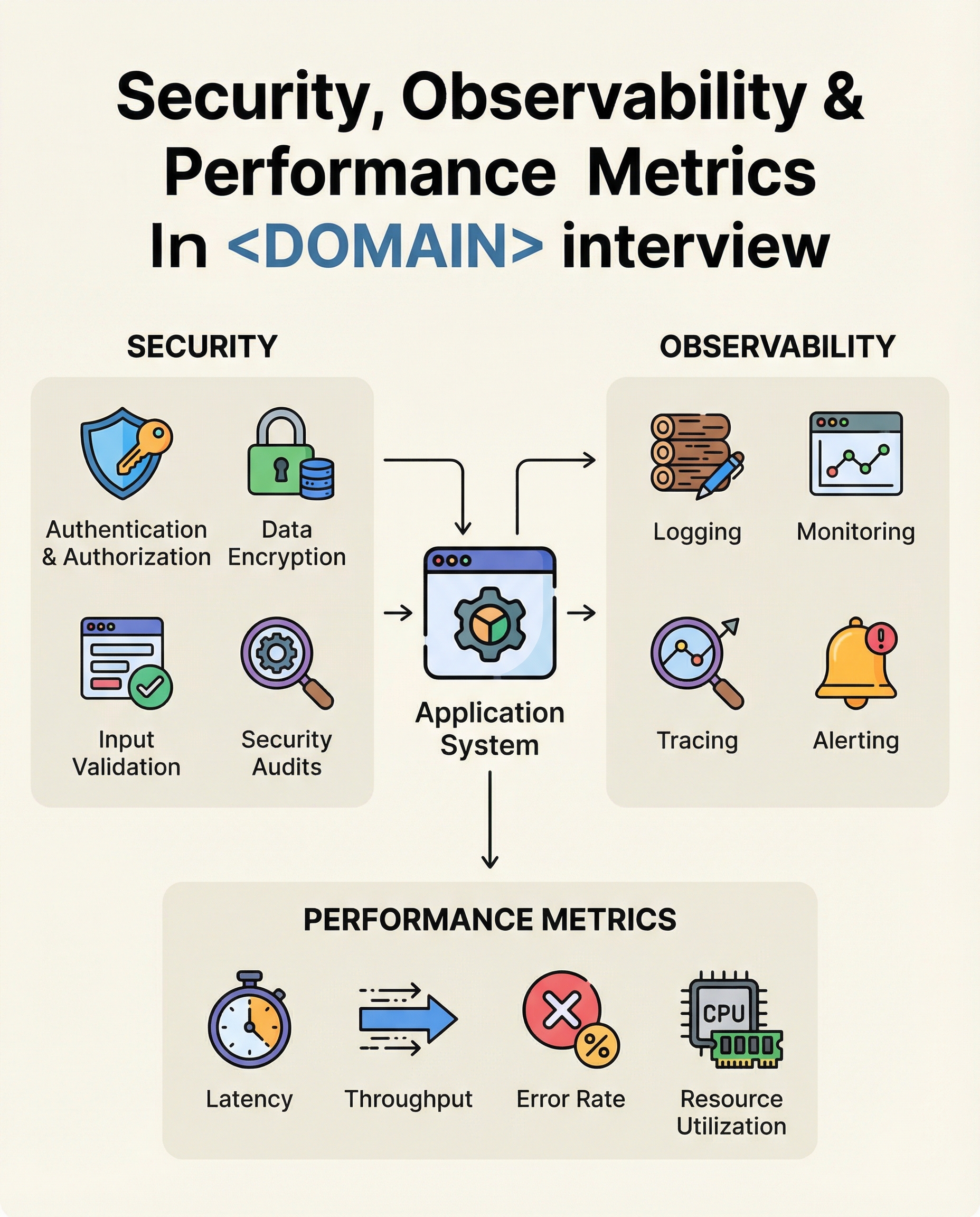
In system design interviews you can't just draw boxes and arrows. Interviewers expect you to demonstrate how a system would actually run in production. That means addressing three practical, non-negotiable areas: Security, Observability, and Performance. Below are clear, interview-ready points, trade-offs you should call out, and short examples you can use to show you know how to operate a real system.
1) Security — enforce and justify it
High-level things to state up front:
- Enforce authentication (authN) and authorization (authZ) boundaries.
- Encrypt data in transit (TLS) and at rest (disk or field-level encryption).
- Validate and sanitize inputs to prevent injection and malformed payloads.
- Plan for secrets and key rotation (KMS, Vault).
- Include audit logging and access reviews for sensitive operations.
What interviewers want to hear (concise examples):
- "We’ll use OAuth2 for service-to-service auth, and RBAC for fine-grained permissions."
- "All traffic between services will be TLS. Sensitive fields are encrypted at rest and keys are rotated via KMS."
- "User input is validated at the edge and again in the service to avoid trusting clients."
Trade-offs to discuss:
- Stronger security (e.g., end-to-end encryption, frequent key rotation) increases latency and operational complexity.
- Centralized auth services simplify policy management but are a single point of failure — mitigate with caching and fail-open/closed strategies.
Common pitfalls to mention:
- Leaving admin APIs unauthenticated for convenience.
- Relying on network segmentation alone without service-level auth.
Quick interview line: "I’ll add auth on the gateway, per-service authorization checks, TLS everywhere, and an audit trail—while noting the latency and complexity trade-offs."
2) Observability — know what’s happening and why
Observability is how you operate and iterate. Outline a plan that includes:
- Structured logs (JSON) shipped to a central store.
- Metrics (latency percentiles, throughput, error rates, resource usage) with retention and aggregation tiers.
- Distributed tracing to follow requests across services (sampled but useful traces).
- Alerting and dashboards with actionable thresholds tied to runbooks.
- Correlation IDs propagated in headers for troubleshooting.
What to explain in an interview:
- "We’ll emit structured logs and metrics, use a tracing system to pin down latency hotspots, and set alerts for SLO violations (not just raw error counts)."
- Show that alerts are actionable: low-noise, auto-escalate, and tied to playbooks.
Trade-offs to discuss:
- High-fidelity traces and full logging increase cost and storage — use sampling and retention policies.
- More metrics improve detection but create alert fatigue — prefer SLO-based alerts.
Example lines: "We’ll monitor p50/p95/p99 latency, request error rate, and queue depth. Traces will help us find cross-service latency; alerts will map to runbooks so on-call can act quickly."
3) Performance — measure, then optimize
Interviewers expect measurable goals and concrete levers you’ll use:
- Track: latency distributions (p50/p95/p99), throughput (RPS), error rate, resource utilization (CPU, memory, I/O), and queue lengths.
- Define SLOs and SLIs: e.g., 99.9% of requests < 200ms.
- Typical techniques: caching, batching, rate limiting, backpressure, horizontal autoscaling, efficient data models and indices.
What you should say:
- "First instrument SLIs and establish SLOs. If p95 exceeds target, inspect traces and hot paths, then optimize with targeted caching or change the data model."
- "If CPU is the bottleneck, consider batching or moving to a more efficient serialization format before adding machines."
Trade-offs to discuss:
- Caching improves latency but increases staleness; decide per data domain.
- Aggressive autoscaling reduces latency but increases cost and can mask inefficient code.
Example quick answer: "We’ll measure p99 latency and error rate, add caching at the CDN and service layers, and implement graceful degradation under load (rate limiting and backpressure)."
What interviewers really want: trade-offs, not buzzwords
It’s easy to list "TLS, logging, caching"—what makes you stand out is explaining why you chose them and how you’ll operate them. For each decision, briefly state:
- What you’ll instrument or enforce.
- How you’ll detect problems (metric/trace/log/alert).
- How you’ll fix or mitigate (specific technique).
- The trade-offs (cost, complexity, latency, consistency).
Quick checklist you can say in an interview
- Security: authN/authZ, TLS, encryption at rest, input validation, audit logs.
- Observability: structured logs, metrics (p50/p95/p99), distributed traces, SLO-driven alerts, correlation IDs.
- Performance: SLIs/SLOs, latency/throughput monitoring, caching/batching, autoscaling, backpressure.
Make these three areas part of every design you present. If you don’t, you might have a neat diagram—but you won’t convince anyone you can run the real world.
#SystemDesign #SoftwareEngineering #SRE
About the author
bugfree.ai is an advanced AI-powered platform designed to help software engineers master system design and behavioral interviews. Whether you’re preparing for your first interview or aiming to elevate your skills, bugfree.ai provides a robust toolkit tailored to your needs. Key Features:
150+ system design questions: Master challenges across all difficulty levels and problem types, including 30+ object-oriented design and 20+ machine learning design problems. Targeted practice: Sharpen your skills with focused exercises tailored to real-world interview scenarios. In-depth feedback: Get instant, detailed evaluations to refine your approach and level up your solutions. Expert guidance: Dive deep into walkthroughs of all system design solutions like design Twitter, TinyURL, and task schedulers. Learning materials: Access comprehensive guides, cheat sheets, and tutorials to deepen your understanding of system design concepts, from beginner to advanced. AI-powered mock interview: Practice in a realistic interview setting with AI-driven feedback to identify your strengths and areas for improvement.
bugfree.ai goes beyond traditional interview prep tools by combining a vast question library, detailed feedback, and interactive AI simulations. It’s the perfect platform to build confidence, hone your skills, and stand out in today’s competitive job market. Suitable for:
New graduates looking to crack their first system design interview. Experienced engineers seeking advanced practice and fine-tuning of skills. Career changers transitioning into technical roles with a need for structured learning and preparation.
Comments
Join the discussionNo comments yet. Be the first to comment.