System Design Interviews: The Scalability + Reliability Checklist You Must Recite
In system design interviews you don't win by drawing boxes — you win by showing you can make, justify, and trade off practical decisions. Below is a compact, interview-ready checklist that helps you present a complete, balanced design focused on scalability and reliability.
Use this as a script: state assumptions, call out tradeoffs, and support choices with numbers where possible.
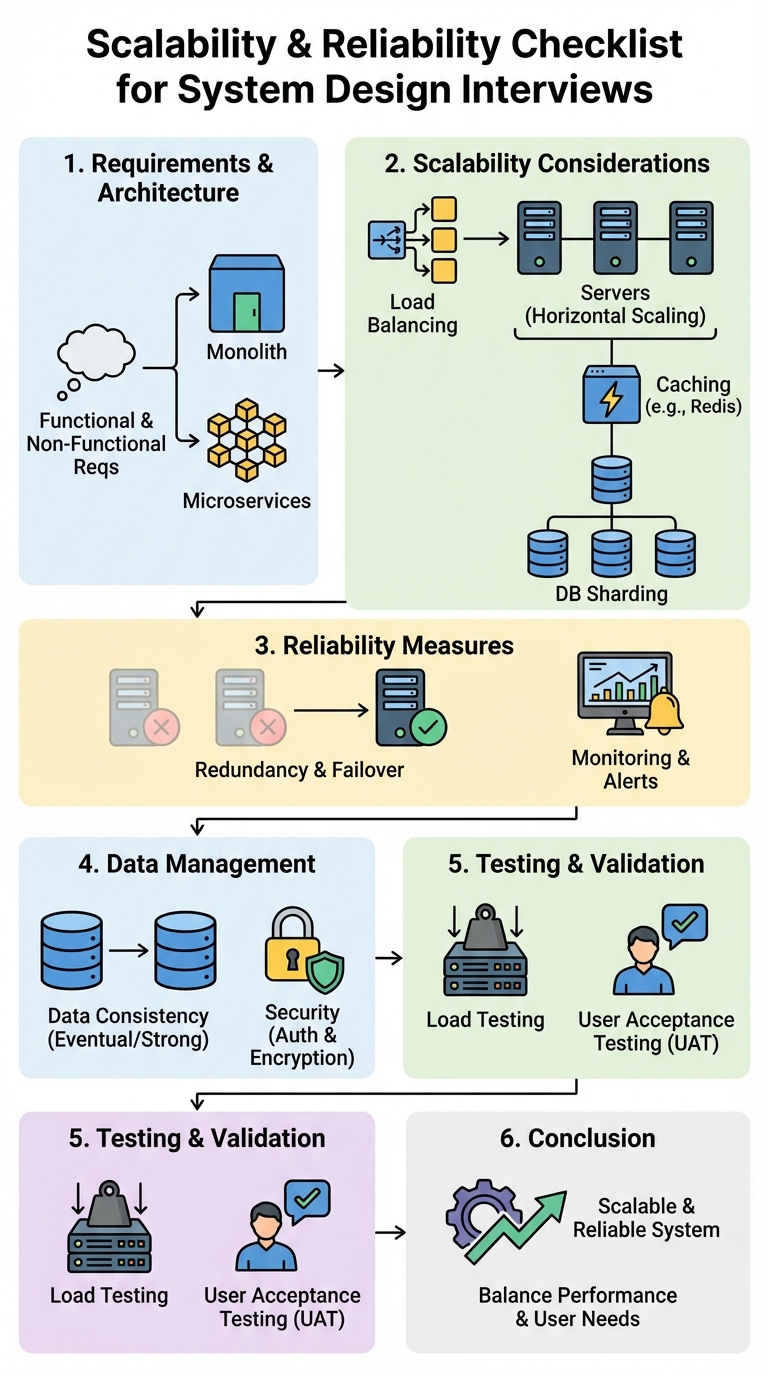
1) Requirements — lock them down first
- Clarify functional requirements (features, request patterns, critical flows).
- Quantify non-functional requirements: latency SLOs (e.g., p95 < 100ms), throughput (RPS), availability target (e.g., 99.95%), and growth projections (user growth, transaction growth per month/year).
- Ask about constraints: budget, regulatory, data residency, client SDKs, device types.
- Outcome: write a 1–2 line requirements statement and target numbers.
2) Architecture — high-level choices and data flow
- Choose a deployment model: monolith vs microservices. State pros/cons (speed of iteration vs team independence and operational overhead).
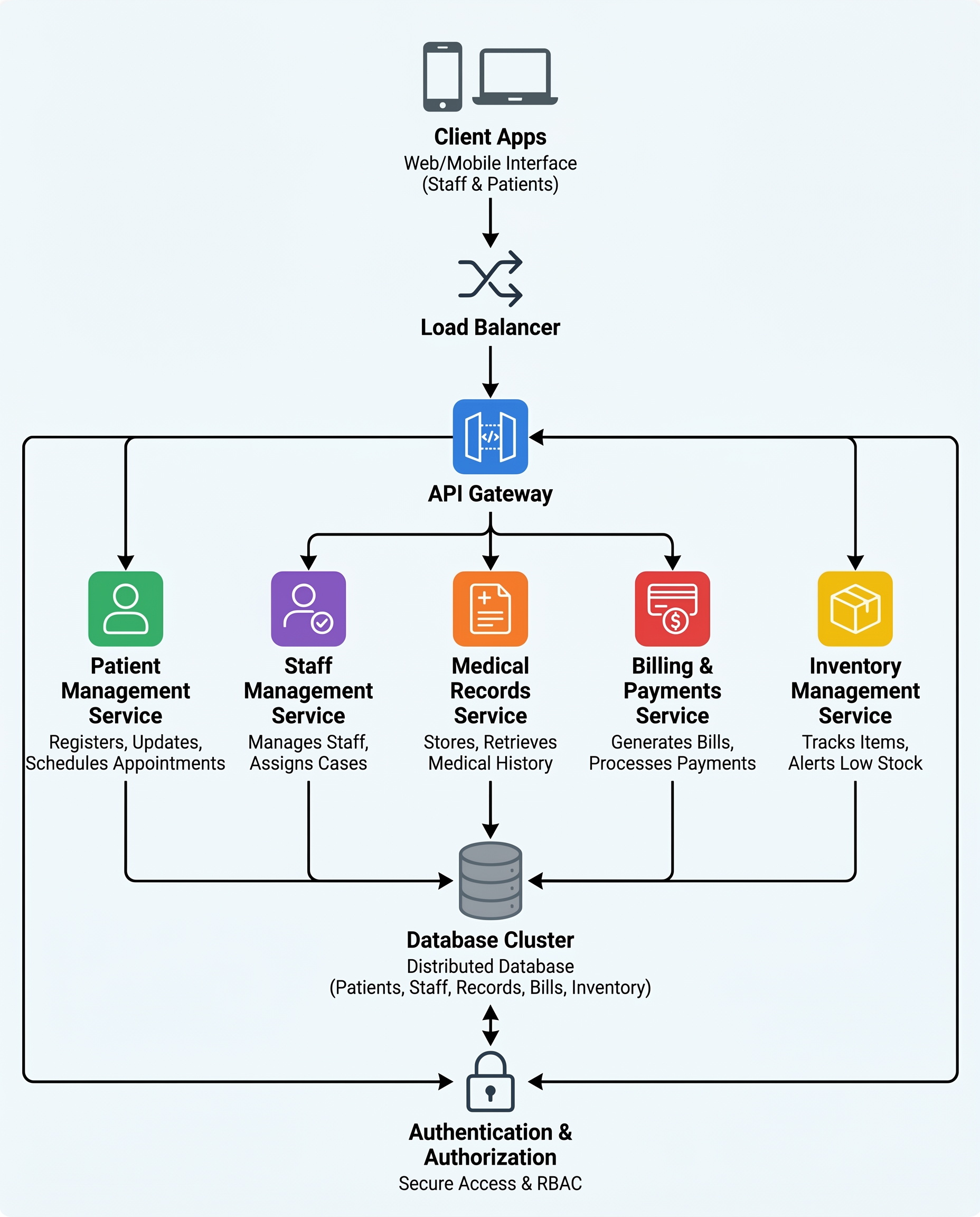
- Show a clear data flow: clients → API gateway/load balancer → services → data stores/queues → caches.
- Define communication patterns: synchronous (REST/gRPC) vs asynchronous (message queues, pub/sub). Explain why.
- Draw one clear path for the critical request and annotate failure modes and latency.
3) Scale — horizontal first, then optimizations
- Prefer horizontal scaling: stateless service instances behind a load balancer.
- Add caching (e.g., Redis) for hot reads; explain TTL and cache invalidation strategy.
- Use CDNs for static content and edge caching.
- When a single data partition is the bottleneck, shard/partition the dataset: pick shard key and explain tradeoffs (hot keys, rebalancing complexity).
- Use read replicas for read-heavy workloads; consider write scalability (leader/follower, multi-leader tradeoffs).
4) Reliability — eliminate single points of failure
- Remove SPOFs: multiple instances, multi-AZ or multi-region deployments for critical services.
- Replication and redundancy: DB replication factor, cross-region replication for DR.
- Automated failover and leader election (e.g., Raft, ZooKeeper, managed DB failover).
- Graceful degradation: prioritized functionality when degraded (serve cached responses, limit feature set).
- Resilience patterns: circuit breakers, retries with exponential backoff, bulkheads.
5) Observability — detect and respond quickly
- Instrument metrics: latency (p50/p95/p99), error rates, throughput, saturation (CPU/memory), queue lengths.
- Distributed tracing for request flow and root-cause analysis.
- Structured logs and correlation IDs.
- Alerts: define thresholds and pages (avoid noisy alerts). Use escalation policies and runbooks.
6) Data — consistency, durability, and lifecycle
- Choose a consistency model: strong vs eventual. Explain impact on user experience and latency.
- Data model and storage choices: relational vs NoSQL vs object store — justify by access patterns.
- Backups and recovery: RPO (how much data you can lose) and RTO (how quickly you must recover).
- Retention and GDPR/CCPA considerations: archival, deletion, and legal hold.
7) Security and compliance
- Authentication (AuthN) and authorization (AuthZ): tokens, OAuth2/OpenID Connect, RBAC or ABAC.
- Encrypt in transit (TLS) and at rest (KMS-managed keys).
- Secrets management, key rotation, and least privilege for services.
- Audit logs, breach detection, rate limiting, and input validation.
8) Validation — prove it works at scale and under failure
- Load testing tools: k6, JMeter, Locust; test target RPS and bottlenecks.
- Chaos and failover tests: simulate AZ/region outages, instance termination, network partitioning.
- Canary releases and progressive rollouts to catch regressions early.
- Measure and tune: profiling, database slow query analysis, and cache hit ratios.
Quick interview script (recite this)
- Clear requirements with numbers (latency, throughput, availability).
- High-level architecture and data flow diagram.
- Scaling plan: stateless services, caching, sharding when needed.
- Reliability: redundancy, failover, graceful degradation.
- Observability: metrics, tracing, alerts and runbooks.
- Data decisions: consistency, backups, retention.
- Security: authN/authZ, encryption, auditing.
- Validation: load tests, chaos/failover tests.
Tips for delivery:
- Always state assumptions and tradeoffs explicitly.
- Use concrete numbers; if unknown, propose realistic targets and explain why.
- If asked for alternatives, show one or two options and the triggers for choosing them.
Memorize this checklist and use it to structure answers that are both practical and defensible.
About the author
bugfree.ai is an advanced AI-powered platform designed to help software engineers master system design and behavioral interviews. Whether you’re preparing for your first interview or aiming to elevate your skills, bugfree.ai provides a robust toolkit tailored to your needs. Key Features:
150+ system design questions: Master challenges across all difficulty levels and problem types, including 30+ object-oriented design and 20+ machine learning design problems. Targeted practice: Sharpen your skills with focused exercises tailored to real-world interview scenarios. In-depth feedback: Get instant, detailed evaluations to refine your approach and level up your solutions. Expert guidance: Dive deep into walkthroughs of all system design solutions like design Twitter, TinyURL, and task schedulers. Learning materials: Access comprehensive guides, cheat sheets, and tutorials to deepen your understanding of system design concepts, from beginner to advanced. AI-powered mock interview: Practice in a realistic interview setting with AI-driven feedback to identify your strengths and areas for improvement.
bugfree.ai goes beyond traditional interview prep tools by combining a vast question library, detailed feedback, and interactive AI simulations. It’s the perfect platform to build confidence, hone your skills, and stand out in today’s competitive job market. Suitable for:
New graduates looking to crack their first system design interview. Experienced engineers seeking advanced practice and fine-tuning of skills. Career changers transitioning into technical roles with a need for structured learning and preparation.
Comments
Join the discussionNo comments yet. Be the first to comment.