System Design Interview Prep (Solo): A Disciplined 7-Step Routine
Practicing system design on your own is absolutely doable—if you follow a structured routine. Below is a focused, practical 7-step plan you can apply weekly to build strong design instincts, practice communication, and stay interview-ready.
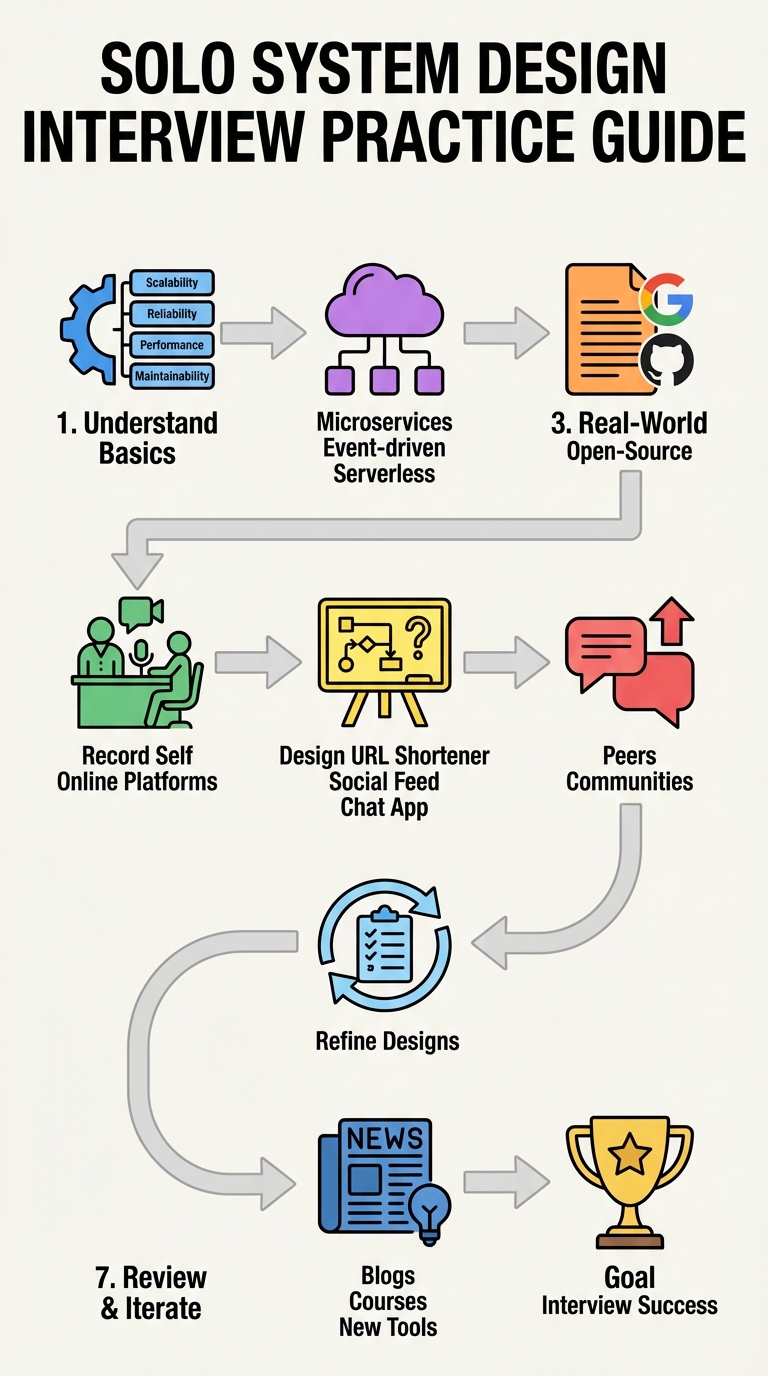
1) Master the fundamentals
- Focus areas: scalability, reliability, performance, maintainability, consistency, availability, latency, throughput, and cost.
- Learn key metrics and trade-offs (e.g., CAP theorem, load balancing, caching hit ratio).
- Actionable: Create a one-page cheat sheet that summarizes goals, metrics, and common trade-offs.
2) Learn core architectures
- Study and compare: monoliths, microservices, event-driven systems, and serverless patterns.
- Understand when to pick each approach and the operational implications (deployment, monitoring, rollback).
- Actionable: For each architecture, list pros/cons and a 3–5 component diagram example.
3) Study real systems via case studies and open source
- Read and diagram real-world systems (e.g., Dropbox, Twitter, WhatsApp) and open-source projects (e.g., Kafka, Redis).
- Break down how they solve scale, persistence, consistency, and failure recovery.
- Actionable: Pick one system per week, diagram it, and note trade-offs and design decisions.
4) Run mock interviews (record yourself)
- Simulate full interviews: problem clarification, high-level design, component deep dives, and scaling discussion.
- Record audio/video to catch clarity, pacing, and gaps in explanations.
- Use platforms like Pramp or Interviewing.io for live practice and timed sessions.
- Actionable: Do 1–2 recorded mocks per week and review them within 48 hours.
5) Drill classic prompts
- Common exercises: URL shortener, news feed, chat service, file storage, e-commerce/catalog, booking system.
- Practice different constraints: high write vs read traffic, strict latency, multi-region availability.
- Actionable: Maintain a rotating list of 6–8 prompts; spend one session designing each end-to-end.
6) Get feedback from peers and communities
- Share diagrams and recordings for critique (Peers, Slack/Discord groups, engineering forums).
- Ask for specific feedback: clarity, missing failure modes, scalability bottlenecks, trade-off reasoning.
- Actionable: After each mock or diagram, request 2–3 concrete improvement points and incorporate them.
7) Review, iterate, and stay current
- Regularly revisit your designs and notes. Turn common mistakes into focused study topics.
- Track emerging patterns and technologies (e.g., service meshes, FaaS best practices, new databases).
- Actionable: Keep a changelog of lessons learned and update your cheat sheet monthly.
Sample weekly routine (compact)
- Monday: Fundamentals refresher + 30-min reading.
- Tuesday: Study a case study and diagram it.
- Wednesday: Mock interview (recorded).
- Thursday: Drill a classic prompt.
- Friday: Peer feedback and iterate on recorded mock.
- Weekend: Read up on new tech/trends and update notes.
Quick checklist before an interview
- Can you clearly state goals and constraints?
- Do you have a high-level diagram with components and responsibilities?
- Have you covered data flow, storage, and failure modes?
- Can you discuss scaling strategies and trade-offs concisely?
Following this 7-step routine consistently will sharpen both your technical judgments and your interview communication. Keep iterating, track progress, and stay curious.
About the author
bugfree.ai is an advanced AI-powered platform designed to help software engineers master system design and behavioral interviews. Whether you’re preparing for your first interview or aiming to elevate your skills, bugfree.ai provides a robust toolkit tailored to your needs. Key Features:
150+ system design questions: Master challenges across all difficulty levels and problem types, including 30+ object-oriented design and 20+ machine learning design problems. Targeted practice: Sharpen your skills with focused exercises tailored to real-world interview scenarios. In-depth feedback: Get instant, detailed evaluations to refine your approach and level up your solutions. Expert guidance: Dive deep into walkthroughs of all system design solutions like design Twitter, TinyURL, and task schedulers. Learning materials: Access comprehensive guides, cheat sheets, and tutorials to deepen your understanding of system design concepts, from beginner to advanced. AI-powered mock interview: Practice in a realistic interview setting with AI-driven feedback to identify your strengths and areas for improvement.
bugfree.ai goes beyond traditional interview prep tools by combining a vast question library, detailed feedback, and interactive AI simulations. It’s the perfect platform to build confidence, hone your skills, and stand out in today’s competitive job market. Suitable for:
New graduates looking to crack their first system design interview. Experienced engineers seeking advanced practice and fine-tuning of skills. Career changers transitioning into technical roles with a need for structured learning and preparation.
Comments
Join the discussionNo comments yet. Be the first to comment.