Stop Writing God Objects: The Interview Red Flag in OOD
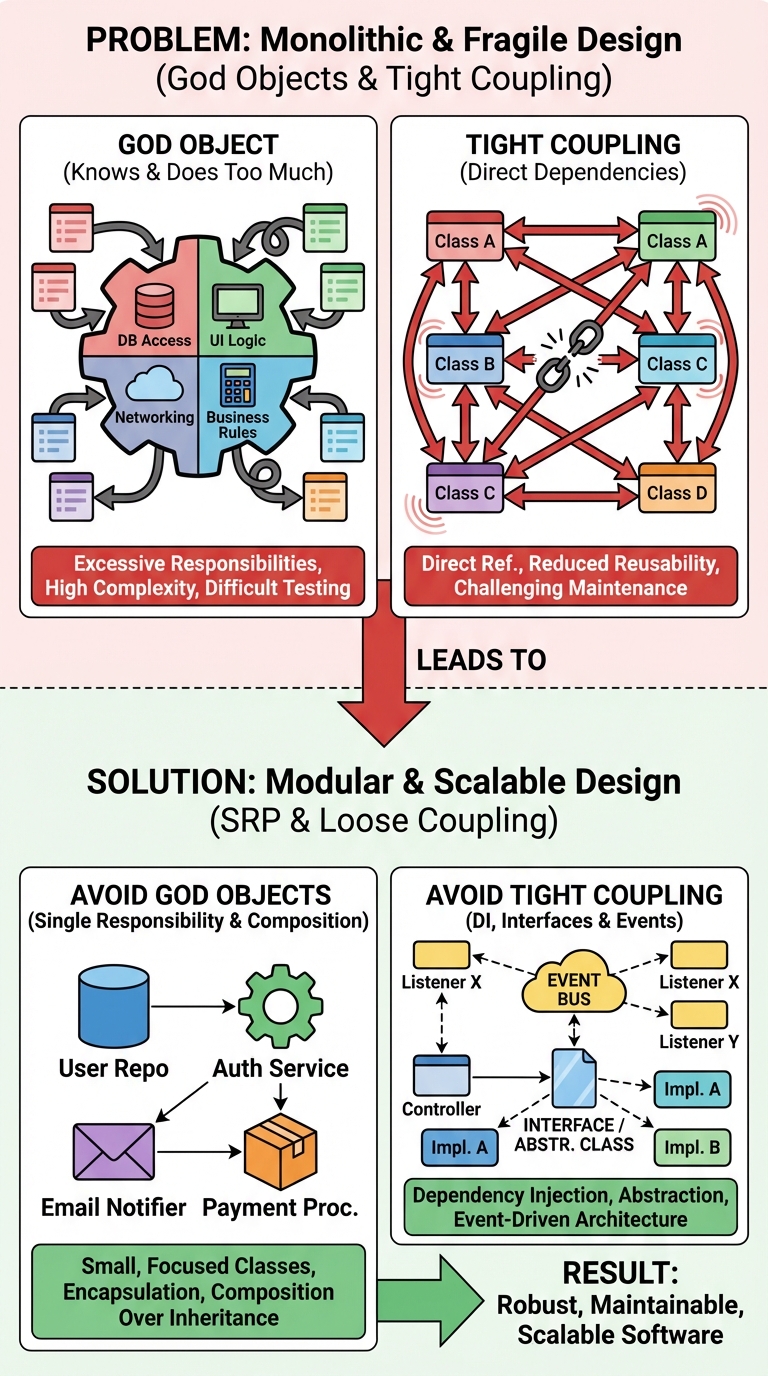
God Objects and tight coupling quietly rot a codebase's maintainability—and experienced interviewers can spot them almost immediately. A "God Object" tries to do everything: it accumulates responsibilities, grows complex, becomes hard to test, and turns simple changes into risky, time-consuming jobs.
This post explains what to look for, why interviewers flag these issues, and practical refactors and design patterns you can apply to fix them.
What is a God Object?
A God Object is a class that centralizes too many responsibilities. Typical symptoms:
- Huge source file with many unrelated methods
- Long constructor with many dependencies
- High cyclomatic complexity and many conditional branches
- Tests are slow, brittle, or sparse because it's hard to isolate behavior
- Frequent merge conflicts because many developers touch it
In short: a maintenance hotspot and a sign your design resists change.
Why interviewers dislike them
Interviewers look for evidence you can design for change. A God Object signals:
- Weak separation of concerns (violates SRP)
- Tight coupling (changes ripple through the system)
- Low testability (hard to mock or isolate parts)
When you explain how you'd refactor one, interviewers assess whether you can reason about boundaries, abstractions, and dependency management.
The damage: tight coupling
Tight coupling means classes can't evolve independently. Common consequences:
- A small change requires touching many files
- Reuse is obstructed because logic is entangled
- Testing becomes integration-heavy instead of unit-focused
You want modules that can change, be replaced, or be tested in isolation.
Practical fixes and patterns
Apply SRP (Single Responsibility Principle)
- Identify distinct responsibilities and extract them into focused classes or services.
Strong encapsulation
- Keep internal state and implementation details private. Expose a minimal public surface.
Prefer composition over inheritance
- Compose small, focused objects rather than extending one big object.
Use Dependency Injection (DI)
- Inject collaborators rather than instantiating them internally. This enables swapping implementations and easier testing.
Example (pseudo-code):
// Bad: creates dependency inside
class OrderProcessor {
  PaymentService payment = new StripePayment();
}

// Better: dependency injected
class OrderProcessor {
  private final PaymentService payment;
  OrderProcessor(PaymentService payment) { this.payment = payment; }
}
Program to interfaces / abstractions
- Depend on contracts, not concrete classes. This reduces coupling and makes components swappable.
Event-driven / message-based communication
- Decouple modules using events, message buses, or observers so they don't need direct references to each other.
Use architectural boundaries
- Apply ports & adapters (hexagonal) or clean architecture to separate core logic from I/O and frameworks.
A pragmatic refactoring workflow
- Identify responsibilities: list what the class does; group related behavior.
- Extract cohesive modules: create classes/services for each responsibility.
- Introduce interfaces: define small contracts for each role.
- Inject dependencies: replace internal instantiation with DI.
- Write or update unit tests for extracted classes first.
- Remove dead code and simplify the original class to a coordinating role (facade) if needed.
- Iterate and measure: ensure cyclomatic complexity and coupling fall.
Design for change
- Keep classes small and focused.
- Name boundaries clearly (what a module does, not how).
- Make dependencies swappable (DI, abstractions).
- Favor immutability for value objects and clear state transitions.
- Organize code by feature, not just technical layer, to reduce cross-cutting churn.
Quick interview checklist
When discussing code in an interview, show you can:
- Explain responsibilities and why they're grouped
- Propose a minimal, testable extraction plan
- Describe how you'd decouple dependencies (DI, interfaces, events)
- Point to trade-offs (YAGNI vs premature extraction)
A short, practical plan beats a vague critique.
Final note
God Objects and tight coupling are both a design smell and an easy-to-spot interview red flag. The remedy is straightforward in principle: split responsibilities, encapsulate implementation, and decouple via composition, DI, and abstractions. Design for change: small classes, clear boundaries, and swappable dependencies make your codebase cleaner, safer, and interview-proof.
#SoftwareEngineering #ObjectOrientedDesign #CleanCode
About the author
bugfree.ai is an advanced AI-powered platform designed to help software engineers master system design and behavioral interviews. Whether you’re preparing for your first interview or aiming to elevate your skills, bugfree.ai provides a robust toolkit tailored to your needs. Key Features:
150+ system design questions: Master challenges across all difficulty levels and problem types, including 30+ object-oriented design and 20+ machine learning design problems. Targeted practice: Sharpen your skills with focused exercises tailored to real-world interview scenarios. In-depth feedback: Get instant, detailed evaluations to refine your approach and level up your solutions. Expert guidance: Dive deep into walkthroughs of all system design solutions like design Twitter, TinyURL, and task schedulers. Learning materials: Access comprehensive guides, cheat sheets, and tutorials to deepen your understanding of system design concepts, from beginner to advanced. AI-powered mock interview: Practice in a realistic interview setting with AI-driven feedback to identify your strengths and areas for improvement.
bugfree.ai goes beyond traditional interview prep tools by combining a vast question library, detailed feedback, and interactive AI simulations. It’s the perfect platform to build confidence, hone your skills, and stand out in today’s competitive job market. Suitable for:
New graduates looking to crack their first system design interview. Experienced engineers seeking advanced practice and fine-tuning of skills. Career changers transitioning into technical roles with a need for structured learning and preparation.
Comments
Join the discussionNo comments yet. Be the first to comment.