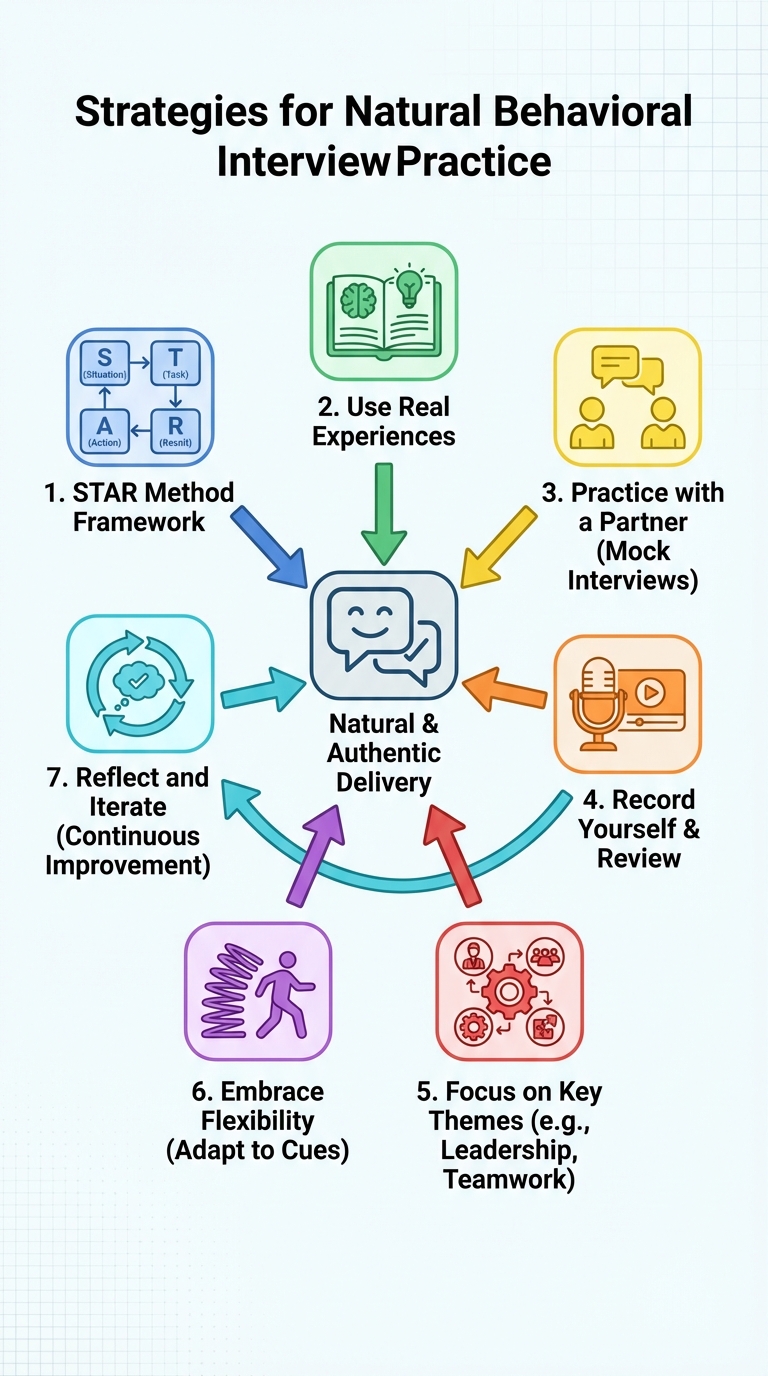
Behavioral interviews are designed to find out how you actually work—not whether you can recite a memorized monologue. The STAR framework (Situation, Task, Action, Result) is a powerful structure, but if used like a script it makes you sound robotic. Use STAR to organize your thoughts, not to deliver a line-by-line speech.
Why candidates sound scripted
- They memorize full answers instead of key anchors.
- They avoid follow-up prompts and stick to rehearsed text.
- They rush through or read answers without natural pacing.
How to use STAR the right way
Know STAR as a skeleton, not a script
Situation: one short sentence of context.
- Task: what needed to happen or your responsibility.
- Action: the concrete steps you took (focus here).
- Result: measurable outcome + what you learned.
Keep each part concise. Let Action be the longest section; that’s where you show skills and choices.
- Prepare 3–4 flexible stories
Choose stories that map to common themes: leadership, conflict, impact, collaboration, failure + learning. For each story note:
- A one-line situation summary (30 words max).
- 2–4 specific actions you took.
- Quantified results or the business impact (metrics if possible).
- A short takeaway/lesson.
These anchors let you adapt quickly to different questions without sounding rehearsed.
- Practice with realistic follow-ups
Most candidates break when interviewers ask follow-ups. Practice with a partner who probes: “What specifically did you do?” “How did you decide that?” “What did the team think?” That forces you to speak from actual experience instead of a script.
- Record and review
Record a few practice answers to catch pacing, filler words, and monotone delivery. Look for parts that feel forced and tighten them. Aim for natural speech and conversational rhythm.
Adapt in the moment
Start with a quick, one-sentence context.
- Pause and ask a clarifying question if the prompt is ambiguous.
- Use your story anchors to shape the answer to the interviewer’s cues.
- End with a clear result and a brief lesson learned.
Timing and length
Aim for ~90–120 seconds per story in most interviews. Shorter (45–60s) can work for small behavioral prompts; longer is okay if the interviewer is engaged, but keep it focused.
Common pitfalls and how to fix them
- Overlong Situations: Trim context to one line.
- Lists of actions with no outcomes: Always close with impact or insight.
- Robotic delivery: Vary tone, pause naturally, and use concrete details.
- Ignoring follow-ups: Practice being flexible; use examples with multiple angles.
Quick practice checklist
- Pick 3–4 real projects with clear outcomes.
- Write anchors, not scripts (situation, 3 actions, result, lesson).
- Practice with a partner who asks follow-ups.
- Record 2–3 answers and refine pacing.
- Before interviews, review anchors and a metric or two to cite.
Sample answer outline (one-liner + STAR anchors)
- One-liner context: "At my last role I led the migration of our analytics pipeline to reduce latency."
- Task anchor: "We needed to cut processing time by 50% to meet SLAs."
- Actions (3 bullets): "I prioritized slow jobs, redesigned ETL, and introduced parallel processing."
- Result + learning: "We cut latency 60%, improving dashboard freshness and reducing incidents. I learned the value of measuring trade-offs before rewriting systems."
Final tip: treat STAR like a map. You don’t have to say every street name—just know the route, pick the right exits when asked, and speak from real experience.
#InterviewTips #SoftwareEngineering #DataScience
About the author
bugfree.ai is an advanced AI-powered platform designed to help software engineers master system design and behavioral interviews. Whether you’re preparing for your first interview or aiming to elevate your skills, bugfree.ai provides a robust toolkit tailored to your needs. Key Features:
150+ system design questions: Master challenges across all difficulty levels and problem types, including 30+ object-oriented design and 20+ machine learning design problems. Targeted practice: Sharpen your skills with focused exercises tailored to real-world interview scenarios. In-depth feedback: Get instant, detailed evaluations to refine your approach and level up your solutions. Expert guidance: Dive deep into walkthroughs of all system design solutions like design Twitter, TinyURL, and task schedulers. Learning materials: Access comprehensive guides, cheat sheets, and tutorials to deepen your understanding of system design concepts, from beginner to advanced. AI-powered mock interview: Practice in a realistic interview setting with AI-driven feedback to identify your strengths and areas for improvement.
bugfree.ai goes beyond traditional interview prep tools by combining a vast question library, detailed feedback, and interactive AI simulations. It’s the perfect platform to build confidence, hone your skills, and stand out in today’s competitive job market. Suitable for:
New graduates looking to crack their first system design interview. Experienced engineers seeking advanced practice and fine-tuning of skills. Career changers transitioning into technical roles with a need for structured learning and preparation.
Comments
Join the discussionNo comments yet. Be the first to comment.