Stop Rambling in Data Interviews: Use STAR to Answer Like a Pro
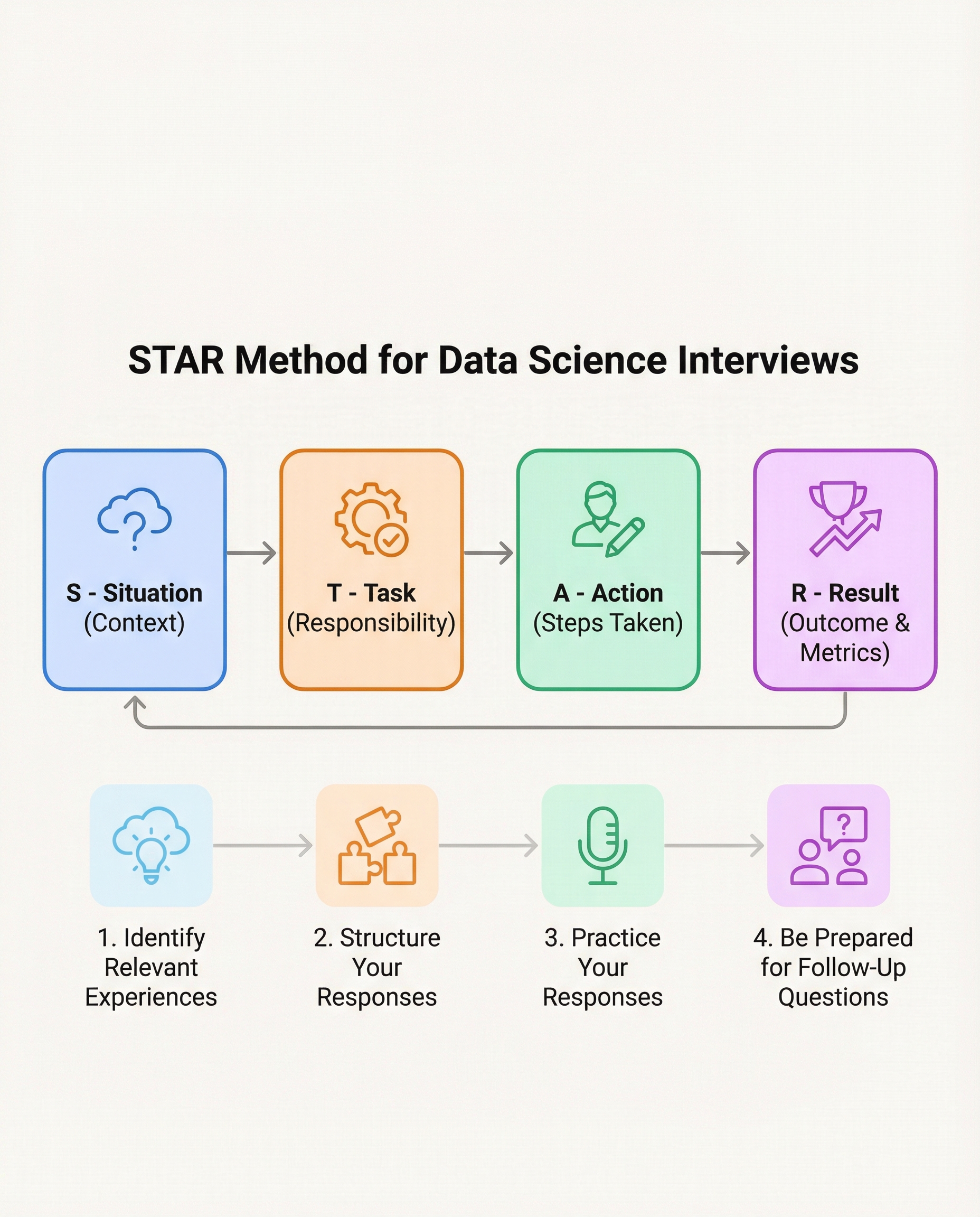
Behavioral questions often sink otherwise strong data candidates because the answers lack structure. Interviewers want concise, evidence-backed stories that show ownership, technical depth, and impact. The STAR framework delivers that clarity.
- S — Situation: Briefly set the context and scope.
- T — Task: State your responsibility or goal.
- A — Action: Explain what you did — methods, tools, collaboration, decisions.
- R — Result: Quantify the impact (metrics, business outcomes, lessons).
Why STAR works for data interviews
- Forces clarity: You avoid long background monologues and get to the point.
- Encourages metrics: Data roles require measurable impact; STAR prompts you to quantify results.
- Structures technical depth: "Action" lets you highlight tools, tradeoffs, and collaboration without losing the narrative.
A data-focused STAR example
Situation: Our fraud rate on a payments product rose 18% in two quarters, increasing chargebacks and manual review costs.
Task: I was asked to reduce fraud while keeping false positives low so we didn’t disrupt legitimate users.
Action: I ran exploratory analysis to identify high-risk feature sets, created new session-level behavioral features, and trained an XGBoost model using time-based cross-validation. I collaborated with the product team to label ambiguous cases, and deployed a lightweight rule-set to block the highest-risk transactions before model scoring to reduce latency.
Result: Precision on flagged transactions improved from 72% to 87%, false positives dropped by 10%, and monthly chargeback-related costs fell by an estimated $200k.
How to prepare 3–5 strong STAR stories
- Pick diverse projects: modeling, data engineering, A/B tests, stakeholder collaboration.
- Keep each story 60–90 seconds when spoken: quick Situation/Task, focused Actions, specific Results.
- Quantify impact: accuracy ±%, latency ms, revenue saved/earned, user retention lift, cost reduction.
- Highlight the stack and techniques briefly: Python, SQL, Spark, sklearn/XGBoost, A/B testing, CI/CD for pipelines.
- Note collaboration and tradeoffs: who you worked with and what constraints influenced decisions.
Expect follow-ups — and prepare for them
Interviewers will probe tradeoffs or alternatives. Prepare short answers for common follow-ups:
- Why choose XGBoost over a neural net? (explain data size, interpretability, latency)
- How did you validate the model to avoid leakage? (time splits, holdout)
- Could simpler features yield similar results? (ablation tests)
- What was the production monitoring plan? (metrics, drift detection)
Quick checklist before interviews
- 3–5 STAR stories ready and practiced aloud.
- Each story has at least one clear metric and one lesson learned.
- 1–2 technical follow-ups and 1–2 product/business follow-ups prepared per story.
- Keep answers concise; offer to dive deeper if interviewer asks.
Final tip: practice aloud and record yourself once. Hearing your answers helps remove filler words and tighten the narrative.
Use STAR to turn loose, rambling answers into focused, convincing stories that show both technical skill and business impact.
#DataScience #InterviewTips #CareerGrowth
About the author
bugfree.ai is an advanced AI-powered platform designed to help software engineers master system design and behavioral interviews. Whether you’re preparing for your first interview or aiming to elevate your skills, bugfree.ai provides a robust toolkit tailored to your needs. Key Features:
150+ system design questions: Master challenges across all difficulty levels and problem types, including 30+ object-oriented design and 20+ machine learning design problems. Targeted practice: Sharpen your skills with focused exercises tailored to real-world interview scenarios. In-depth feedback: Get instant, detailed evaluations to refine your approach and level up your solutions. Expert guidance: Dive deep into walkthroughs of all system design solutions like design Twitter, TinyURL, and task schedulers. Learning materials: Access comprehensive guides, cheat sheets, and tutorials to deepen your understanding of system design concepts, from beginner to advanced. AI-powered mock interview: Practice in a realistic interview setting with AI-driven feedback to identify your strengths and areas for improvement.
bugfree.ai goes beyond traditional interview prep tools by combining a vast question library, detailed feedback, and interactive AI simulations. It’s the perfect platform to build confidence, hone your skills, and stand out in today’s competitive job market. Suitable for:
New graduates looking to crack their first system design interview. Experienced engineers seeking advanced practice and fine-tuning of skills. Career changers transitioning into technical roles with a need for structured learning and preparation.
Comments
Join the discussionNo comments yet. Be the first to comment.