Stop Rambling in Data Interviews: Use STAR to Answer Like a Pro
Behavioral questions can sink otherwise strong data candidates—especially when answers are unfocused or rambling. The STAR framework gives your response a clear, memorable structure so you communicate impact, technical skills, and judgment without losing the listener.
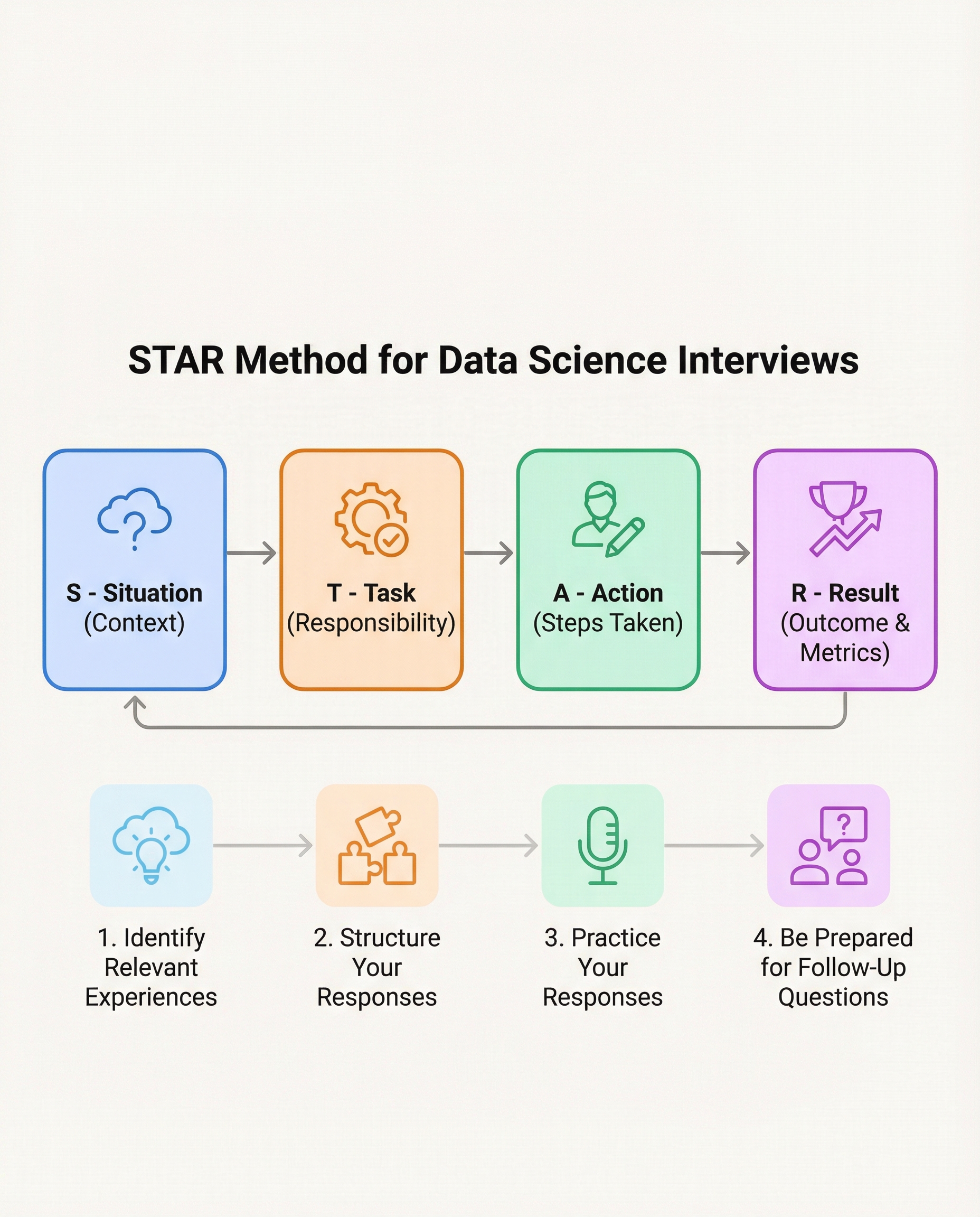
What STAR means
- S — Situation: Briefly set the scene and context.
- T — Task: State your role or responsibility in that situation.
- A — Action: Explain what you did—methods, tools, analysis, and collaboration.
- R — Result: Quantify the outcome (metrics, time saved, revenue, accuracy, etc.).
Why STAR works for data roles
- Employers want evidence of impact plus the steps you took.
- STAR forces you to include quantifiable results and the technical choices behind them.
- It makes follow-ups (tradeoffs, alternatives, failure modes) easier to address because the interviewer already understands the context.
How to use STAR — practical tips
- Keep it concise: aim for 60–120 seconds per story in a first pass, then expand when asked.
- Quantify the Result whenever possible (e.g., "accuracy +15%", "latency -20%", "revenue +$X").
- Mention tools/tech (e.g., SQL, Python, scikit-learn, Spark) in Action to signal domain competence.
- Call out collaboration: who did you work with (PMs, engineers, analysts), and what decisions were joint?
- Prepare 3–5 stories that cover themes: technical challenge, ownership, leadership/communication, tradeoff decisions, and a learning/failure.
- Practice aloud and time yourself; practicing helps you trim unnecessary detail while keeping impact clear.
STAR answer templates for data interviews
- Situation: "At Company X, we had [problem/context], which caused [negative outcome]."
- Task: "As the [your role], I was responsible for [goal/metric to improve]."
- Action: "I [what you did]: analyzed [dataset], used [model/technique], validated with [method], collaborated with [teams]."
- Result: "That reduced/raised [metric] by [X%], saving/earning [time/money/users], and led to [next step]."
Example (machine learning feature implementation)
- Situation: "Our fraud detection pipeline at FinApp had a high false-positive rate, creating customer friction and extra manual review work."
- Task: "I was tasked with reducing false positives while preserving recall."
- Action: "I examined feature distributions, engineered behavioral features, trained an XGBoost model with stratified CV, and worked with the product and ops teams to run an A/B test. I also implemented monitoring for drift."
- Result: "We cut false positives by 30% and increased precision 12% without losing recall, reducing manual review costs by ~$150K/year. The model was deployed and monitored in production."
This example shows context, technical choices, collaboration, and a quantified business impact—everything interviewers want to hear.
Expect follow-ups — and how to handle them
- Tradeoffs: "Why XGBoost instead of a neural net?" — explain dataset size, interpretability, latency, and deployment constraints.
- Alternatives: "What else did you try?" — briefly mention other models or features and why they underperformed.
- Failure modes: "What could go wrong?" — talk about drift, label noise, or biased features and your mitigation plan.
- Ownership: "What parts did you do vs. the team?" — be explicit about your contributions.
Quick checklist before interviews
- Pick 3–5 stories covering diverse themes.
- For each story, write 1–2 sentence lines for S, T, A, R.
- Add 1–2 follow-up talking points (tradeoffs, alternatives, failure modes).
- Practice aloud and time the full answer.
Behavioral questions are an opportunity to demonstrate both technical depth and real-world impact. Use STAR to structure your answers, quantify the results, and be ready to dive deeper when interviewers push on tradeoffs. With a few practiced stories, you'll stop rambling and start persuading.
#DataScience #InterviewTips #CareerGrowth
About the author
bugfree.ai is an advanced AI-powered platform designed to help software engineers master system design and behavioral interviews. Whether you’re preparing for your first interview or aiming to elevate your skills, bugfree.ai provides a robust toolkit tailored to your needs. Key Features:
150+ system design questions: Master challenges across all difficulty levels and problem types, including 30+ object-oriented design and 20+ machine learning design problems. Targeted practice: Sharpen your skills with focused exercises tailored to real-world interview scenarios. In-depth feedback: Get instant, detailed evaluations to refine your approach and level up your solutions. Expert guidance: Dive deep into walkthroughs of all system design solutions like design Twitter, TinyURL, and task schedulers. Learning materials: Access comprehensive guides, cheat sheets, and tutorials to deepen your understanding of system design concepts, from beginner to advanced. AI-powered mock interview: Practice in a realistic interview setting with AI-driven feedback to identify your strengths and areas for improvement.
bugfree.ai goes beyond traditional interview prep tools by combining a vast question library, detailed feedback, and interactive AI simulations. It’s the perfect platform to build confidence, hone your skills, and stand out in today’s competitive job market. Suitable for:
New graduates looking to crack their first system design interview. Experienced engineers seeking advanced practice and fine-tuning of skills. Career changers transitioning into technical roles with a need for structured learning and preparation.
Comments
Join the discussionNo comments yet. Be the first to comment.